


AP EAMCET · Chemistry · Biomolecules
When glucose reacts with bromine water, the main product is
- A acetic acid
- B saccharic acid
- C glyceraldehyde
- D gluconic acid
Answer & Solution
Correct Answer
(D) gluconic acid
Step-by-step Solution
Detailed explanation
When glucose react with bromine water, then it undergoes oxidation reaction to form glucoinc acid as a product. The reaction is as follows:…
See the Complete Solution
Get step-by-step explanations for this and 2.5 Lakh+ more JEE, NEET & CET questions.
- Unlock all solutions
- Practice the full chapter
- Track accuracy across PYQs
4.8 rated on Google Play · 14,000+ reviews
More questions from Chemistry
- Consider the following standard electrode potentials ( \(\mathrm{E}^0\) in volts) in aqueous solution
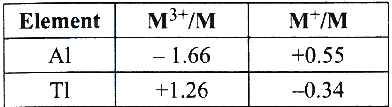
Based on this data, which of the following statements is correct?AP EAMCET 2024 Medium - Which condition is not satisfied by an ideal solution?AP EAMCET 2021 Easy
- For a crystal, the angle of diffraction \((2 \theta)\) is \(90^{\circ}\) and the second order line has a \(d\) value of \(2.28 Ã…\). The wavelength (in \(Ã…\) ) of X-rays used for Bragg's diffraction isAP EAMCET 2008 Easy
- Which of the following is not explained by hyperconjugation?AP EAMCET 2021 Easy
- At \(1000 \mathrm{~K}\), if the equilibrium constant \(K_p\) for the reaction.
\(2 \mathrm{NOCl}(g) \rightleftharpoons 2 \mathrm{NO}(g)+\mathrm{Cl}_2(g)\)
is \(4.157 \times 10^{-4}\) bar, the \(K_C\left(\right.\) in \(\mathrm{mol} \mathrm{L}^{-1}\) ) is \(\left(R=0.083 \mathrm{~L} \mathrm{bar} \mathrm{K}^{-1} \mathrm{~mol}^{-1}\right)\)AP EAMCET 2018 Medium - Which of the following reactions can produce aniline as main product?AP EAMCET 2006 Easy
More PYQs from AP EAMCET
- In a transistor circuit, when the base current is increased by 50 micro-amperes keeping the collector voltage fixed at 2 volts, the collector current increases by \(1 \mathrm{~mA}\). The current gain of the transistor isAP EAMCET 2002 Easy
- The equilibrium constant for the given reaction is 100 .
\(\mathrm{N}_2(g)+2 \mathrm{O}_2(g) \rightleftharpoons 2 \mathrm{NO}_2(g)\)
What is the equilibrium constant for the reaction given below?
\(\mathrm{NO}_2(g) \rightleftharpoons \frac{1}{2} \mathrm{~N}_2(g)+\mathrm{O}_2(g)\)AP EAMCET 2009 Easy - Identify the reaction in which monobasic and dibasic acids are formed.AP EAMCET 2018 Easy
- \[
\int \frac{1}{\cos 4 x \cos 2 x} d x=\frac{1}{2 \sqrt{2}} \log \left(\frac{1+f(x)}{1-f(x)}\right)
\]
\(-\frac{1}{2} \log g(x)+C\), then \(g\left(\frac{\pi}{6}\right)-\sqrt{2} f\left(\frac{\pi}{6}\right)=\)AP EAMCET 2022 Hard - The abscissae of two points \(P, Q\) are the roots of the equation \(2 x^2+4 x-7=0\) and their ordinates are the roots of the equation \(3 x^2-12 x-1=0\). Then the centre of the circle with \(P Q\) as a diameter isAP EAMCET 2019 Medium
- The tangents to the parabola \(y^2=4 a x\) from an external point \(P\) make angles \(\theta_1\) and \(\theta_2\) with the axis of the parabola. Such that \(\tan \theta_1+\tan \theta_2=b\), where \(b\) is constant. Then \(P\) lies onAP EAMCET 2017 Medium