


AP EAMCET · Chemistry · Chemical Bonding and Molecular Structure
The correct order of dipole moments of \(\mathrm{NH}_3 \cdot \mathrm{H}_2 \mathrm{O}\) and \(\mathrm{NF}_3\) is
- A \(\mathrm{H}_2 \mathrm{O}>\mathrm{NH}_3>\mathrm{NF}_3\)
- B \(\mathrm{H}_2 \mathrm{O}>\mathrm{NF}_3>\mathrm{NH}_3\)
- C \(\mathrm{NF}_3>\mathrm{NH}_3>\mathrm{H}_2 \mathrm{O}\)
- D \(\mathrm{NH}_3>\mathrm{NF}_3>\mathrm{H}_2 \mathrm{O}\)
Answer & Solution
Correct Answer
(A) \(\mathrm{H}_2 \mathrm{O}>\mathrm{NH}_3>\mathrm{NF}_3\)
Step-by-step Solution
Detailed explanation
The correct order of dipole moment of NH3,H2O and NF3 is the dipole moment of NF3 NH3 and is lesser then H2O because O2 is more electronegative than nitrogen so the attracts the bonding electrons to a greater extant. Also oxygen atom has two lone pair which reduce the between…
See the Complete Solution
Get step-by-step explanations for this and 2.5 Lakh+ more JEE, NEET & CET questions.
- Unlock all solutions
- Practice the full chapter
- Track accuracy across PYQs
4.8 rated on Google Play · 14,000+ reviews
More questions from Chemistry
- Assertion (A) Covalent character follows \(\mathrm{NaCl} < \mathrm{MgCl}_2 < \mathrm{BeCl}_2 < \mathrm{LiCl}\).
Reason (R) According to Fajan's rules, covalent character of ionic compounds increases with decrease in size of cation.AP EAMCET 2021 Medium - The density of an ideal gas can be given by where and respectively denote pressure, volume, molar-mass, temperature and universal gas constant.AP EAMCET 2021 Easy
- A covalent molecule is found to have a dipole moment of and bond length of . The percent ionic character of the bond will beAP EAMCET 2021 Medium
- If for the reaction \(\mathrm{CCl}_4(\mathrm{~g}) \rightarrow \mathrm{C}(\mathrm{g})+4 \mathrm{Cl}(\mathrm{g})\) the following data is given
\(\begin{aligned} & \Delta_{\mathrm{vap}} \mathrm{H}^\theta \mathrm{CCl}_4(\mathrm{l})=30 \mathrm{~kJ} \mathrm{~mol}^{-1} \text {, vap = vaporization } \\ & \Delta_{\mathrm{f}} \mathrm{H}^\theta{ }_{\mathrm{CCl}_4}=-136.0 \mathrm{~kJ} \mathrm{~mol}^{-1}, \mathrm{f}=\text { formation } \\ & \Delta_{\mathrm{a}} \mathrm{H}_{\mathrm{C}}^{\mathrm{q}}=714.0 \mathrm{~kJ} \mathrm{~mol}^{-1}, \mathrm{a}=\text { atomization } \\ & \Delta_{\mathrm{a}} \mathrm{H}^\theta \mathrm{Cl}_2=242.0 \mathrm{~kJ} \mathrm{~mol}^{-1}, \mathrm{a}=\text { atomization }\end{aligned}\)
the bond mean enthalpy of \(\mathrm{C}-\mathrm{Cl}\) in \(\mathrm{CCl}_4(\mathrm{l})\) isAP EAMCET 2023 Medium - Assertion (A) Propene on addition with hydrogen bromide in the presence of peroxide gives 1-bromopropane as the major product.
Reason (R) l-bromopropane is the major product because it is formed through the stable carbocation.
The correct answer isAP EAMCET 2018 Easy - The energy of a photon is \(3 \times 10^{-12}\) ergs. What is its wavelength in \(\mathrm{nm}\) ?
\(\text { ( } h=6.62 \times 10^{-27} \text { ergs-s; } c=3 \times 10^{10} \mathrm{~cm} / \mathrm{s} \text { ) }\)AP EAMCET 2006 Easy
More PYQs from AP EAMCET
- The correct order of the non-metallic character among the elements \(\mathrm{B}, \mathrm{C}, \mathrm{N}, \mathrm{F}\) and Si isAP EAMCET 2025 Easy
- Two spherical soap bubbles of radii \(r_1\) and \(r_2\) in vacuum combine under isothermal conditions. The resulting bubble has a radius equal to:AP EAMCET 2003 Easy
- A bullet of mass \(10 \mathrm{~g}\) pierces through a plate \(A\) of mass \(500 \mathrm{~g}\) and then gets embedded into a second plate \(B\) of mass \(1.49 \mathrm{~kg}\) as shown in the figure. Initially, the two plates \(A\) and \(B\) are at rest and move with same velocity after collision. The percentage loss in the initial kinetic energy of the bullet, when it is between the plates \(A\) and \(B\) is _______
(Neglect any loss of material of the plates during the collision)
[QUESTION]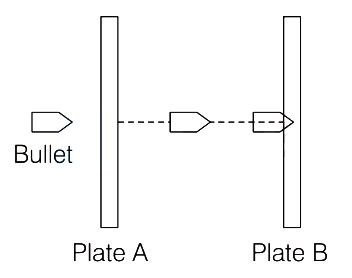 AP EAMCET 2018 Hard
 - The area (in square unit) of the circle which touches the lines \(4 x+3 y=15\) and \(4 x+3 y=5\) isAP EAMCET 2009 Easy
- \(\int \frac{\mathrm{x}}{\sqrt{\mathrm{x}^2-2 \mathrm{x}+5}} \mathrm{dx}=\)AP EAMCET 2025 Medium
- Variance of the following continuous frequency distribution is
Class Interval \(0\)–\(4\) \(4\)–\(8\) \(8\)–\(12\) \(12\)–\(16\) Frequency \(1\) \(2\) \(2\) \(1\) AP EAMCET 2025 Medium