


AP EAMCET · Chemistry · Thermodynamics (C)
If for the reaction \(\mathrm{CCl}_4(\mathrm{~g}) \rightarrow \mathrm{C}(\mathrm{g})+4 \mathrm{Cl}(\mathrm{g})\) the following data is given
\(\begin{aligned} & \Delta_{\mathrm{vap}} \mathrm{H}^\theta \mathrm{CCl}_4(\mathrm{l})=30 \mathrm{~kJ} \mathrm{~mol}^{-1} \text {, vap = vaporization } \\ & \Delta_{\mathrm{f}} \mathrm{H}^\theta{ }_{\mathrm{CCl}_4}=-136.0 \mathrm{~kJ} \mathrm{~mol}^{-1}, \mathrm{f}=\text { formation } \\ & \Delta_{\mathrm{a}} \mathrm{H}_{\mathrm{C}}^{\mathrm{q}}=714.0 \mathrm{~kJ} \mathrm{~mol}^{-1}, \mathrm{a}=\text { atomization } \\ & \Delta_{\mathrm{a}} \mathrm{H}^\theta \mathrm{Cl}_2=242.0 \mathrm{~kJ} \mathrm{~mol}^{-1}, \mathrm{a}=\text { atomization }\end{aligned}\)
the bond mean enthalpy of \(\mathrm{C}-\mathrm{Cl}\) in \(\mathrm{CCl}_4(\mathrm{l})\) is
- A -319
- B 326
- C -326
- D 292
Answer & Solution
Correct Answer
(B) 326
Step-by-step Solution
Detailed explanation
\(\mathrm{CCl}_4(\mathrm{~g}) \rightarrow \mathrm{C}(\mathrm{g})+4 \mathrm{Cl}(\mathrm{g})\) or…
See the Complete Solution
Get step-by-step explanations for this and 2.5 Lakh+ more JEE, NEET & CET questions.
- Unlock all solutions
- Practice the full chapter
- Track accuracy across PYQs
4.8 rated on Google Play · 14,000+ reviews
More questions from Chemistry
- Ranitidine belongs to which of the following class of drugs?AP EAMCET 2023 Easy
- Identify the pair of molecules in which the central atom has same hybridizationAP EAMCET 2017 Easy
- When difference in boiling points of two liquids is too small, then the separation is carried out byAP EAMCET 2021 Medium
- The number of sigma and pi bonds in peroxodisulphuric acid are, respectivelyAP EAMCET 2008 Hard
- The reaction
\(\mathrm{Ar}_2 \stackrel{\ominus}{\mathrm{C}} \stackrel{\oplus}{\mathrm{Cl}}+\mathrm{Cu}+\mathrm{HCl} \longrightarrow \mathrm{ArCl}+\mathrm{N}_2+\mathrm{CuCl}\)
is known asAP EAMCET 2019 Easy - If the rate of disappearance of \(\mathrm{N}_2 \mathrm{O}_5\) in the following reaction is \(1.2 \times 10^{-5}\) in \(\mathrm{mol} \mathrm{L}^{-1} \mathrm{~s}^{-1}\), the rate of production of \(\mathrm{NO}_2 \mathrm{~mol} \mathrm{~L}^{-1} \mathrm{~s}^{-1}\) is
\(2 \mathrm{~N}_2 \mathrm{O}_5(g) \longrightarrow 4 \mathrm{NO}_2(g)+\mathrm{O}_2(g)\)AP EAMCET 2016 Easy
More PYQs from AP EAMCET
- Young's modulus of a wire is . If an external stretching force of is applied to a wire of length , the final length of the wire is (cross-sectionunity)AP EAMCET 2021 Easy
- When glucose is oxidized with nitric acid the compound formed isAP EAMCET 2024 Medium
- If \(f(x)=10 \cos x+(13+2 x) \sin x, \quad\) then \(f^{\prime \prime}(x)+f(x)\) is equal toAP EAMCET 2005 Hard
- What is \((P)\) in the reaction given below?
\[
\text { (P) } \xrightarrow[\text { (ii) } \mathrm{H}_3 \mathrm{O}^{+}]{\text {(i) } \mathrm{CH}_3 \mathrm{MgBr}}(R) \xrightarrow[\text { (ii) } \Delta]{\text { (i) dil. } \mathrm{NaOH}}
\]
4-methyl-pent-3-en-2-oneAP EAMCET 2021 Hard - If \(\sin (x+3 \alpha)+3 \sin (x-\alpha)=0\), thenAP EAMCET 2017 Easy
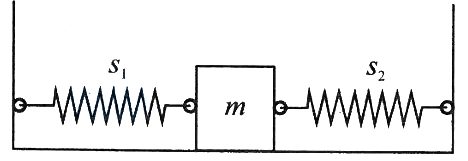
- When a mass ' \(m\) ' is connected individually to the springs \(s_1\) and \(s_2\), the oscillation frequencies are \(v_1\) and \(v_2\). If the same mass is attached to the two springs as shown in the figure, the oscillation frequency would be
 AP EAMCET 2024 Medium