


AP EAMCET · Chemistry · Chemical Equilibrium
At \(\mathrm{T}(\mathrm{K})\), the equilibrium constant for the reaction \(\mathrm{a} \mathrm{A}(\mathrm{g}) \rightleftharpoons \mathrm{b} \mathrm{B}(\mathrm{g})\) is \(\mathrm{K}_{\mathrm{c}}\). If the reaction takes place in the following form \(2 \mathrm{aA}(\mathrm{g}) \rightleftharpoons 2 \mathrm{bB}(\mathrm{g})\) its equilibrium constant is \(\mathrm{K}_{\mathrm{c}}^{\prime}\). The correct relationship between \(\mathrm{K}_{\mathrm{c}}\) and \(\mathrm{K}_{\mathrm{c}}\) is
- A \(\mathrm{K}_{\mathrm{c}}^{\prime}=\left(\mathrm{K}_{\mathrm{c}}\right)^2\)
- B \(\mathrm{K}_{\mathrm{c}}^{\prime}=\left(\mathrm{K}_{\mathrm{c}}\right)^{\frac{1}{2}}\)
- C \(\mathrm{K}_{\mathrm{c}}^{\prime}=\left(\mathrm{K}_{\mathrm{c}}\right)^{-1}\)
- D \(\mathrm{K}_{\mathrm{c}}^{\prime}=\mathrm{K}_{\mathrm{c}}\)
Answer & Solution
Correct Answer
(A) \(\mathrm{K}_{\mathrm{c}}^{\prime}=\left(\mathrm{K}_{\mathrm{c}}\right)^2\)
Step-by-step Solution
Detailed explanation
\begin{aligned} & \text {} \mathrm{K}_{\mathrm{c}}=\frac{[\mathrm{B}]^{\mathrm{b}}}{[\mathrm{A}]^{\mathrm{a}}} \text { and } \mathrm{K}_{\mathrm{c}}^{\prime}=\frac{[\mathrm{B}]^{2 \mathrm{~b}}}{[\mathrm{~A}]^{2 \mathrm{a}}} \\ & \Rightarrow…
See the Complete Solution
Get step-by-step explanations for this and 2.5 Lakh+ more JEE, NEET & CET questions.
- Unlock all solutions
- Practice the full chapter
- Track accuracy across PYQs
4.8 rated on Google Play · 14,000+ reviews
More questions from Chemistry
- For the reaction, \(A \rightarrow\) products, if the graph of \([A]\) vs time gives a straight line, predict the order of the reaction.AP EAMCET 2020 Easy
- The number of valence electrons present in an element with atomic number 117 isAP EAMCET 2022 Easy
- If the radius of electron orbit in the excited state of hydrogen atom is \(476.1 \mathrm{pm}\), the energy of electron in that excited state in \(\mathrm{J}\) is (Radius and energy of electron in the first orbit of hydrogen atom are \(52.9 \mathrm{pm}\) and \(-2.18 \times 10^{-18} \mathrm{~J}\) respectively)AP EAMCET 2018 Medium
- The wavelengths of electron waves in two orbits is \(3: 5\). The ratio of kinetic energy of electrons will beAP EAMCET 2009 Easy
- Molal depression constant \(\left(\mathrm{K}_{\mathrm{f}}\right)\) is dependent onAP EAMCET 2023 Easy
- The vapors of \(1 \mathrm{~g}\) of an element occupy \(2.5625 \mathrm{~L}\) exerting a pressure of \(0.5 \mathrm{~atm}\) at \(1000 \mathrm{~K}\). What is the molar mass (in \(\mathrm{g} \mathrm{mol}^{-1}\) ) of the element?
(Assume vapors follow ideal gas equation Given \(\mathrm{R}=0.082 \mathrm{~L} \mathrm{~atm} \mathrm{~mol}^{-1} \mathrm{~K}^{-1}\) )AP EAMCET 2023 Medium
More PYQs from AP EAMCET
- Which of the following gas has the highest \(\mathrm{pH}\) at \(25^{\circ} \mathrm{C}\) ?AP EAMCET 2021 Medium
- Two metals \(A\) and \(B\) having similar ionic radii, react with oxygen to give only monoxides and react with nitrogen to give nitrides. Then, \(A\) and \(B\) respectively areAP EAMCET 2020 Medium
- Which of the following is false?
1. If \((a, b, c)\) are direction ratios of a line, then \(a^2+b^2+c^2 \neq 1\).
2. The direction cosines of a line can be its direction ratios but not vice-versa.
3. If \((l, m, n)\) is one set of direction cosines, then \((-l,-m,-n)\) is also a valid set.
4. If \(\left(l_1, m_1, n_1\right)\) and \(\left(l_2, m_2, n_2\right)\) are direction cosines of perpendicular lines, then \(l_1 l_2+m_1 m_2+n_1 n_2=1\).AP EAMCET 2020 Easy - Let \((a-3) x^2+12 x+(a+6)>0, \forall x \in R ~\&~ a \in(\ell, \infty)\). If \(\alpha\) is the least positive integral value of \(a\), then the roots of \((\alpha-3) x^2+12 x+(\ell+2)=0\) areAP EAMCET 2025 Medium
- The logic gates in which all the inputs must be low to get a high output areAP EAMCET 2022 Medium
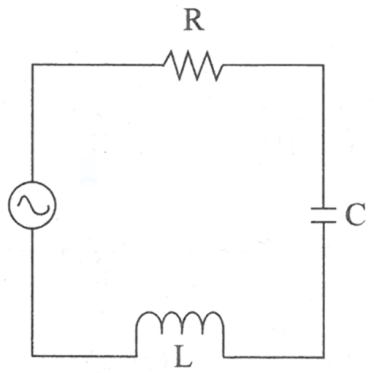
- A series LCR circuit is shown in the figure. Where the inductance of 10 H , capacitance \(40 \mu \mathrm{~F}\) and resistance 60 \(\Omega\) are connected to a variable frequency 240 V source. The current at resonating frequency is
 AP EAMCET 2024 Easy