


WBJEE · Physics · Dual Nature of Matter
When light of frequency \(v_{1}\) is incident on a metal with work function \(W\) (where \(h v_{1}>w\) ), then photocurrent falls to zero at a stopping potential of \(V_{1}\). If the frequency of light is increased to \(v_{2},\) the stopping potential changes to \(V_{2}\). Therefore, the charge of an electron is given by
- A \(\frac{W\left(v_{2}+v_{1}\right)}{v_{1} V_{2}+v_{2} V_{1}}\)
- B \(\frac{W\left(v_{2}+v_{1}\right)}{v_{1} V_{1}+v_{2} V_{2}}\)
- C \(\frac{W\left(v_{2}-v_{1}\right)}{v_{1} V_{2}-v_{2} V_{1}}\)
- D \(\frac{W\left(v_{2}-v_{1}\right)}{v_{2} V_{2}-v_{1} V_{1}}\)
Answer & Solution
Correct Answer
(C) \(\frac{W\left(v_{2}-v_{1}\right)}{v_{1} V_{2}-v_{2} V_{1}}\)
Step-by-step Solution
Detailed explanation
From Einstein's photoelectric equation, \[ \begin{array}{l} h v=W+e V \\ W=\text { Work function } \end{array} \] \(v=\) Frequency of incident photon \(V=\) Stopping potential For a photon of frequency \(v_{1},\) \[ h v_{1}=W+e V_{1} \] For photon of frequency \(v_{2}\)…
See the Complete Solution
Get step-by-step explanations for this and 2.5 Lakh+ more JEE, NEET & CET questions.
- Unlock all solutions
- Practice the full chapter
- Track accuracy across PYQs
4.8 rated on Google Play · 14,000+ reviews
More questions from Physics
- Work done for a certain spring when it is streched to 1mm from mean position is 10J amount of work that must be done on the spring to stretch it further by \(1 \mathrm{mm}\) isWBJEE 2016 Medium
-
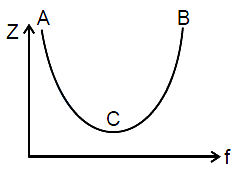
The variation of impedance Z of a series LCR circuit with frequency of the source is shown in the figure. Which of the following statement(s) is/are true?WBJEE 2024 Hard - When a \(60 \mathrm{mH}\) inductor and a resistor are connected in series with an AC voltage source, the voltage leads the current by \(60^{\circ}\). If the inductor is replaced by a \(0.5 \mu \mathrm{F}\) capacitor, the voltage lags behind the current by \(30^{\circ} .\) What is the frequency of the AC supply?WBJEE 2019 Medium
- \(\vec{A}\) and \(\vec{B}\) are two vectors given by \(\vec{A}=2 \hat{i}+3 \hat{j}\) and \(\vec{B}=\hat{i}+\hat{j}\). The magnitude of the component of \(\vec{A}\) along \(\vec{B}\) isWBJEE 2009 Medium
- If the Earth were to suddenly contract to \(\frac{1}{n}\) th of its present radius without any change in its mass, the duration of the new day will be nearlyWBJEE 2011 Hard
- An electrical cable having a resistance of \(0.2 \Omega\) delivers \(10 \mathrm{kw}\) at \(200 \mathrm{~V}\) D.C. to a factory. What is the efficiency of transmission?WBJEE 2009 Easy
More PYQs from WBJEE
- A function \(f: \mathbb{R} \rightarrow \mathbb{R}\), satisfies \(f\left(\frac{x+y}{3}\right)=\frac{f(x)+f(y)+f(0)}{3}\) for all, \(x, y \in \mathbb{R}\). If the function ' \(f\) ' is differentiable at \(x=\) 0 , then \(f\) isWBJEE 2025 Hard
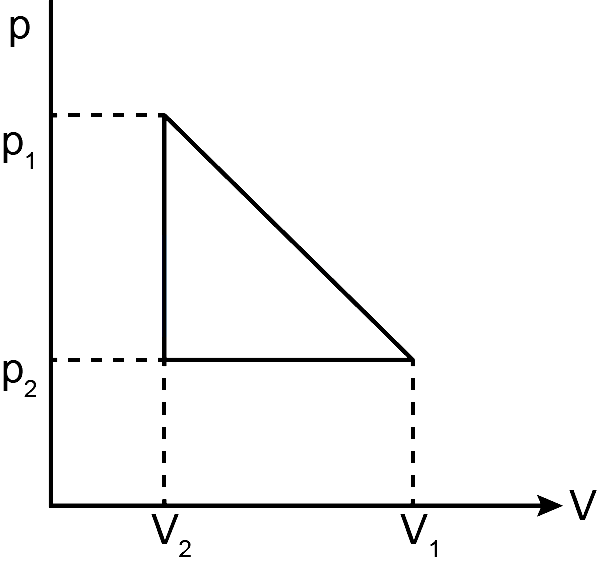
- One mole of a van der Waals' gas obeying the equation \(\left(p+\frac{a}{V^{2}}\right)(V-b)=R T\) undergoes the quasi-static cyclic process which is shown in the \(p \cdot V\) diagram. The net heat absorbed by the gas in this process is
 WBJEE 2014 Easy
 - A proton of mass \(m\) and charge \(q\) is moving in a plane with kinetic energy \(E\). If there exists a uniform magnetic field \(B\), perpendicular to the plane of the motion, the proton will move in a circular path of radiusWBJEE 2014 Medium
- A particle is subjected to two simple harmonic motions in the same direction having equal amplitudes and equal frequency. If the resultant amplitude is equal to the amplitude of the individual motion, the phase difference \((\delta)\) between the two motions isWBJEE 2022 Hard
- If the total number of m-element subsets of the set \(\mathrm{A}=\left\{\mathrm{a}{1}, \mathrm{a}{2}, \ldots . \mathrm{a}{\mathrm{n}}\right\}\) is \(\mathrm{k}\) times the number of \(\mathrm{m}\) element subsets containing \(\mathrm{a}{4}\), then \(\mathrm{n}\) isWBJEE 2020 Medium
- A particle moving in a straight line starts from rest and the acceleration at any time \(\mathrm{t}\) is \(a-k t^2{ }^2\) where a and \(k\) are positive constants. The maximum velocity attained by the particle isWBJEE 2022 Easy