


WBJEE · Physics · Oscillations
A particle is subjected to two simple harmonic motions in the same direction having equal amplitudes and equal frequency. If the resultant amplitude is equal to the amplitude of the individual motion, the phase difference \((\delta)\) between the two motions is
- A \(\delta=\frac{\pi}{3}\)
- B \(\delta=\frac{2 \pi}{3}\)
- C \(\delta=\pi\)
- D \(\delta=\frac{\pi}{2}\)
Answer & Solution
Correct Answer
(B) \(\delta=\frac{2 \pi}{3}\)
Step-by-step Solution
Detailed explanation
\(A_{\text {res }}^2=A_1^2+A_2^2+2 A_1 A_2 \cos \delta \quad A^2=A^2+A^2+2 A^2 \cos \delta, \cos \delta=-\frac{1}{2} \delta=120^{\circ}\)
See the Complete Solution
Get step-by-step explanations for this and 2.5 Lakh+ more JEE, NEET & CET questions.
- Unlock all solutions
- Practice the full chapter
- Track accuracy across PYQs
4.8 rated on Google Play · 14,000+ reviews
More questions from Physics
- A conducting circular loop of resistance \(20 \Omega\) and cross-sectional area \(20 \times 10^{-2} \mathrm{~m}^{2}\) is placed perpendicular to a spatially uniform magnetic field B, which varies with time tas \(\mathrm{B}=2 \sin (50 \pi t)\) T. Find the net charge flowing through the loop in \(20 \mathrm{~ms}\) starting from \(\mathrm{t}=0\)WBJEE 2020 Medium
- The de-Broglie wavelength of an electron is \(0.4 \times 10^{-10} \mathrm{m}\) when its kinetic energy is \(1.0 \mathrm{keV} .\) Its wavelength will be \(1.0 \times 10^{-10} \mathrm{m}\)
when its kinetic energy isWBJEE 2017 Medium - Consider the circuit shown in the figure.
The value of the resistance \(X\) for which the thermal power generated in it is independent of small variation of its resistance is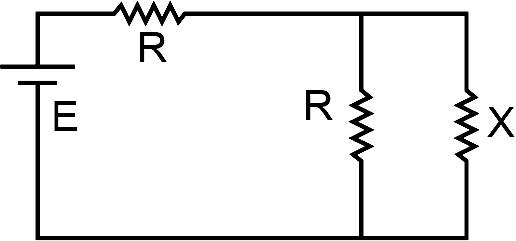 WBJEE 2017 Medium
 - The temperature of the water of a pond is \(0^{\circ} \mathrm{C}\) while that of the surrounding atmosphere is \(-20^{\circ} \mathrm{C}\). If the density of ice is \(\rho\) coefficient of thermal conductivity is \(k\) and latent heat of melting is \(L,\) then the thickness \(Z\) of ice layer formed increases as a function of time \(t\) isWBJEE 2016 Hard
- A stone of relative density \(\mathrm{K}\) is released from rest on the surface of a lake. If viscous effects are ignored, the stone sinks in water with an acceleration ofWBJEE 2011 Easy
- Four cells, each of emf \(E\) and internal resistance \(r,\) are connected in series across an external resistance \(R .\) By mistake one of the cells is connected in reverse. Then the current in the external circuit isWBJEE 2014 Medium
More PYQs from WBJEE
- Equilibrium constants for the following reactions at \(1200 \mathrm{K}\) are given
\(2 \mathrm{H}_{2} \mathrm{O}(g) \rightleftharpoons 2 \mathrm{H}_{2}(g)+\mathrm{O}_{2}(g)\)
\(K_{1}=6.4 \times 10^{-8}\)
\(2 \mathrm{CO}_{2}(g) \rightleftharpoons 2 \mathrm{CO}(g)+\mathrm{O}_{2}(g)\)
\(K_{2}=1.6 \times 10^{-6}\)
The equilibrium constant for the reaction? \(\mathrm{H}_{2}(g)+\mathrm{CO}_{2}(g) \rightleftharpoons \mathrm{CO}(g)+\mathrm{H}_{2} \mathrm{O}(g)\)
at \(1200 \mathrm{K}\) will beWBJEE 2017 Medium - An ideal gas expands adiabatically against vaccum. Which of the following is correct for the given process?WBJEE 2020 Easy
- The value of \(\lambda\) such that the system of equations \(2x-y-2 y=2 ; x-2 y+z=-4\),\(x+y+\lambda z=4,\) has no solution, isWBJEE 2015 Easy
- As per the following equation, 0.217 g of HgO (molecular mass \(=217 \mathrm{~g} \mathrm{~mol}^{-1}\) ) reacts with excess iodide. On titration of the resulting solution, how many mL of 0.01 M HCl is required to reach the equivalence point?
\(\mathrm{HgO}+4 \mathrm{I}^{-}+\mathrm{H}_2 \mathrm{O} \longrightarrow \mathrm{HgI}_4^{2-}+2 \mathrm{OH}^{-}\)WBJEE 2025 Medium - If \(\mathrm{R}\) is the Rydberg Constant in \(\mathrm{cm}^{-1}\), then hydrogen atom does not emit any radiation of wave-length in the range ofWBJEE 2020 Medium
- Three blocks of masses 4 kg. 2 kg. 1 kg respectively are in contact on a frictionless table as shown in the figure. If a force of \(14 \mathrm{N}\) is applied on the 4 kg block, the contact force between the \(4 \mathrm{kg}\) and the \(2 \mathrm{kg}\) block will be
 WBJEE 2012 Medium