


WBJEE · Physics · Thermal Properties of Matter
The specific heat \(C\) of a solid at low temperature shows temperature dependence according to the relation \(C=D T^{3}\), where \(D\) is a constant and \(T\) is the temperature is kelvin. A piece of this solid of mass \(m \mathrm{kg}\) is taken and its temperature is raised from \(20 \mathrm{K}\) to \(30 \mathrm{K}\). The amount of heat required in the process in energy units is
- A \(5 \times 10^{4} \mathrm{Dm}\)
- B \((33 / 4) \times 10^{4} D m\)
- C \((65 / 4) \times 10^{4} D m\)
- D \((5 / 4) \times 10^{4} D m\)
Answer & Solution
Correct Answer
(C) \((65 / 4) \times 10^{4} D m\)
Step-by-step Solution
Detailed explanation
Amount of heat required, \(Q=\int d Q\) \(=\int_{T_{1}=20}^{T_{2}=30} \mathrm{mcdT}\) Given, \(C=D T^{3}\) \(\therefore \quad Q=\int_{20}^{30} m D T^{3} d T=m D \int_{20}^{30} T^{3} d T\) \[ =m D \frac{1}{4}\left[(30)^{2}-(20)^{2}\right]=\frac{65}{4} \times 10^{4} m D \]
See the Complete Solution
Get step-by-step explanations for this and 2.5 Lakh+ more JEE, NEET & CET questions.
- Unlock all solutions
- Practice the full chapter
- Track accuracy across PYQs
4.8 rated on Google Play · 14,000+ reviews
More questions from Physics
- A galvanometer having internal resistance \(10 \Omega\) requires 0.01 A for a full scale deflection. To convert this galvanometer to a voltmeter of full-scale deflection at \(120 \mathrm{V}\), we need to connect a resistance ofWBJEE 2014 Easy
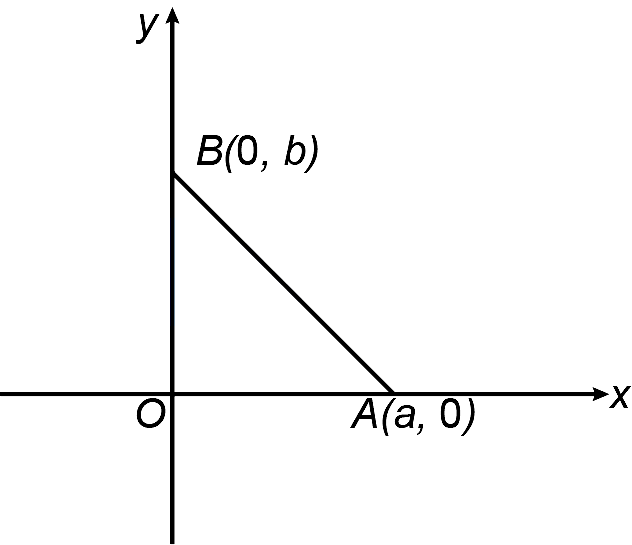
- A charge \(+q\) is placed at the origin \(O\) of \(X-Y\) axes as shown in the figure. The work done in taking a charge \(Q\) from \(A\) to \(B\) along the straight line \(A B\) is
 WBJEE 2012 Medium
 - A thin plastic sheet of refractive index 1.6 is used to cover one of the slits of a clouble slit arrangement. The central point on the scireen is now occupied by what would have been the 7th bright fringo before the plastic was used. If the wavelength of light is \(600 \mathrm{nm}\), what is the thickness (in \(\mu \mathrm{m}\) ) of the plastic sheet?WBJEE 2015 Medium
-
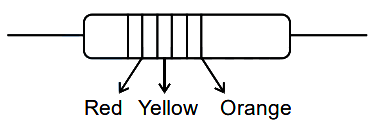
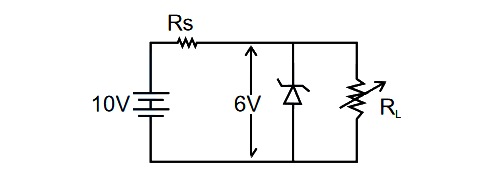
A carbon resistor with colour code is shown in the figure. There is no fourth band in the resistor. The value of the resistance isWBJEE 2021 Easy - A Zener diode having break down voltage \(\mathrm{Vz}=6 \mathrm{~V}\) is used in a voltage regulator circuit as shown in the figure. The minimum current required to pass through the Zener to act as a voltage regulator is \(10 \mathrm{~mA}\) and maximum allowed current through Zener is \(40 \mathrm{~mA}\). The maximum value of \(R_{\mathrm{s}}\) for Zener to act as a voltage regulator is
 WBJEE 2022 Easy
 -
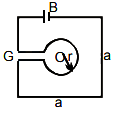
As shown in the figure, a single conducting wire is bent to form a loop in the form of a circle of radius 'r' concentrically inside a square of side ' \(a\) ', where \(a: r=8: \pi\). A battery B drives a current through the wire. If the battery B and the gap G are of negligible sizes, determine the strength of magnetic field at the common centre \(O\).WBJEE 2020 Medium
More PYQs from WBJEE
- A scientist proposes a new temperature scale in which the ice point is \(25 \mathrm{X}(\mathrm{X}\) is the new unit of temperature) and the steam point is \(305 \mathrm{X}\). The specific heat capacity of water in this new scale is \(\left(\operatorname{in} J \mathrm{kg}^{-1} \mathrm{X}^{-1}\right)\)WBJEE 2014 Medium
- \(\beta-emission\) is always accompanied byWBJEE 2014 Easy
- The limit of \(\left[\frac{1}{x^{2}}+\frac{(2013)^{x}}{e^{x}-1}-\frac{1}{e^{x}-1}\right]\) as \(x \rightarrow 0\)WBJEE 2013 Easy
- At constant pressure, the heat of formation of a compound is not dependent on temperature, whenWBJEE 2019 Hard
- The species in which nitrogen atom is in a state of sp hybridisation isWBJEE 2023 Easy
- Reaction of formaldehyde and ammonia givesWBJEE 2011 Easy