


WBJEE · Physics · Oscillations
The potential energy of a particle of mass \(0.02 \mathrm{~kg}\) moving along \(x\)-axis is given by \(V=A x(x-4) J\) where \(x\) is in metres and \(\mathrm{A}\) is a constant. Which of the following is/are correct statement(s)?
- A The particle is acted upon by a constant force
- B The particle executes simple harmonic motion
- C The speed of the particle is maximum at \(x=2 m\)
- D The period of oscillation of the particle is \(\frac{\pi}{5} \mathrm{sec}\)
Answer & Solution
Correct Answer
(C) The speed of the particle is maximum at \(x=2 m\)
Step-by-step Solution
Detailed explanation
\(V=A x(x-4) J m=0.02=A x^{2}-4 A x\) \[ \begin{array}{l} \mathrm{F}=-\frac{\mathrm{d} \mathrm{V}}{\mathrm{dx}}=-2 \mathrm{Ax}+4 \mathrm{~A} \text { (not constant) } \\ \mathrm{F}=-2 \mathrm{~A}(\mathrm{x}-2) \end{array} \] Hence position execute S.H.M mean position is when…
See the Complete Solution
Get step-by-step explanations for this and 2.5 Lakh+ more JEE, NEET & CET questions.
- Unlock all solutions
- Practice the full chapter
- Track accuracy across PYQs
4.8 rated on Google Play · 14,000+ reviews
More questions from Physics
-
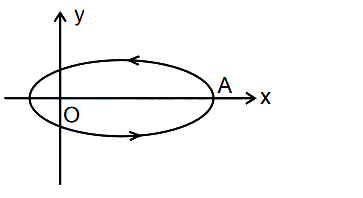
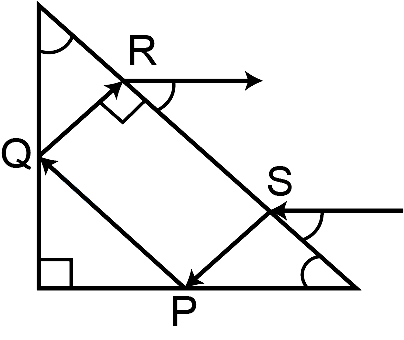
particle is moving in an elliptical orbit as shown in figure. If \(\vec{p}, \vec{L}\) and \(\vec{r}\) denote the linear momentum, angular momentum and position vector of the particle (from focus \(\mathrm{O}\) ) respectively at a point \(\mathrm{A}\), then the direction of \(\vec{\alpha}=\overrightarrow{\mathrm{p}} \times \overrightarrow{\mathrm{L}}\) is alongWBJEE 2022 Hard - A ray of light is incident on a right angled isosceles prism parallel to its base as shown in the figure. Refractive index of the material of the prism is \(\sqrt{2}\). Then. which of the following statement(s) is/are true?
 WBJEE 2018 Medium
 - An infinite sheet carrying a uniform surface charge density \(\sigma\) lies on the \(x y\) -plane. The work done to carry a charge \(q\) from the point \(\mathbf{A}=a(\mathbf{i}+2 \hat{\mathbf{j}}+3 \hat{\mathbf{k}})\) to the point \(\mathbf{B}=a(\mathbf{i}-2 \hat{\mathbf{j}}+6 \hat{\mathbf{k}})\)
(where \(a\) is a constant with the dimension of length and \(\varepsilon_{0}\) is the permittivity of free space) isWBJEE 2014 Medium - A bar magnet has a magnetic moment of \(200 \mathrm{Am}^{2}\). The magnet is suspended in a magnetic field of \(0.30 \mathrm{NA}^{-1} \mathrm{m}^{-1}\). The torque required to rotate the magnet from its equilibrium position through an angle of \(30^{\circ},\) will beWBJEE 2013 Easy
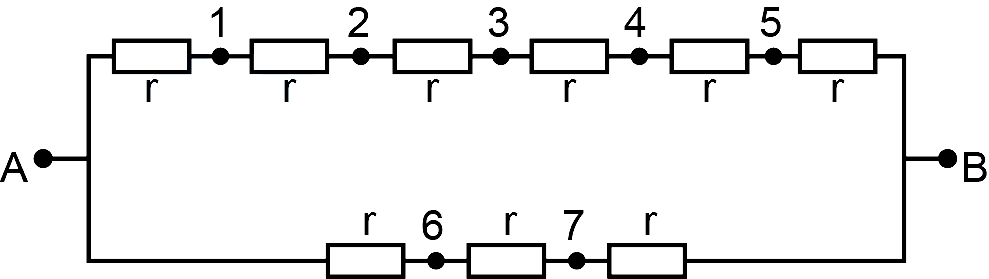
- In the circult shown in the figure all the resistance are identical and each has the value \(r \Omega\). The equivalent resistance of the combination between the points \(A\) and \(B\) will remain unchanged even when the followring pairs of points marked in the figure are connected through a resistance \(\mathbb{R}\).
 WBJEE 2019 Medium
 - A uniform thin rod of length \(L\), mass \(m\) is lying on a smooth horizontal table. A horizontal impulse \(P\) is suddenly applied perpendicular to the rod at one end. The total energy of the rod after the impulse isWBJEE 2021 Medium
More PYQs from WBJEE
- If \(\mathrm{I}_1=\int_0^{3 \pi} \mathrm{f}\left(\cos ^2 \mathrm{x}\right) \mathrm{dx}\) and \(\mathrm{I}_2=\int_0^\pi \mathrm{f}\left(\cos ^2 \mathrm{x}\right) \mathrm{dx}\), thenWBJEE 2010 Easy
- Two wires of same radius having lengths \(l_{1}\)
and \(I_{2}\) and resistivities \(\rho_{1}\) and \(\rho_{2}\) are connected in series. The equivalent resistivity will beWBJEE 2016 Medium - A block of mass \(m_{2}\) is placed on a horizontal table and another block of mass \(m_{1}\) is placed on top of it. An increasing horizontal force \(F=\alpha t\) is exerted on the upper block but the lower block never moves as a result. If the coefficient of friction between the blocks is \(\mu_{i}\) and that between the lower block and the table is \(\mu_{2}\), then what is the maximum possible value of \(\mu_{1} / \mu_{2} ?\)WBJEE 2018 Medium
- The displacement of a particle at time \(t\) is \(x\), where \(x=t^4-k t^3\). If the velocity of the particle at time \(t=2\) is minimum, thenWBJEE 2010 Easy
- The equilibrium constant for the reaction \(\mathrm{N}_{2}(\mathrm{~g})+\mathrm{O}_{2}(\mathrm{~g}) \rightleftharpoons 2 \mathrm{NO}(\mathrm{g})\) is \(4 \times 10^{-4}\) at \(2000 \mathrm{~K}\). In presence of a catalyst the equilibrium is attained 10 times faster. Therefore, the equilibrium constant, in presence of the catalyst at \(2000 \mathrm{~K}\) isWBJEE 2021 Easy
- If the algebraic sum of the distances from the points \((2,0),(0,2)\) and \((1,1)\) to a variable straight line be zero, then the line passes through the fixed pointWBJEE 2022 Medium