


WBJEE · Physics · Electrostatics
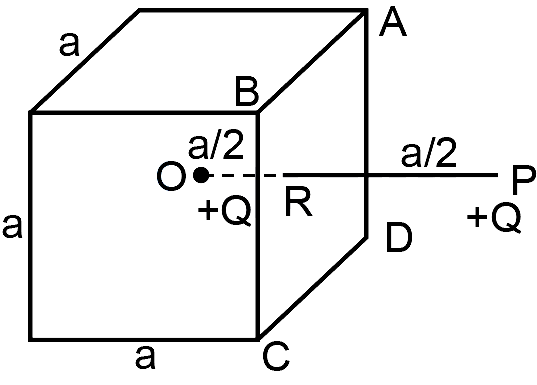
Consider a region in free space bounded by the surfaces of an imaginary cube having sides of length \(a\) as shown in the figure. A charge \(+Q\) is placed at the centre \(O\) of the cube. \(P\) is such a point out side the cube that the line \(O P\) perpendicularly intersects the surface \(A B C D\) at \(R\) and also \(O R=R P=a / 2\). A charge \(+Q\) is placed at point \(P\) also. What is the total electric flux through the five faces of the cube other than \(A B C D ?\)
- A \(\frac{Q}{\varepsilon_{0}}\)
- B \(\frac{5 Q}{6 \varepsilon_{0}}\)
- C \(\frac{10 Q}{6 \varepsilon_{0}}\)
- D zero
Answer & Solution
Correct Answer
(A) \(\frac{Q}{\varepsilon_{0}}\)
Step-by-step Solution
Detailed explanation
For surface \(A B C D\) clectric flux is zero. Because at surface \(A B C D\) net electric field is zero. Using Gauss's law, \[ \oint \mathbf{E} \cdot d \mathbf{S}=\frac{Q_{\mathrm{in}}}{\varepsilon_{0}} \] Electric flux through the five faces of the cube,…
See the Complete Solution
Get step-by-step explanations for this and 2.5 Lakh+ more JEE, NEET & CET questions.
- Unlock all solutions
- Practice the full chapter
- Track accuracy across PYQs
4.8 rated on Google Play · 14,000+ reviews
More questions from Physics
- Light travels through a glass plate of thickness \(t\) and having refractive index \(\mu\). If \(c\) be the velocity of light in vacuum, time taken by the light to travel through this thickness of glass isWBJEE 2016 Easy
- A particle moves with constant acceleration along a straight line starting from rest. The percentage increase in its displacement during the 4th second compared to that in the 3rd second isWBJEE 2014 Easy
- A luminous object is separated from a screen by distance \(d\). A convex lens is placed between the object and the screen such that it forms a distinct image on the screen. The maximum possible focal length of this convex lens isWBJEE 2014 Medium
- A scientist proposes a new temperature scale in which the ice point is \(25 \mathrm{X}(\mathrm{X}\) is the new unit of temperature) and the steam point is \(305 \mathrm{X}\). The specific heat capacity of water in this new scale is \(\left(\operatorname{in} J \mathrm{kg}^{-1} \mathrm{X}^{-1}\right)\)WBJEE 2014 Medium
- A particle of charge ' \(q\) ' and mass ' \(m\) ' moves in a circular orbit of radius ' \(r\) ' with angular speed ' \(\omega\) '. The ratio of the magnitude of its magnetic moment to that of its angular momentum depends onWBJEE 2025 Medium
- A spring of force constant \(\mathrm{k}\) is cut into two equal halves. The force constant of each half isWBJEE 2009 Medium
More PYQs from WBJEE
- Let \(\alpha, \beta\) be the roots of the equation \(x^{2}-6 x-2=0\) with \(\alpha>\beta\). If \(a_{n}=\alpha^{n}-\beta^{n}\) for \(n \geq 1\), then the value of \(\frac{a_{10}-2 a_{8}}{2 a_{9}}\) isWBJEE 2021 Hard
- The value of \(\int_{-2}^2(x \cos x+\sin x+1) d x\) isWBJEE 2011 Easy
- For spontaneous polymerization, which of the following is (are) correct?WBJEE 2020 Easy
- The side \(A B\) of \(\triangle A B C\) is fixed and is of length \(2 a\) unit. The vertex moves in the plane such that the vertical angle is always constant and is \(\alpha\). Let \(x\)-axis be along \(A B\) and the origin be at \(A\). Then the locus of the vertex isWBJEE 2022 Hard
- Let \(f: \mathbb{R} \rightarrow \mathbb{R}\) be a function defined by \(f(x)=\frac{e^{|x|}-e^{-x}}{e^x+e^{-x}}\), thenWBJEE 2024 Easy
- Two identical blocks of ice move in opposite directions with equal speed and collide with cach other. What will be the minimum speed required to make both the blocks melt completely, if the initial temperatures of the blocks were \(-8^{\circ} \mathrm{C}\) each? (Specific heat of ice is \(2100 \mathrm{Jkg}^{-1} \mathrm{K}^{-1}\) and latent heat of fusion of ice is \(3.36 \times 10^{5} \mathrm{Jkg}^{-1}\) )WBJEE 2019 Medium