


WBJEE · Physics · Motion In One Dimension
At a particular height, the velocity of an ascending body is \(\mathbf{u}\). The velocity at the same height while the body falls freely is
- A \(2 \mathbf{u}\)
- B \(-\mathbf{u}\)
- C \(\mathbf{u}\)
- D \(-2 \mathbf{u}\)
Answer & Solution
Correct Answer
(B) \(-\mathbf{u}\)
Step-by-step Solution
Detailed explanation
Given that velocity of ascending body = u Let there is no air resistance when body falls freely in downward direction, the direction of falling body will opposite to the ascending body. \(\therefore\) The velocily at the same height while the body falls freely \(=-u\)
See the Complete Solution
Get step-by-step explanations for this and 2.5 Lakh+ more JEE, NEET & CET questions.
- Unlock all solutions
- Practice the full chapter
- Track accuracy across PYQs
4.8 rated on Google Play · 14,000+ reviews
More questions from Physics
- Two particles \(A\) and \(B\) having different masses are projected from a tower with same speed. \(A\) is projected vertically upward and \(B\) vertically downward. On reaching the groundWBJEE 2015 Medium
-
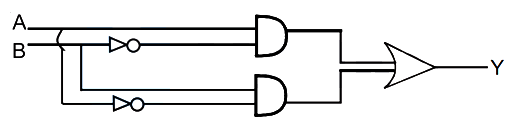
For the given logic circuit, the output \(Y\) for inputs \((A=0, B=1)\) and \((A=0, B=0)\) respectively areWBJEE 2021 Easy - In the circuit shown, what will be the current through the \(6 \mathrm{V}\) zener?
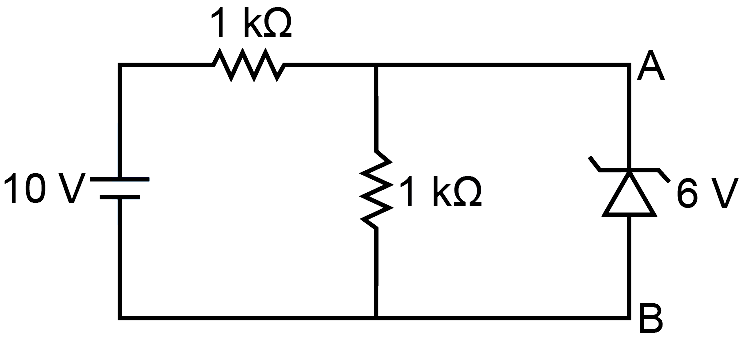 WBJEE 2019 Easy
 - Heat is produced at a rate given by \(H\) in a resistor when it is connected across a supply of voltage \(V\). If now the resistance of the resistor is doubled and the supply voltage is made \(V / 3\), then the rate of production of heat in the resistor will beWBJEE 2012 Easy
- What is the particle \(\mathrm{x}\) in the following nuclear reaction :
\({ }_4^9 \mathrm{Be}+{ }_2^4 \mathrm{He} \rightarrow{ }_6^{12} \mathrm{C}+\mathrm{x}\)WBJEE 2009 Medium - Two monochromatic coherent light beams \(A\) and \(B\) have intensities \(L\) and \(\frac{L}{4},\) respectively. If these beams are superposed, the maximum and minimum intensities will beWBJEE 2017 Easy
More PYQs from WBJEE
- Which of the following compounds is not formed in iodoform reaction of acetoneWBJEE 2011 Hard
- The ease of hydrolysis in the compounds \(\mathrm{CH}_{3} \mathrm{COCl}(\mathrm{I}), \mathrm{CH}_{3}-\mathrm{CO}-\mathrm{O}-\mathrm{COCH}_{3}(\mathrm{II})\)
\(\mathrm{CH}_{3} \mathrm{COOC}_{2} \mathrm{H}_{5}(\mathrm{III})\) and \(\mathrm{CH}_{3} \mathrm{CONH}_{2}\) (IV) is of
the orderWBJEE 2018 Medium - \[
\text { If } f(x)=\begin{array}{|ccc|}
1 & x & x+1\\
2 x & x(x-1) & (x+1)x\\
3 x(x-1) & x(x-1)(x-2) & (x+1)x(x-1)
\end{array}
\] Then, \(f(100)\) is equal toWBJEE 2015 Medium - \(\stackrel{\mathrm{L}}{=}~\xrightarrow [\text { (ii) } \mathrm{H}_3 \mathrm{O}^{\oplus}]{\text { (i) } \mathrm{PhMgBr}}\stackrel{\mathrm{M}}{=}~\xrightarrow []{\mathrm{CrO}_3 / \mathrm{H}^{\oplus}}\stackrel{\mathrm{N}}{=}~\xrightarrow []{\mathrm{Ph}_3 \mathrm{P}=\mathrm{CH}_2}\mathrm{Ph}_2 \mathrm{C}= \mathrm{CH}_2\)
"L" in the above sequence of reaction is/are (where \(L \neq M \neq N\))WBJEE 2023 Hard - A proton of mass \(m\) and charge \(q\) is moving in a plane with kinetic energy \(E\). If there exists a uniform magnetic field \(B\), perpendicular to the plane of the motion, the proton will move in a circular path of radiusWBJEE 2014 Medium
- The intermediate image formed by the objective of a compound microscope isWBJEE 2014 Hard