


WBJEE · Physics · Mechanical Properties of Fluids
A small spherical body of radius \(r\) and density p moves with the terminal velocity \(v\) in a fluid of coefficient of viscosity \(\eta\) and density \(\bar{\sigma}\). What will be the net force on the body?
- A \(\frac{4 \pi}{3} r^{3}(p-\sigma) g\)
- B \(6 \pi \eta rv\)
- C Zero
- D Infinity
Answer & Solution
Correct Answer
(C) Zero
Step-by-step Solution
Detailed explanation
When the spherical body falls with constant velocity, i.e. terminal velocity then the net force becomes zero, i.e the weight of body is equal to the buoyancy force. Hence, \(F_{\text {net }}=0\)
See the Complete Solution
Get step-by-step explanations for this and 2.5 Lakh+ more JEE, NEET & CET questions.
- Unlock all solutions
- Practice the full chapter
- Track accuracy across PYQs
4.8 rated on Google Play · 14,000+ reviews
More questions from Physics
-
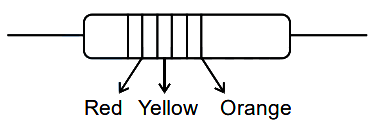
A carbon resistor with colour code is shown in the figure. There is no fourth band in the resistor. The value of the resistance isWBJEE 2021 Easy - The height of a waterfall is \(50 \mathrm{~m}\). If \(g=9.8 \mathrm{~ms}^{-2}\) the difference between the temperature at the top and the bottom of the waterfall is:WBJEE 2009 Hard
- At two different places, the angles of dip are respectively \(30^{\circ}\) and \(45^{\circ} .\) At these two places the ratio of horizontal component of earth's magnetic field isWBJEE 2013 Easy
- A conducting circular loop of resistance \(20 \Omega\) and cross-sectional area \(20 \times 10^{-2} \mathrm{~m}^{2}\) is placed perpendicular to a spatially uniform magnetic field B, which varies with time tas \(\mathrm{B}=2 \sin (50 \pi t)\) T. Find the net charge flowing through the loop in \(20 \mathrm{~ms}\) starting from \(\mathrm{t}=0\)WBJEE 2020 Medium
- A circular disc rolls on a horizontal Iloor without slipping and the centre of the disc moves with a uniform velocity \(v\). Which of the following values of the velocily at a point on the rim of the disc can have?WBJEE 2015 Medium
- The glass prisms \(P_{1}\) and \(P_{2}\) are to be combined together to produce dispersion without deviation. The angles of the prisms \(P_{1}\) and \(P_{2}\) are selected as \(4^{\circ}\) and \(3^{\circ}\) respectively. If the refractive index of prism \(P_{1}\) is \(1.54,\) then that of \(P_{2}\) will beWBJEE 2013 Hard
More PYQs from WBJEE
- Let \((1+x)^{10}=\sum_{r=0}^{10} c_{r} x^{r}\) and \((1+x)^{7}=\sum_{r=0}^{7} d_{r} x^{r}\)
If \(P=\sum_{r=0}^{5} c_{2}\) and \(Q=\sum_{r=0}^{3} d_{2 r+1},\) then \(\frac{P}{Q}\) is equal
toWBJEE 2012 Medium - The distance covered by a particle in \(t\) seconds is given by \(x=3+8 t-4 t^2\). After 1 second velocity will beWBJEE 2009 Easy
- A line passing through the point of intersection of \(x+y=4\) and \(x-y=2\) makes an angle \(\tan ^{-1}\left(\frac{3}{4}\right)\) with the \(X\) -axis. It intersects the parabola \(y^{2}=4(x-3)\) at points \(\left(x_{1}, y_{1}\right)\) and \(\left(x_{2}, y_{2}\right),\) respectively. Then \(\left|x_{1}-x_{2}\right|\) is equal toWBJEE 2016 Hard
- A quantity X is given by \(\varepsilon_0 \mathrm{~L} \frac{\Delta \mathrm{~V}}{\Delta t}\), where \(\varepsilon_0\) is the permittivity of free space, L is the length, \(\Delta \mathrm{V}\) is a potential difference and \(\Delta t\) is a time interval. The dimension of \(X\) is same as that ofWBJEE 2025 Medium
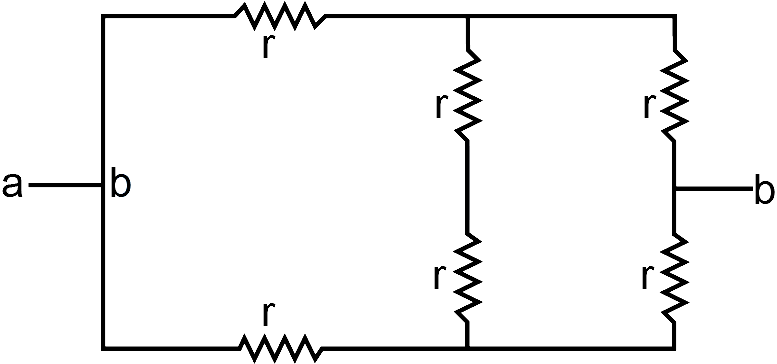
- The equivalent resistance between the points \(a\) and \(b\) of the electrical network shown in the figure is
 WBJEE 2013 Easy
 - A gas bubble of \(2 \mathrm{cm}\) diameter rises througha liquid of density \(1.75 \mathrm{g} \mathrm{cm}^{-3}\) with a fixed speed of \(0.35 \mathrm{cms}^{-1}\). Neglect the density of the gas. The coefficient of viscosity of the liquid isWBJEE 2016 Hard