


WBJEE · Physics · Electrostatics
A point charge \(-q\) is carried from a point \(A\) to another point \(B\) on the axis of a charged ring of radius \(r\) carrying a charge \(+q\). If the point \(A\) is at a distance \(\frac{4}{3} r\) from the centre of the
ring and the point \(B\) is \(\frac{3}{4} r\) from the centre but
on the opposite side, what is the net work that need to be done for this?
- A \(-\frac{7}{5} \cdot \frac{q^{2}}{4 \pi \varepsilon_{0} r}\)
- B \(-\frac{1}{5} \cdot \frac{q^{2}}{4 \pi \varepsilon_{0} I}\)
- C \(\frac{7}{5} \cdot \frac{q^{2}}{4 \pi \varepsilon_{0} r}\)
- D \(\frac{1}{5} \cdot \frac{q^{2}}{4 \pi \varepsilon_{0} r}\)
Answer & Solution
Correct Answer
(B) \(-\frac{1}{5} \cdot \frac{q^{2}}{4 \pi \varepsilon_{0} I}\)
Step-by-step Solution
Detailed explanation
A charged circular ring of radius \(R\) is shown in figure. From the figure, \(d=\sqrt{x^{2}+r^{2}}\) \(\therefore\) Potential due to a uniform ring of positive charge \(q\) at point \(P\)…
See the Complete Solution
Get step-by-step explanations for this and 2.5 Lakh+ more JEE, NEET & CET questions.
- Unlock all solutions
- Practice the full chapter
- Track accuracy across PYQs
4.8 rated on Google Play · 14,000+ reviews
More questions from Physics
- A particle of mass \(M\) and charge \(q\) is at rest at the mid point between two other fixed similar charges each of magnitude \(Q\) placed a distance \(2 d\) apart. The system is collinear as shown in the figure. The particle is now displaced by a small amount \(x(x< < d)\) along the joining the two charges and is left to itself. It will now oscillate about the mean position with a time period \(\left(\varepsilon_{0}=\right.\) permittivity of free space)
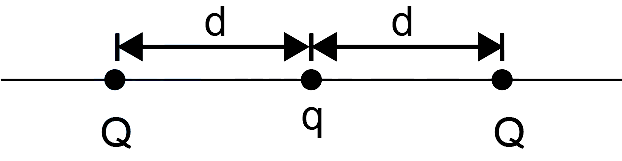 WBJEE 2013 Hard
 - At a particular height, the velocity of an ascending body is \(\mathbf{u}\). The velocity at the same height while the body falls freely isWBJEE 2016 Medium
- Which of the following relation represent Biot-Savart's law?WBJEE 2009 Easy
-
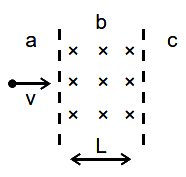
A particle of mass \(\mathrm{m}\) and charge \(\mathrm{q}\) moving with velocity \(\mathrm{v}\) enters region-b form region-a along the normal to the boundary as shown is the figure. Region-b has a uniform magnetic field \(B\) perpendicular to the plane of the paper. Also, region-b has length L. Choose the correct statements :WBJEE 2021 Easy - How the linear velocity \(v\) of an electron in the Bohr orbit is related to its quantum number \(m\)WBJEE 2018 Easy
- One mole of an ideal monoatomic gas is heated at a constant pressure from \(0^{\circ} \mathrm{C}\) to \(100^\circ C\). Then the change in the internal enery of the gas is (Given, \(R=8.32 \mathrm{J} \mathrm{mol}^{-1} \mathrm{K}^{-1}\) )WBJEE 2014 Easy
More PYQs from WBJEE
- If \(z_{1}, z_{2}, z_{3}\) are imaginary numbers such that \(\left|z_{1}\right|=\left|z_{2}\right|=\left|z_{3}\right|=\left|\frac{1}{z_{1}}+\frac{1}{z_{2}}+\frac{1}{z_{3}}\right|=1,\) then
\(\left|z_{1}+z_{2}+z_{3}\right|\) isWBJEE 2016 Medium - The correct statement regarding the following energy diagrams is
 WBJEE 2014 Easy
 - The points \((-a,-b),(a, b),(0,0)\) and \(\left(a^{2}, a b\right), a \neq 0, b \neq 0\) are alwaysWBJEE 2016 Medium
- A long conducting wire carrying a current \(I\) is bent at \(120^{\circ}\) (see figure). The magnetic field \(B\) at a point \(P\) on the right bisector of bending angle at a distance \(d\) from the bend is \(\left(\mu_{0}\right.\) is the permeability of free space)
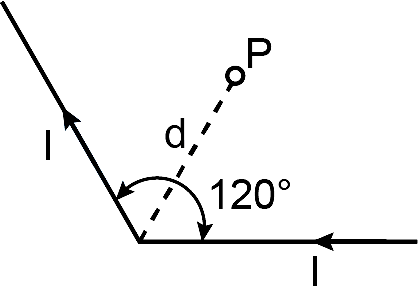 WBJEE 2014 Medium
 - Consider the parabola \(y^{2}=4 x\). Let \(P\) and \(Q\) be points on the parabola where \(P(4,-4)\) and \(Q (9,6)\). Let \(R\) be a point on the arc of the parabola between \(P\) and \(Q\). Then, the area of \(\Delta P Q R\) is largest whenWBJEE 2018 Medium
- The value of \(\lim _{n \rightarrow \infty}\left[\left(\frac{1}{2 \cdot 3}+\frac{1}{2^2 \cdot 3}\right)+\left(\frac{1}{2^2 \cdot 3^2}+\frac{1}{2^3 \cdot 3^2}\right)+\ldots+\left(\frac{1}{2^n \cdot 3^n}+\frac{1}{2^{n+1} \cdot 3^n}\right)\right]\) isWBJEE 2023 Medium