


WBJEE · Physics · Oscillations
A particle of mass \(m\) is located in a one dimensional potential field where potential energy is given by : \(\mathrm{V}(\mathrm{x})=\mathrm{A}(1-\cos \mathrm{px})\), where \(\mathrm{A}\) and \(\mathrm{p}\) are constants. The period of small oscillations of the particle is
- A \(2 \pi \sqrt{\frac{m}{(A p)}}\)
- B \(2 \pi \sqrt{\frac{m}{\left(A p^2\right)}}\)
- C \(2 \pi \sqrt{\frac{\mathrm{m}}{\mathrm{A}}}\)
- D \(\frac{1}{2 \pi} \sqrt{\frac{A p}{m}}\)
Answer & Solution
Correct Answer
(B) \(2 \pi \sqrt{\frac{m}{\left(A p^2\right)}}\)
Step-by-step Solution
Detailed explanation
Hints: \(v_x=A(1-\cos p x)\) \(F=-\frac{d u}{d x}=-A p \sin p x\) For small (x) \(\mathrm{F}=-\mathrm{AP}^2 \mathrm{x}\) \(a=-\frac{A p^2}{m} x \quad a=-\omega^2 x\) \(\omega=\sqrt{\frac{A P^2}{\mathrm{~m}}} \quad \therefore \mathrm{T}=2 \pi \sqrt{\frac{\mathrm{m}}{A p^2}}\)
See the Complete Solution
Get step-by-step explanations for this and 2.5 Lakh+ more JEE, NEET & CET questions.
- Unlock all solutions
- Practice the full chapter
- Track accuracy across PYQs
4.8 rated on Google Play · 14,000+ reviews
More questions from Physics
- As shown in figure below, a charge \(+2 \mathrm{C}\) is situated at the origin \(O\) and another charge \(+5 \mathrm{C}\) is on the \(x\) -axis at the point \(A .\) The later charge from the point \(A\) is then brought to a point \(B\) on the \(y\) -axis. The work done is \(\left(\right.\) given \(\left.\frac{1}{4 \pi \varepsilon_{0}}=9 \times 10^{9} \mathrm{m} / \mathrm{F}\right)\)
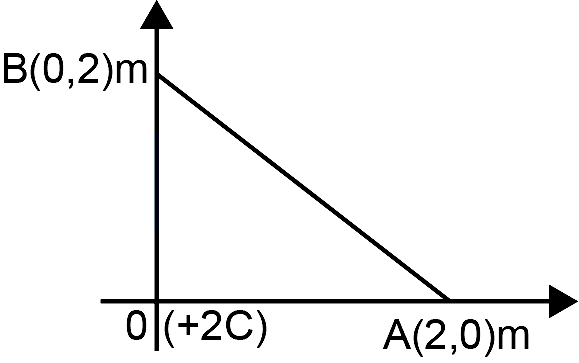 WBJEE 2013 Easy
 - A tennis ball hits the floor with a speed \(v\) at an angle \(\theta\) with the normal to the floor. If the collision is inelastic and the co-efficient of restitution is \(\varepsilon\), what will be the angle of reflection?WBJEE 2020 Easy
- A body floats in water with \(40 \%\) of its volume outside water. When the same body floats in an oil, \(60 \%\) of its volume remains outside oil. The relative density of oil isWBJEE 2011 Hard
- \(12 \mathrm{mC}\) and \(6 \mathrm{mC}\) charges are given to the two conducting plates having same cross-sectional area and placed face to face close to each other as shown in the figure. The resulting charge distribution in \(\mathrm{mC}\) on surface \(A, B, C\) and \(D\) are respectively,
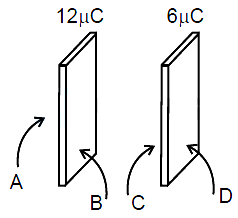 WBJEE 2023 Easy
 - The initial pressure and volume of a given mass of an ideal gas \(\left(\right.\) with \(\frac{C_{p}}{C_{V}}=\gamma),\) taken in a cylinder fitted with a piston, are \(p_{0}\) and \(V_{0}\) respectively. At this stage the gas has the same temperature as that of the surrounding medium which is \(T_{0}\). It is adiabatically compressed to a volume equal to \(\frac{V_{0}}{2}\) Subsequently the gas is allowed to come to thermal equilibrium with the surroundings. What is the heat released to the surrounding?WBJEE 2019 Medium
- If the charge on a capacitor is increased by 2 coulomb, the energy stored in it increases by \(21 \%\). The original charge on the capacitor isWBJEE 2009 Hard
More PYQs from WBJEE
-
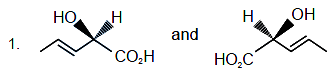
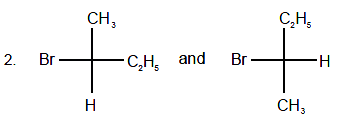

The relationship between the pair of compounds shown above are respectively,WBJEE 2023 Hard - \({ }_5 \mathrm{~B}^{10}+{ }_2 \mathrm{He}^4 \rightarrow \mathrm{X}+{ }_{\mathrm{o}} \mathrm{n}^1\)
In the above nuclear reaction ' X ' will beWBJEE 2025 Easy - \(\mathrm{PbCl}_{2}\) is insoluble in cold water. Addition of \(\mathrm{HCl}\) increases its solubility due toWBJEE 2017 Easy
- In the crystalline solid \(M \mathrm{SO}_{4} \cdot n \mathrm{H}_{2} \mathrm{O}\) of molar mass 250 g \(mol^{-1}\) , the percentage of anhydrous salt is 64 by weight. The value of \(n\) isWBJEE 2019 Medium
- In a \(\triangle A B C, a, b, c\) are the sides of the triangle opposite to the angles \(A, B, C,\) respectively. Then, the value of \(a^{3} \sin (B-C)\) \(+b^{3} \sin (C-A)+c^{3} \sin (A-B)\) is equal toWBJEE 2014 Hard
- Two pith balls, each carrying charge \(+q\) are hung from a hook by two strings. It is found that when each charge is tripled, angle between the strings double. What was the initial angle between the strings?WBJEE 2020 Hard