


WBJEE · Maths · Continuity and Differentiability
The function \(f(x)=a \sin |x|+b e^{| x \mid} \quad\) is differentiable at \(x=0\) when
- A \(3 a+b=0\)
- B \(3 a-b=0\)
- C \(a+b=0\)
- D \(a-b=0\)
Answer & Solution
Correct Answer
(C) \(a+b=0\)
Step-by-step Solution
Detailed explanation
Given, \(f(x)=a \sin |x|+b e^{|x|}\) We know that \(\sin |x|\) and \(e^{|x|}\) is not differentiable at \(x=0\). Therefore, for \(f(x)\) to differentiable at \(x=0\), we must have \(a=b=0\). \(\therefore\) \[ a+b=0 \]
See the Complete Solution
Get step-by-step explanations for this and 2.5 Lakh+ more JEE, NEET & CET questions.
- Unlock all solutions
- Practice the full chapter
- Track accuracy across PYQs
4.8 rated on Google Play · 14,000+ reviews
More questions from Maths
- If the three points \(A(1,6), B(3,-4)\) and \(C(x, y)\) are collinear then the equation satisfying by \(x\) and \(y\) isWBJEE 2011 Easy
- Let \(\vec{\alpha}=\hat{i}+\hat{j}+\hat{k}, \vec{\beta}=\hat{i}-\hat{j}-\hat{k}\) and
\(\vec{\gamma}=-\hat{i}+\hat{j}-\hat{k}\) be three vectors. A vector \(\vec{\delta},\) in the plane of \(\vec{\alpha}\) and \(\vec{\beta}\), whose projection on \(\vec{\gamma}\) is \(\frac{1}{\sqrt{3}},\) is given byWBJEE 2018 Medium - Let \(f(x)=\left\{\begin{array}{cc}x+1, & -1 \leq x \leq 0 \\ -x, & 0 \leq x \leq 1\end{array}\right.\)WBJEE 2023 Easy
- The equation \(r \cos \left(\theta-\frac{\pi}{3}\right)=2\) representsWBJEE 2020 Easy
- The remainder when \(7^{7^{7^{...7}}}(22\) times 7\()\) is divided by 48 isWBJEE 2021 Easy
- If \(\cos (\theta+\phi)=\frac{3}{5}\) and \(\sin (\theta-\phi)=\frac{5}{13}, 0 \lt \theta, \phi \lt \frac{\pi}{4}\), then \(\cot (2 \theta)\) has the valueWBJEE 2025 Medium
More PYQs from WBJEE
- The number of solution(s) of the equation \(\sqrt{x+1}-\sqrt{x-1}=\sqrt{4 x-1}\) is/areWBJEE 2014 Easy
- A straight line through the point (3,-2) is ndined at an angle \(60^{\circ}\) to the line \(\sqrt{3} x+y=1\). If it intersects the \(X\) -axis, then its equation vill beWBJEE 2019 Medium
- The limit of \(x \sin \left(e^{\frac{1}{x}}\right)\) as \(x \rightarrow 0\)WBJEE 2013 Easy
-
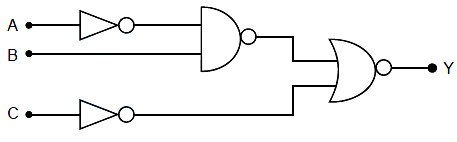
Consider the logic circuit with inputs A, B, C and output \(Y\). How many combinations of \(A, B\) and \(C\) gives the output \(Y=0\) ?WBJEE 2023 Easy - The coordinates of the two points lying on \(x+y=4\) and at a unit distance from the straight line \(4 x+3 y=10\) areWBJEE 2011 Medium
- \(\mathrm{I}=\int \cos (\ln \mathrm{x}) \mathrm{dx}\). Then \(\mathrm{I}=\)WBJEE 2022 Easy