


WBJEE · Chemistry · Electrochemistry
The molar conductances of \(\mathrm{Ba}(\mathrm{OH})_2, \mathrm{BaCl}_2\) and \(\mathrm{NH}_4 \mathrm{Cl}\) at infinite dilution are \(523.28,280.0\) and \(129.8 \mathrm{~S} \mathrm{~cm}^2 \mathrm{~mol}^{-1}\) respectively. The molar conductance of \(\mathrm{NH}_4 \mathrm{OH}\) at infinite dilution will be
- A \(125.72 \mathrm{~S} \mathrm{~cm}^2 \mathrm{~mol}^{-1}\)
- B \(251.44 \mathrm{~S} \mathrm{~cm}^2 \mathrm{~mol}^{-1}\)
- C \(502.88 \mathrm{~S} \mathrm{~cm}^2 \mathrm{~mol}^{-1}\)
- D \(754.32 \mathrm{~S} \mathrm{~cm}^2 \mathrm{~mol}^{-1}\)
Answer & Solution
Correct Answer
(B) \(251.44 \mathrm{~S} \mathrm{~cm}^2 \mathrm{~mol}^{-1}\)
Step-by-step Solution
Detailed explanation
\begin{aligned} 2 \lambda_{\mathrm{m}\left[\mathrm{NH} \mathrm{H}_4 \mathrm{OH}\right]}^{\infty} & =2 \lambda_{\mathrm{m}[\mathrm{NH} 4 \mathrm{Cl}]}^{\infty}-\lambda_{\mathrm{m}\left[\mathrm{BaCl}_2\right]}^{\infty}+\lambda_{\mathrm{m}\left[\mathrm{Ba}(\mathrm{OH})_2\right]}^{\i…
See the Complete Solution
Get step-by-step explanations for this and 2.5 Lakh+ more JEE, NEET & CET questions.
- Unlock all solutions
- Practice the full chapter
- Track accuracy across PYQs
4.8 rated on Google Play · 14,000+ reviews
More questions from Chemistry
- The correct order of decreasing \(\mathrm{H}-\mathrm{C}-\mathrm{H}\) angle in the following molecule is
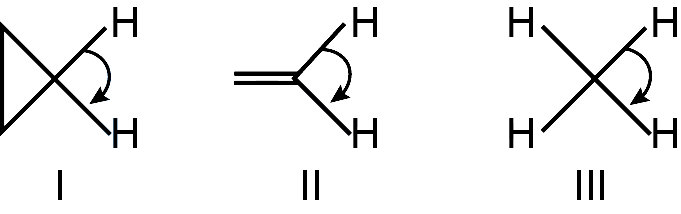 WBJEE 2014 Hard
 - In Sommerfeld's modification of Bohr's theory, the trajectory of an electron in a hydrogen atom isWBJEE 2010 Easy
- Which of the following contributes to the double helical structure of DNAWBJEE 2009 Medium
- The isomerisation of 1 -butyne to 2 -butyne can be achieved by treatment withWBJEE 2017 Easy
- The conversion of \(\mathrm{CH}_{3}-\mathrm{CH}_{2}-\mathrm{COOH}\) to
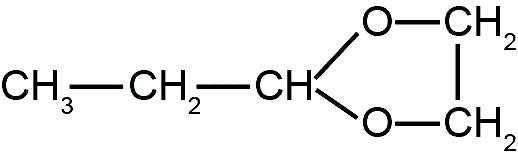
can be accomplished byWBJEE 2017 Easy - In which of the following mixed aqueous solutions, \(\mathrm{pH}=\mathrm{p} K_{a}\) at equilibrium?
(1) \(100 \mathrm{mL}\) of \(0.1 \mathrm{M} \mathrm{CH}_{3} \mathrm{COOH}+100 \mathrm{mL}\) of \(0.1 \mathrm{MCH}_{3} \mathrm{COONa}\)
(2) \(100 \mathrm{mL}\) of \(0.1 \mathrm{MCH}_{3} \mathrm{COOH}+50 \mathrm{mL}\) of 0.1 \(\mathrm{M} \mathrm{NaOH}\)
(3) \(100 \mathrm{mL}\) of \(0.1 \mathrm{M} \mathrm{CH}_{3} \mathrm{COOH}+100 \mathrm{mL}\) of \(0.1 \mathrm{M} \mathrm{NaOH}\)
(4) \(100 \mathrm{mL}\) of \(0.1 \mathrm{M} \mathrm{CH}_{3} \mathrm{COOH}+100 \mathrm{mL}\) of \(0.1 \mathrm{M} \mathrm{NH}_{3}\)WBJEE 2016 Hard
More PYQs from WBJEE
- If \(z_1\) and \(z_2\) are two complex numbers satisfying the equation \(\left|\frac{z_1+z_2}{z_1-z_2}\right|=1\), then \(\frac{z_1}{z_2}\) may beWBJEE 2023 Hard
- The elastic potential energy of a strained body isWBJEE 2024 Easy
- If \(y=\tan ^{-1} \frac{\sqrt{1+x^2}-1}{x}\), then \(y^{\prime}(1)=\)WBJEE 2011 Medium
- The value of the integral \(\int_{1}^{2} e^{x}\left(\log _{e} x+\frac{x+1}{x}\right) d x\) isWBJEE 2013 Medium
- The trigonometric equation \(\sin ^{-1} x=2 \sin ^{-1} 2 a\) has a real solution, ifWBJEE 2015 Medium
- Under the same reaction conditions, initial concentration of \(1.386 \mathrm{~mol} \mathrm{dm}^{-3}\) of a substance becomes half in \(40 \mathrm{~s}\) and 20 s through first-order and zero-order kinetics respectively. Ratio \(\left(\frac{k_{1}}{k_{0}}\right)\) of the rate constants for first-order \(\left(k_{1}\right)\) and zero-order \(\left(\mathrm{k}_{0}\right)\) of the reactions isWBJEE 2021 Medium