


WBJEE · Maths · Differentiation
Let \(f(x)=x^{13}+x^{11}+x^{9}+x^{7}+x^{5}\)
\(+x^{3}+x+19 .\) Then, \(f(x)=0\) has
- A 13 real roots
- B only one positive and only two negative real roots
- C not more than one real root
- D has two positive and one negative real root
Answer & Solution
Correct Answer
(C) not more than one real root
Step-by-step Solution
Detailed explanation
We have, \(f(x)=x^{13}+x^{11}+x^{9}+x^{7}+x^{5}+x^{3}+x+19\) \[ \begin{array}{r} \Rightarrow f^{\prime}(x)=13 x^{12}+11 x^{10}+9 x^{4} \\ +7 x^{6}+5 x^{4}+3 x^{2}+1 \end{array} \] \(f^{\prime}(x)\) has no real root. \(\therefore f(x)=0\) has not more than one real root.
See the Complete Solution
Get step-by-step explanations for this and 2.5 Lakh+ more JEE, NEET & CET questions.
- Unlock all solutions
- Practice the full chapter
- Track accuracy across PYQs
4.8 rated on Google Play · 14,000+ reviews
More questions from Maths
- Under which of the following condition(s) does(do) the system of equations \(\left(\begin{array}{ccc}1 & 2 & 4 \\ 2 & 1 & 2 \\ 1 & 2 & (a-4)\end{array}\right)\left(\begin{array}{l}x \\ y \\ z\end{array}\right)=\left(\begin{array}{l}6 \\ 4 \\ a\end{array}\right)\) possesses (possess) unique solution?WBJEE 2022 Easy
- Let \(A(2,-3)\) and \(B(-2,1)\) be two angular points of \(\Delta A B C\). If the centroid of the triangle moves on the line \(2 x+3 y=1\), then the locus of the angular point \(C\) is given byWBJEE 2017 Medium
- The value of
\(\lim _{n \rightarrow \infty} \sum_{r=1}^n \frac{r^3}{r^4+n^4} \text { is }\)WBJEE 2011 Hard - If ' \(f\) ' is the inverse function of ' \(g\) ' and \(g^{\prime}(x)=\frac{1}{1+x^n}\), then the value of \(f^{\prime}(x)\) isWBJEE 2025 Medium
- The solutions set of inequation \(\cos ^{-1} x < \sin ^{-1} x\) isWBJEE 2011 Easy
- From a collection of 20 consecutive natural numbers, four are selected such that they are not consecutive. The number of such selections isWBJEE 2018 Medium
More PYQs from WBJEE
- You are supplied with \(500 \mathrm{mL}\) each of \(2 \mathrm{N} \mathrm{HCl}\) and \(5 \mathrm{N} \mathrm{HCl}\). What is the maximum volume of 3M HCl that you can prepare using only these two solutions?WBJEE 2017 Medium
- If \({ }^n C_4,{ }^n C_5\) and \({ }^n C_6\) are in A.P., then \(n\) isWBJEE 2011 Easy
- The equivalent weight of \(\mathrm{K}_{2} \mathrm{Cr}_{2} \mathrm{O}_{7}\) in acidic medium is expressed in terms of its molecular weight (M) asWBJEE 2012 Hard
- If \(x\) is a positive real number different from 1 such that \(\log _{a} x, \log _{b} x, \log _{c} x\) are in \(\mathrm{AP}\), thenWBJEE 2016 Medium
- The coefficient of \(x^{3}\) in the infinite series expansion of \(\frac{2}{(1-x)(2-x)},\) for \(|x| < 1,\) isWBJEE 2014 Hard
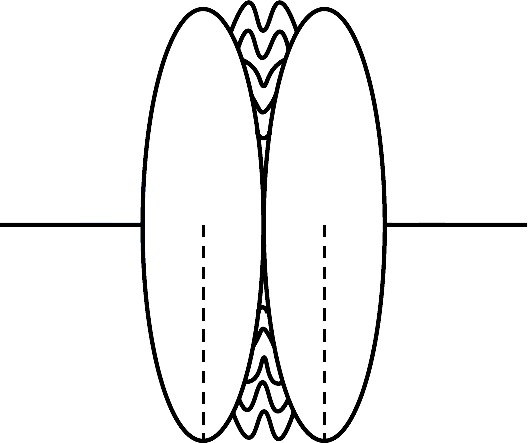
- Two identical equiconvex lenses, each of focal length \(f\) are placed side by side in contact with each other with a layer of water in between them as shown in the figure. If refractive index of the material of the lenses is greater than that of water, how the combined focal length \(F\) is related to \(f ?\)
 WBJEE 2018 Medium