


WBJEE · Maths · Application of Derivatives
Let \(f:[a, b] \rightarrow R\) be differentiable on \([a, b]\) and \(k \in R\). Let \(f(a)=0=f(b)\)
Also let \(J(x)=f'(x)+k f(x) .\) Then
- A \(J(x)>0\) for all \(x \in[a, b]\)
- B \(J(x) < 0\) for all \(x \in[a, b]\)
- C \(J(x)=0\) has at least one root in \((a, b)\)
- D \(J(x)=0\) through \((a, b)\)
Answer & Solution
Correct Answer
(C) \(J(x)=0\) has at least one root in \((a, b)\)
Step-by-step Solution
Detailed explanation
We have, \(f:[a, b] \longrightarrow R\) be differentiable on \([a, b]\) and \(k \in R,\) also \(f(a)=0=f(b)\) and \(\quad J(x)=f(x)+k f(x)\) Let \(g(x)=k x f(x)\) which is continuous in \([a, b]\) and differentiable in \((a, b)\) such that \[ g(a)=0=g(b) \] Then, for every…
See the Complete Solution
Get step-by-step explanations for this and 2.5 Lakh+ more JEE, NEET & CET questions.
- Unlock all solutions
- Practice the full chapter
- Track accuracy across PYQs
4.8 rated on Google Play · 14,000+ reviews
More questions from Maths
- Maximum value of the function \(f(x)=\frac{x}{8}+\frac{2}{x}\) on the interval [1,6] isWBJEE 2012 Medium
- Let \(\mathrm{P}(3 \sec \theta, 2 \tan \theta) \mathrm{Q}(3 \sec \phi, 2 \tan \phi)\) be two points on \(\frac{\mathrm{x}^2}{9}-\frac{\mathrm{y}^2}{4}=1\) such that \(\theta+\phi=\frac{\pi}{2} .0 < \theta, \phi < \frac{\pi}{2}\). Then the ordinate of the point of intersection of the normals at \(P\) and \(Q\) isWBJEE 2022 Medium
- For any two real numbers \(\theta\) and \(\phi\) we define \(\theta\). R \(\phi\) if and only if \(\sec ^{2} \theta-\tan ^{2} \phi=1\). The relation \(R\) isWBJEE 2014 Easy
- For each \(n \in N, 2^{3 n}-1\) is divisible by
where \(\mathrm{N}\) is a set of natural numbersWBJEE 2009 Hard - Let \(f: X \rightarrow Y\) and \(A, B\) are non-void subsets of \(Y\), then (where the symbols have their usual interpretation)WBJEE 2019 Easy
- Product of any \(r\) consecutive natural numbers is always divisible byWBJEE 2009 Medium
More PYQs from WBJEE
- If \(|z-25 i| \leq 15\), then Maximum \(\arg (z)-\) Minimum \(\arg (z)\) is equal toWBJEE 2022 Medium
- Consider the integral form of the Gaussian law in electrostatics.
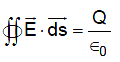
Which of the following statements are correct?WBJEE 2024 Medium - If \(\lim _{x \rightarrow 0} \frac{a x e^{x}-b \log (1+x)}{x^{2}}=3\) then the values of \(a\) and \(b\) are, respectivelyWBJEE 2015 Easy
- Of the following compounds the most acidic isWBJEE 2009 Easy
- A cylinder of height his filled with wator and is kept on a block of height \(h / 2\) The level of water in the cylinder is kept constant. Four holes numbered 1,2,3 and 4 are at the side of the cylinder and at heights \(0, h / 4, h / 2\) and \(3 h / 4,\) respectively. When all four holes are openned together, the hole from which water will reach farthest distance on the plane \(P Q\) is the hole number.
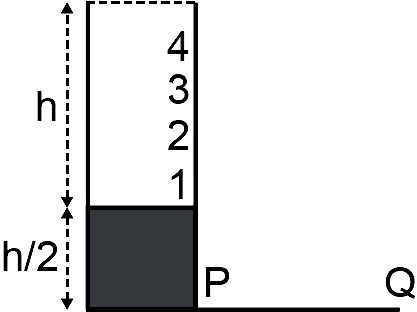 WBJEE 2015 Medium
 - An electric cell of emf \(E\) is connected across a copper wire of diameter \(d\) and length \(l\). The drift velocity of electrons in the wire is \(v_{d}\). If the length of the wire is changed to \(2 l,\) the new drift velocity of electrons in the copper wire will beWBJEE 2013 Easy