


WBJEE · Maths · Differential Equations
If \(U_n(n=1,2)\) denote the \(n^{\text {th }}\) derivative \((n=1,2)\) of \(U(x)=\frac{L x+M}{x^2-2 B x+C}(L, M, B, C\) are constants \()\), then \(P U_2+Q U_1\) \(+R U=0\), holds for
- A \(\mathrm{P}=\mathrm{x}^2-2 \mathrm{~B}, \mathrm{Q}=2 \mathrm{x}, \mathrm{R}=3 \mathrm{x}\)
- B \(P=x^2-2 B x+C, Q=4((x-B), R=2\)
- C \(P=2 x, Q=2 B, R=2\)
- D \(P=x^2, Q=x, R=3\)
Answer & Solution
Correct Answer
(B) \(P=x^2-2 B x+C, Q=4((x-B), R=2\)
Step-by-step Solution
Detailed explanation
\begin{aligned} & \text { Hint: } U(x)=\frac{L x+m}{x^2-2 B x+c}, U(x)\left(x^2-2 B x+c\right)=L x+m \\ & U(x)(2 x-2 B)+\left(x^2-2 B x+c\right) U_1(x)=L \\ & U(x)2 \times 2(2 x-2 B) U_1(x)+(2 x-2 B) U_1(x)+\left(x^2-2 B x+c\right) U_2(x)=0 \\ & \Rightarrow U_2\left(x^2-2…
See the Complete Solution
Get step-by-step explanations for this and 2.5 Lakh+ more JEE, NEET & CET questions.
- Unlock all solutions
- Practice the full chapter
- Track accuracy across PYQs
4.8 rated on Google Play · 14,000+ reviews
More questions from Maths
- If a particle moves in a straight line according to the law \(x=a \sin (\sqrt{\lambda} t+b)\), then the particle will come to rest at two points whose distance is [symbols have their usual meaning]WBJEE 2024 Medium
- If the quadratic equation \(a x^2+b x+c=0(a\gt0)\) has two roots \(\alpha\) and \(\beta\) such that \(\alpha \lt -2\) and \(\beta\gt2\) thenWBJEE 2024 Easy
- If \({ }^{n} C_{r-1}=36,{ }^{n} C_{r}=84\) and \({ }^{n} C_{r+1}=126\) then the value of \({ }^{n} C_{8}\) isWBJEE 2016 Easy
- For the real numbers \(x \& y\), we write \(x p\) y if \(x-y+\sqrt{2}\) is an irrational number. Then relation \(p\) isWBJEE 2024 Easy
- Let \(f: \mathbb{R} \rightarrow \mathbb{R}\) be a function defined by \(f(x)=\frac{e^{|x|}-e^{-x}}{e^x+e^{-x}}\), thenWBJEE 2024 Easy
- Let \(\mathrm{A}=\left(\begin{array}{ll}\mathrm{a} & \mathrm{b} \\ c & \mathrm{~d}\end{array}\right)\) be a \(2 \times 2\) real matrix with \(\operatorname{det} \mathrm{A}=1\). If the equation \(\operatorname{det}\left(\mathrm{A}-\lambda \mathrm{I}{2}\right)=0\) has imaginary roots \(\left(\mathrm{I}{2}\right.\) be the
Identity matrix of order 2), thenWBJEE 2020 Medium
More PYQs from WBJEE
- Number of moles of ions produced by complete dissociation of one mole of Mohr's salt in water isWBJEE 2024 Medium
- If one of the diameters of the curve \(x^{2}+y^{2}-4 x-6 y+9=0\) is a chord of a circle with centre \((1,1),\) the radius of this circle isWBJEE 2017 Easy
- A line passes through the point \((-1,1)\) and makes an angle \(\sin ^{-1}\left(\frac{3}{5}\right)\) in the positive direction of \(x\)-axis. If this line meets the curve \(x^2=4 y-9\) at \(A\) and \(B\), then \(|A B|\) is equal toWBJEE 2022 Easy
- On the set \(R\) of real numbers, the relation \(\rho\) is defined by \(x \rho y,(x, y) \in R\)WBJEE 2018 Easy
- Let \(n\) be a positive even integer. If the ratio of the largest coefficient and the 2nd largest coefficient in the expansion of \((1+x)^{n}\) is \(11: 10 .\) Then, the number of terms in the expansion of \((1+x)^{n}\) isWBJEE 2013 Easy
- The velocity-time graph for a body of mass 10 kg is shown in the figure. Work done on the body in the first two seconds of motion is
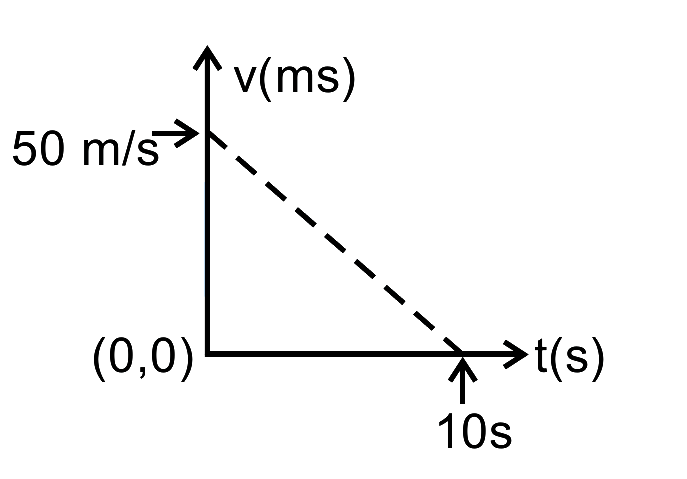 WBJEE 2025 Medium