


WBJEE · Maths · Binomial Theorem
If in the expansion of \((a-2 b)^{\mathrm{n}}\), the sum of the 5 th and 6 th term is zero, then the value of \(\frac{\mathrm{a}}{\mathrm{b}}\) is
- A \(\frac{\mathrm{n}-4}{5}\)
- B \(\frac{2(n-4)}{5}\)
- C \(\frac{5}{n-4}\)
- D \(\frac{5}{2(n-4)}\)
Answer & Solution
Correct Answer
(B) \(\frac{2(n-4)}{5}\)
Step-by-step Solution
Detailed explanation
\[ \text { Hints: } \begin{gathered} (a-2 b)^{\mathrm{n}}=\sum_{\mathrm{r}=0}^{\mathrm{n}}{ }^{\mathrm{n}} \mathrm{C}_{\mathrm{r}}(a)^{\mathrm{n}-\mathrm{r}}(-2 \mathrm{~b})^{\mathrm{r}} \\ \mathrm{t}_5+\mathrm{t}_6=0 \end{gathered} \]…
See the Complete Solution
Get step-by-step explanations for this and 2.5 Lakh+ more JEE, NEET & CET questions.
- Unlock all solutions
- Practice the full chapter
- Track accuracy across PYQs
4.8 rated on Google Play · 14,000+ reviews
More questions from Maths
- In a \(\triangle A B C, a, b, c\) are the sides of the triangle opposite to the angles \(A, B, C,\) respectively. Then, the value of \(a^{3} \sin (B-C)\) \(+b^{3} \sin (C-A)+c^{3} \sin (A-B)\) is equal toWBJEE 2014 Hard
- The area enclosed by \(y=3 x-5, y=0, x=3\) and \(x=5\) isWBJEE 2010 Easy
- The total number of tangents through the point \((3,5)\) that can be drawn to the ellipses \(3 x^2+5 y^2=32\) and \(25 x^2+9 y^2=450\) isWBJEE 2009 Easy
- Let \(f(x)=x^2+x \sin x-\cos x\). ThenWBJEE 2022 Medium
- The coefficient of \(x^{10}\) in the expansion of \(1+(1+x)+\dots+(1+x)^{20}\)WBJEE 2012 Medium
- The length of the latus rectum of the ellipse \(16 x^2+25 y^2=400\) isWBJEE 2011 Easy
More PYQs from WBJEE
- \[
\text { If } f(x)=\begin{array}{|ccc|}
1 & x & x+1\\
2 x & x(x-1) & (x+1)x\\
3 x(x-1) & x(x-1)(x-2) & (x+1)x(x-1)
\end{array}
\] Then, \(f(100)\) is equal toWBJEE 2015 Medium - The locus of the mid-points of all chords of the parabola \(y^{2}=4 a x\) through its vertex is another parabola with directrixWBJEE 2016 Hard
- Let \(\tan \alpha=\frac{a}{a+1}\) and \(\tan \beta=\frac{1}{2 a+1}\) then \(\alpha+\beta\) isWBJEE 2011 Medium
- \(\tan \left[\frac{\pi}{4}+\frac{1}{2} \cos ^{-1}\left(\frac{a}{b}\right)\right]+\tan \left[\frac{\pi}{4}-\frac{1}{2} \cos ^{-1}\left(\frac{a}{b}\right)\right]\) is equal toWBJEE 2009 Hard
- If the energy, \(E=G^p h^q c^r\), where \(G\) is the universal gravitational constant, \(h\) is the Planck's constant and \(c\) is the velocity of light, then the values of \(p, q\) and \(r\) are, respectivelyWBJEE 2024 Hard
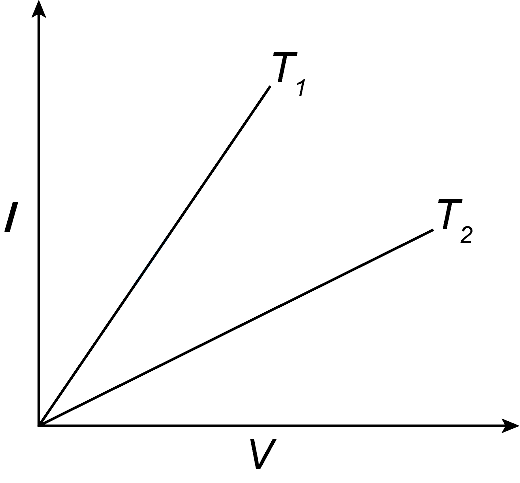
- The \(I\) - \(V\) characteristics of a metal wire at two different temperatures \(\left(T_{1}\right.\) and \(T_{2}\) ) are given in the adjoining figure. Here, we can conclude that
 WBJEE 2012 Easy