


WBJEE · Maths · Matrices
If \(I=\left(\begin{array}{ccc}1 & 0 & 0 \\ 0 & 1 & 0 \\ 0 & 0 & 1\end{array}\right)\) and \(P=\left(\begin{array}{ccc}1 & 0 & 0 \\ 0 & -1 & 0 \\ 0 & 0 & -2\end{array}\right)\) Then, the matrix \(P^{3}+2 P^{2}\) is equal to
- A P
- B I-P
- C \(2I+P\)
- D \(2I-P\)
Answer & Solution
Correct Answer
(C) \(2I+P\)
Step-by-step Solution
Detailed explanation
Given, \(I=\left(\begin{array}{lll}1 & 0 & 0 \\ 0 & 1 & 0 \\ 0 & 0 & 1\end{array}\right)\) and \(P=\left(\begin{array}{ccc}1 & 0 & 0 \\ 0 & -1 & 0 \\ 0 & 0 & -2\end{array}\right)\) The characteristic equation of \(P\) is \[ |P-\lambda|=0 \]…
See the Complete Solution
Get step-by-step explanations for this and 2.5 Lakh+ more JEE, NEET & CET questions.
- Unlock all solutions
- Practice the full chapter
- Track accuracy across PYQs
4.8 rated on Google Play · 14,000+ reviews
More questions from Maths
- If \(\mathrm{I}_1=\int_0^{3 \pi} \mathrm{f}\left(\cos ^2 \mathrm{x}\right) \mathrm{dx}\) and \(\mathrm{I}_2=\int_0^\pi \mathrm{f}\left(\cos ^2 \mathrm{x}\right) \mathrm{dx}\), thenWBJEE 2010 Easy
- The locus of points \((x, y)\) in the plane satisfying \(\sin ^2 x+\sin ^2 y=1\) consists ofWBJEE 2023 Hard
- The maximum value of \(f(x)=e^{\sin x}+e^{\cos x} ; x \in R\) isWBJEE 2022 Medium
- \(\triangle O A B\) is an equilateral triangle inscribed in the parabola \(y^2=4 a x, a\gt0\) with \(O\) as the vertex, then the length of the side of \(\triangle \mathrm{OAB}\) isWBJEE 2024 Medium
- If \({ }^n C_4,{ }^n C_5\) and \({ }^n C_6\) are in A.P., then \(n\) isWBJEE 2011 Easy
- Let \(p, q\) and \(r\) be the sides opposite to the angles \(P, Q\) and \(R,\) respectively in a \(\Delta P Q R .\) If \(r^{2} \sin P \sin Q=p q,\) then the triangle isWBJEE 2012 Easy
More PYQs from WBJEE
-
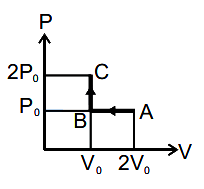
Consider the P-V diagram for 1 mole of an ideal monatomic gas shown in the figure. Which of the following statements is/are true?WBJEE 2021 Medium - A particle of mass \(M\) and charge \(q\), initially at rest, is accelerated by a uniform electric field \(E\) through a distance \(D\) and is then allowed to approach a fixed static charge \(Q\) of the same sign. The distance of the closest approach of the charge \(q\) will then beWBJEE 2013 Medium
- The reagents to carry out the following conversion are
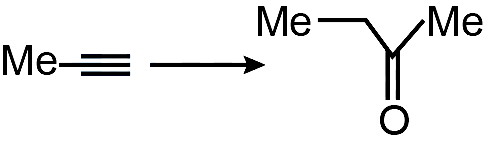 WBJEE 2014 Easy
 - p-nitro-N, N - dimethylaniline cannot be represented by the resonating structures
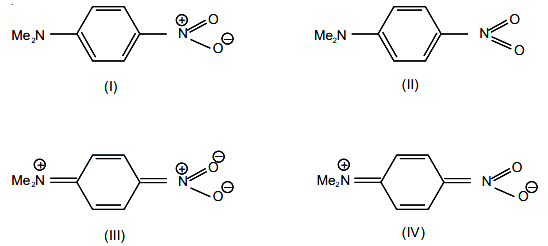 WBJEE 2021 Medium
 - An alternating current in a circuit is given by \(I=20 \sin (100 \pi t+0.05 \pi)\) A. The r.m.s. value and the frequency of current respectively areWBJEE 2013 Easy
- Three different liquids are filled in a U-tube as shown in figure. Their densities are \(\rho_1, \rho_2\) and \(\rho_3\) respectively. From the figure we may conclude that
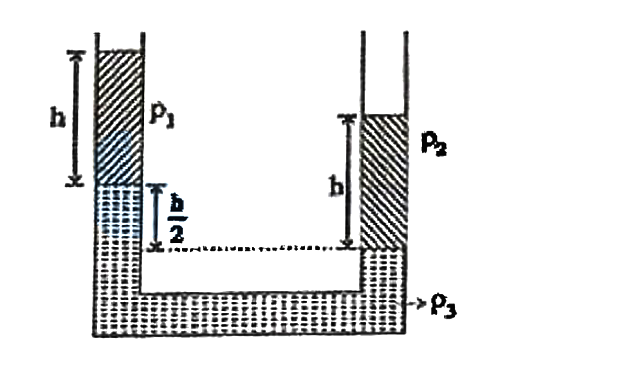 WBJEE 2025 Medium