


WBJEE · Maths · Quadratic Equation
If \(\sin \alpha, \cos \alpha\) be the roots of the equation \(x^{2}-b x+c=0 .\) Then, which of the following statements is/are correct?
- A \(c \leq \frac{1}{2}\)
- B \(b \leq \sqrt{2}\)
- C \(c>\frac{1}{2}\)
- D \(b>\sqrt{2}\)
Answer & Solution
Correct Answer
(B) \(b \leq \sqrt{2}\)
Step-by-step Solution
Detailed explanation
Given equation is \(x^{2}-b x+c=0\) and roots are \(\sin \alpha\) and \(\cos \alpha\) Also \(\sin \alpha+\cos \alpha=b\) and \(\sin \alpha \cdot \cos \alpha=c\)…
See the Complete Solution
Get step-by-step explanations for this and 2.5 Lakh+ more JEE, NEET & CET questions.
- Unlock all solutions
- Practice the full chapter
- Track accuracy across PYQs
4.8 rated on Google Play · 14,000+ reviews
More questions from Maths
- Let N be the number of quadratic equations with coefficients from {0, 1, 2, ....., 9) such that 0 is a solution of each equation. Then the value of N isWBJEE 2024 Medium
- If the equation \(x^{2}-ca+d=0\) has roots equal to the fourth powers of the roots of \(x^{2}+a x+b=0,\) where \(a^{2}>4 b,\) then the roots of \(x^{2}-4 b x+2 b^{2}-c=0\) will beWBJEE 2018 Medium
- A rectangle \(A B C D\) has its side parallel to the line \(y=2 x\) and vertices \(A, B, D\) are on lines \(y=1, x=1\) and \(x=-1\) respectively. The coordinate of \(C\) can beWBJEE 2023 Hard
- \(\vec{a}, \vec{b}, \vec{c}\) are non-coplanar vectors and \(\lambda\) is a real number then the vectors \(\vec{a}+2 \vec{b}+3 \vec{c}, \lambda \vec{b}+4 \vec{c}\) and \((2 \lambda-1) \vec{c}\) are non-coplanar forWBJEE 2025 Medium
- \(\int \frac{\mathrm{dx}}{\sin x+\sqrt{3} \cos x}\) equals
where \(\mathrm{c}\) is an arbitrary constantWBJEE 2009 Medium - Consider the equation \(y-y_1=m\left(x-x_1\right)\). If \(m\) and \(x_1\) are fixed and different lines are drawn for different values of \(y_1\), thenWBJEE 2022 Easy
More PYQs from WBJEE
- The \(\mathrm{sp}^3 \mathrm{~d}^2\) hybridization of central atom of a molecule would lead toWBJEE 2011 Easy
- An electron in Hydrogen atom jumps from the second Bohr orbit to the ground state and the difference between the energies of the two states is radiated in the form of a photon. This photon strikes a material. If the work function of the material is 4.2 eV , then the stopping potential is (Energy of electron in n -th orbit \(=-\frac{13.6}{\mathrm{n}^2} \mathrm{eV}\) )WBJEE 2025 Medium
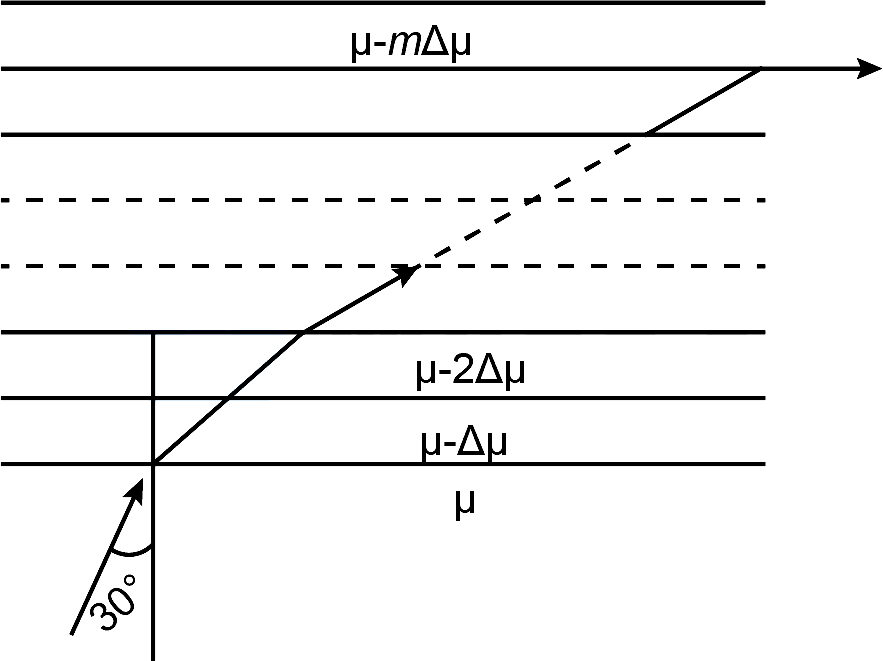
- A glass slab consists of thin uniform layers of progressively decreasing refractive indices RI (see figure) such that the RI of any layer is \(\mu-m \Delta \mu\). Here, \(\mu\) and \(\Delta \mu\) denote the \(\mathrm{RI}\) of 0 th layer and the difference in RI between any two consecutive layers, respectively. The integer \(m=0,1,2,3, \ldots\) denotes the numbers of the successive layers. A ray of light from the oth layer enters the 1st layer at an angle of incidence of \(30^{\circ}\). After undergoing the mth refraction, the ray emerges parallel to the interface. If \(\mu=1.5\) and \(\Delta \mu=0.015,\) the value of \(m\) is
 WBJEE 2014 Medium
 - A fair six-faced die is rolled 12 times. The probability that each face turns up twice is equal toWBJEE 2014 Hard
- 3 moles of mono-atomic gas \((\gamma=5 / 3)\) is mixed with 1 mole of a diatomic gas \((\gamma=7 / 3) .\) The value of \(\gamma\) for the mixture will beWBJEE 2013 Easy
- Calculate \(\mathrm{K}_{\mathrm{C}}\) for the reversible process given below if \(\mathrm{K}_{\mathrm{P}}=167\) and \(\mathrm{T}=800^{\circ} \mathrm{C}\)
\(\mathrm{CaCO}_3(\mathrm{~s}) \rightleftharpoons \mathrm{CaO}(\mathrm{s})+\mathrm{CO}_2(\mathrm{~g})\)WBJEE 2010 Easy