


WBJEE · Maths · Quadratic Equation
If the equation \(x^{2}-ca+d=0\) has roots equal to the fourth powers of the roots of \(x^{2}+a x+b=0,\) where \(a^{2}>4 b,\) then the roots of \(x^{2}-4 b x+2 b^{2}-c=0\) will be
- A both real
- B both negative
- C both positive
- D one positive and one negative
Answer & Solution
Correct Answer
(D) one positive and one negative
Step-by-step Solution
Detailed explanation
Let \(\alpha\) and \(\beta\) are the roots of \(x^{2}+a x+b=0\) and the roots of \(x^{2}-cx+d=0\) are \(\alpha^{4}\) and \(\beta^{4}\) Now, \(\alpha+\beta=-a, \alpha \beta=b\) ...(i) and \(\alpha^{4}+\beta^{4}-c, \alpha^{4} \beta^{4}=d\) ...(ii) From Eqs. (i) and (ii),…
See the Complete Solution
Get step-by-step explanations for this and 2.5 Lakh+ more JEE, NEET & CET questions.
- Unlock all solutions
- Practice the full chapter
- Track accuracy across PYQs
4.8 rated on Google Play · 14,000+ reviews
More questions from Maths
- If the sum of the squares of the roots of the equation \(x^2-(a-2) x-(a+1)=0\) is least for an appropriate value of the variable parameter \(a\), then the value of ' \(a\) ' will beWBJEE 2025 Medium
- Product of any \(r\) consecutive natural numbers is always divisible byWBJEE 2009 Medium
- Let \(I=\int_{0}^{{100 \pi }} \sqrt{(1-\cos 2 x)} d x\), thenWBJEE 2017 Medium
- The equation of the chord of the circle \(x^2+y^2-4 x=0\) whose mid point is \((1,0)\) isWBJEE 2009 Easy
- If \(\mathrm{a}=2 \sqrt{2}, \mathrm{~b}=6, \mathrm{~A}=45^{\circ}\), thenWBJEE 2009 Medium
- If 64,27,36 are the Pth \(Q\) th and \(R\) th terms of a GP, then \(P+2 Q\) is equal toWBJEE 2012 Easy
More PYQs from WBJEE
- If \({ }^{\mathrm{n}-1} \mathrm{C}_3+{ }^{\mathrm{n}-1} \mathrm{C}_4>{ }^{\mathrm{n}} \mathrm{C}_3\), then \(\mathrm{n}\) is just greater than integerWBJEE 2010 Hard
- If the velocity of light in vacuum is \(3 \times 10^{8} \mathrm{ms}^{-1}\), the time taken (in nanosecond) to travel through a glass plate of thickness \(10 \mathrm{cm}\) and refractive index 1.5 isWBJEE 2012 Easy
- Let \(A(-1,0)\) and \(B(2,0)\) be two points. \(A\) point \(M\) moves in the plane in such a way that \(\angle M B A=2 \angle M A B .\) Then, the point \(M\) moves alongWBJEE 2017 Medium
- The number of ways in which the letters of the word ARRANGE can be permuted such that the R's occur together, isWBJEE 2016 Medium
-
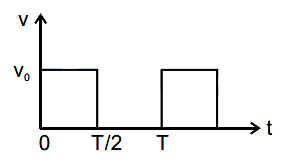
The rms value of potential difference \(v\) shown in the figure isWBJEE 2021 Easy - If \(\sin ^{2} \theta+3 \cos \theta=2,\) then \(\cos ^{3} \theta+\sec ^{3} \theta\) is equal out toWBJEE 2013 Hard