


WBJEE · Maths · Quadratic Equation
If \(\alpha\) and \(\beta\) are the roots of the quadratic equation \(a x^{2}+b x+c=0\) and \(3 b^{2}=16 a c\) then
- A \(\alpha=4 \beta\) or \(\beta=4 \alpha\)
- B \(\alpha=-4 \beta\) or \(\beta=-4 \alpha\)
- C \(\alpha=3 \beta\) or \(\beta=3 \alpha\)
- D \(\alpha=-3 \beta\) or \(\beta=-3 \alpha\)
Answer & Solution
Correct Answer
(C) \(\alpha=3 \beta\) or \(\beta=3 \alpha\)
Step-by-step Solution
Detailed explanation
Given that, \((\alpha, \beta)\) are roots of the quadratic equation and \(\begin{aligned} a x^{2}+b x+c &=0 \\ 3 b^{2} &=16 a c \end{aligned}\) \(\therefore\) \(\alpha+\beta=\frac{-b}{a}\) and \(\alpha \beta=\frac{c}{a}\) From Eq. (i), we get…
See the Complete Solution
Get step-by-step explanations for this and 2.5 Lakh+ more JEE, NEET & CET questions.
- Unlock all solutions
- Practice the full chapter
- Track accuracy across PYQs
4.8 rated on Google Play · 14,000+ reviews
More questions from Maths
- \(\int_\pi^{16 \pi}|\sin x| d x=\)WBJEE 2011 Easy
- Let \(\left(1+x+x^{2}\right)^{9}=a_{0}+a_{1} x+a_{2} x^{2}\)
\(+\ldots+a_{18} x^{18} \cdot\) ThenWBJEE 2017 Medium - If \(P\) be a point on the parabola \(y^{2}=4 a x\) with focus \(F\). Let \(Q\) denote the foot of the perpendicular from \(P\) onto the directrix. Then, \(\frac{\tan \angle P Q F}{\tan \angle P F Q}\) isWBJEE 2013 Medium
- If the line \(a x+b y+c=0, a b \neq 0,\) is a tangent
to the curve \(x y=1-2 x,\) thenWBJEE 2017 Medium - Let \(\mathrm{A}=\left(\begin{array}{ccc}12 & 24 & 5 \\ \mathrm{x} & 6 & 2 \\ -1 & -2 & 3\end{array}\right) .\) The value of \(\mathrm{x}\) for which the matrix \(\mathrm{A}\) is not invertible isWBJEE 2020 Easy
- \(B\) is an extremity of the minor axis of an ellipse whose foci are \(S\) and \(S^{\prime} .\) If \(\angle S B S^{\prime}\) is a right angle, then the eccentricity of the ellipse isWBJEE 2017 Medium
More PYQs from WBJEE
- For \(0 \leq P, Q \leq \frac{\pi}{2},\) if \(\sin P+\cos Q=2\), then the
value of \(\tan \left(\frac{\vec{P}+Q}{2}\right)\) is equal toWBJEE 2013 Medium - In which of the following reactions new carbon-carbon bond is not formed :WBJEE 2009 Easy
- The bob of a pendulum of mass \(m\), suspended by an inextensible string of length \(L\) as shown in the figure carries a small charge \(a\). An infinite horizontal plane conductor with uniform surface charge density \(\sigma\) is placed below it. What will be the time period of the pendulum for small amplitude oscillations?
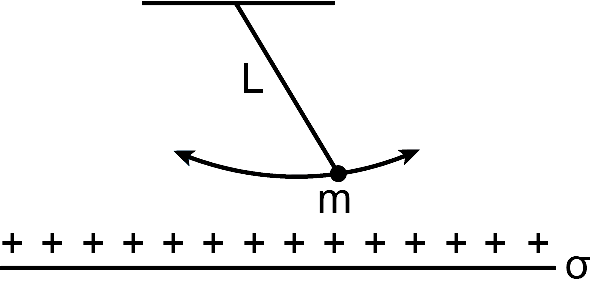 WBJEE 2018 Hard
 - A tennis ball hits the floor with a speed \(v\) at an angle \(\theta\) with the normal to the floor. If the collision is inelastic and the co-efficient of restitution is \(\varepsilon\), what will be the angle of reflection?WBJEE 2020 Easy
- For the reaction \(S O_2+\frac{1}{2} O_2=S O_3\), if we write \(K_p=K_c(R T)^x\), then \(\mathrm{x}\) becomesWBJEE 2009 Easy
- The value of the integration \(\int_{-\pi / 4}^{\pi / 4}\left(\lambda|\sin x|+\frac{\mu \sin x}{1+\cos x}+\gamma\right) d x\)WBJEE 2019 Medium