


WBJEE · Maths · Vector Algebra
If \(\vec{a}=\hat{i}+\hat{j}-\hat{k}, \vec{b}=\hat{i}-\hat{j}+\hat{k}\) and \(\vec{c}\) is unit vector perpendicular to \(\vec{a}\) and coplanar with \(\vec{a}\) and \(\vec{b}\), then unit vector \(\vec{d}\) perpendicular to both \(\vec{a}\) and \(\vec{c}\) is
- A \(\pm \frac{1}{\sqrt{6}}(2 \hat{i}-\hat{j}+\hat{k})\)
- B \(\pm \frac{1}{\sqrt{2}}(\hat{j}+\hat{k})\)
- C \(\pm \frac{1}{\sqrt{6}}(\hat{i}-2 \hat{j}+\hat{k})\)
- D \(\pm \frac{1}{\sqrt{2}}(\hat{j}-\hat{k})\)
Answer & Solution
Correct Answer
(B) \(\pm \frac{1}{\sqrt{2}}(\hat{j}+\hat{k})\)
Step-by-step Solution
Detailed explanation
\(\because \overrightarrow{\mathrm{d}}\) is normal to the plane of \(\overrightarrow{\mathrm{a}}\) and \(\overrightarrow{\mathrm{b}}\) \(\overrightarrow{\mathrm{a}} \times \overrightarrow{\mathrm{b}}\) or…
See the Complete Solution
Get step-by-step explanations for this and 2.5 Lakh+ more JEE, NEET & CET questions.
- Unlock all solutions
- Practice the full chapter
- Track accuracy across PYQs
4.8 rated on Google Play · 14,000+ reviews
More questions from Maths
- Which of the following statements is /are correct for \(0 < \theta < \frac{\pi}{2} ?\)WBJEE 2015 Easy
- The equation of the directrices of the hyperbola \(3 x^{2}-3 y^{2}-18 x+12 y+2=0\) isWBJEE 2019 Easy
- Consider the non-constant differentiable function \(f\) of one variable which obeys the relation \(\frac{f(x)}{f(y)}=f(x-y) .\) If \(f^{\prime}(0)=p\) and \(f^{\prime}(5)=q,\) then \(f^{\prime}(-5)\) isWBJEE 2017 Medium
- A function \(f: \mathbb{R} \rightarrow \mathbb{R}\), satisfies \(f\left(\frac{x+y}{3}\right)=\frac{f(x)+f(y)+f(0)}{3}\) for all, \(x, y \in \mathbb{R}\). If the function ' \(f\) ' is differentiable at \(x=\) 0 , then \(f\) isWBJEE 2025 Hard
- The points \((-a,-b),(a, b),(0,0)\) and \(\left(a^{2}, a b\right), a \neq 0, b \neq 0\) are alwaysWBJEE 2016 Medium
- Let the eccentricity of the hyperbola \(\frac{x^{2}}{a^{2}}-\frac{y^{2}}{b^{2}}=1\) be reciprocal to that of the ellipse \(x^{2}+9 y^{2}=9,\) then the ratio \(a^{2}: b^{2}\) equalsWBJEE 2018 Easy
More PYQs from WBJEE
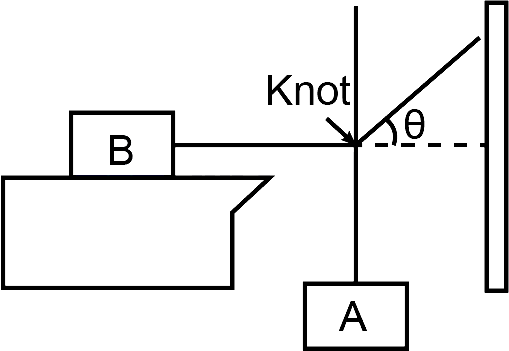
- Block \(B\) lying on a table weighs W. The coefficient of static friction between the block and the table is \(\mu\). Assume that the cord between \(B\) and the knot is horizontal. The maximum weight of the block \(A\) for which the system will be stationary is
 WBJEE 2015 Medium
 - The line segment joining the foci of the hyperbola \(x^{2}-y^{2}+1=0\) is one of the diameters of a circle. The equation of the circle isWBJEE 2017 Medium
- Identify the correct statement(s):WBJEE 2019 Hard
- In \(\mathbb{R}\), a relation \(p\) is defiened as follows :
\(\forall a, b \in \mathbb{R}\), a p b holds if \(a^2-4 a b+3 b^2=0\). ThenWBJEE 2024 Easy - A bullet of mass \(m\) travelling with a speed \(v\) hits a block of mass \(M\) initially at rest and gets embedded in it. The combined system is free to move and there is no other force acting on the system. The heat generated in the process will beWBJEE 2013 Easy
- Let \(\mathrm{A}=\{\mathrm{x} \in \mathbb{R}:-1 \leq \mathrm{x} \leq 1\} \& \mathrm{f}: \mathrm{A} \rightarrow \mathrm{A}\) be a mapping defined by \(\mathrm{f}(\mathrm{x})=\mathrm{x}|\mathrm{x}| .\) Then \(\mathrm{f}\) isWBJEE 2020 Medium