


WBJEE · Maths · Probability
A and \(\mathrm{B}\) are independent events. The probability that both A and \(\mathrm{B}\) occur is \(\frac{1}{20}\) and the probability that neither of them occurs is \(\frac{3}{5}\). The probability of occurrence of \(\mathrm{A}\) is
- A \(\frac{1}{2}\)
- B \(\frac{1}{10}\)
- C \(\frac{1}{4}\)
- D \(\frac{1}{5}\)
Answer & Solution
Correct Answer
(D) \(\frac{1}{5}\)
Step-by-step Solution
Detailed explanation
\(P(A \cap B)=P(A) P(B)=\frac{1}{20} \Rightarrow P(B)=\frac{1}{2 O P(A)}\) \(P(\bar{A} \cap \bar{B})=\frac{3}{5}=1-P(A \cup B)\) \(\Rightarrow \frac{3}{5}=1-P(A)-P(B)+P(A \cap B)\) \(\Rightarrow \frac{3}{5}=1-P(A)-\frac{1}{20 P(A)}+\frac{1}{20}\)…
See the Complete Solution
Get step-by-step explanations for this and 2.5 Lakh+ more JEE, NEET & CET questions.
- Unlock all solutions
- Practice the full chapter
- Track accuracy across PYQs
4.8 rated on Google Play · 14,000+ reviews
More questions from Maths
- \(\int \frac{\log \sqrt{\mathrm{x}}}{3 \mathrm{x}} \mathrm{dx}\) is equal toWBJEE 2010 Easy
- The area of the region lying above \(X\) -axis, and included between the circle \(x^{2}+y^{2}=2 a x\) and the parabola \(y^{2}=a x, a>0\) isWBJEE 2018 Medium
- If \(\int_{-1}^4 f(x) d x=4\) and \(\int_2^4\{3-f(x)\} d x=7\) then the value of \(\int_{-1}^2 \mathrm{f}(\mathrm{x}) \mathrm{dx}\)WBJEE 2009 Easy
- The general solution of the differential equation \(\frac{d y}{d x}=e^{y+x}+e^{y-x}\) is
where \(c\) is an arbitrary constantWBJEE 2009 Easy - \(\int \frac{d x}{x(x+1)}\) equals
where \(c\) is an arbitrary constant.WBJEE 2009 Medium - Let \(A\) and \(B\) be two square matrices of order 3 and \(A B=O_{3}\), where \(O_{3}\) denotes the null matrix of order 3. Then,WBJEE 2019 Easy
More PYQs from WBJEE
- Which of the following ion/ions is/are diamagnetic?WBJEE 2024 Medium
- If \(P_1 P_2\) and \(P_3 P_4\) are two focal chords of the parabola \(y^2=4 a x\) then the chords \(P_1 P_3\) and \(P_2 P_4\) intersect on theWBJEE 2022 Medium
- The position vectors of the points \(A, B, C\) and \(D\) are \(3 \hat{\mathbf{i}}-2 \hat{\mathbf{j}}-\hat{\mathbf{k}}, 2 \hat{\mathbf{i}}-3 \hat{\mathbf{j}}+2 \mathbf{k}, \hat{\mathbf{i}}-\hat{\mathbf{j}}+2 \hat{\mathbf{k}}\) and \(4 \hat{\mathbf{i}}-\hat{\mathbf{j}}-\lambda \hat{\mathbf{k}},\) respectively. If the points \(A, B, C\) and \(D\) lie on a plane, the value of \(\lambda\) isWBJEE 2019 Medium
- The minimum force required to start pushing a body up a rough (having co-efficient of friction \(\mu\) ) inclined plane is \(\vec{F}_1\) while the minimum force needed to prevent it from sliding is \(\vec{F}_2\). If the inclined plane makes an angle \(\theta\) with the horizontal such that \(\tan \theta=2 \mu\), then the ratio \(F_1 / F_2\) isWBJEE 2025 Medium
- The conversion of \(\mathrm{CH}_{3}-\mathrm{CH}_{2}-\mathrm{COOH}\) to
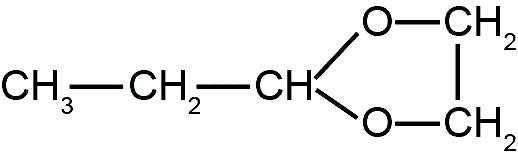
can be accomplished byWBJEE 2017 Easy - Two elements \(A\) and \(B\) with atomic numbers \(Z_{A}\) and \(Z_{B}\) are used to produce characteristic X-rays with frequencies \(v_{A}\) and \(v_{B}\) respectively. If \(Z_{A}: Z_{B}=1: 2,\) then \(v_{A}: v_{B}\) will beWBJEE 2012 Medium