


WBJEE · Chemistry · Chemical Kinetics
Under the same reaction conditions, initial concentration of \(1.386 \mathrm{~mol} \mathrm{dm}^{-3}\) of a substance becomes half in \(40 \mathrm{~s}\) and 20 s through first-order and zero-order kinetics respectively. Ratio \(\left(\frac{k_{1}}{k_{0}}\right)\) of the rate constants for first-order \(\left(k_{1}\right)\) and zero-order \(\left(\mathrm{k}_{0}\right)\) of the reactions is
- A \(0.5 \mathrm{~mol}^{-1} \mathrm{dm}^{3}\)
- B \(0.5 \mathrm{~mol} \mathrm{dm}^{-3}\)
- C \(1.0 \mathrm{~mol} \mathrm{dm}^{-3}\)
- D \(2.0 \mathrm{~mol}^{-1} \mathrm{dm}^{3}\)
Answer & Solution
Correct Answer
(A) \(0.5 \mathrm{~mol}^{-1} \mathrm{dm}^{3}\)
Step-by-step Solution
Detailed explanation
For First order reaction \(\mathrm{t}_{1 / 2}=\frac{0.693}{\mathrm{k}_{1}} \Rightarrow \mathrm{k}_{1}=\frac{0.693}{40} \mathrm{~s}^{-1}\quad_{-} \text {(i) }\) For Zero order reaction…
See the Complete Solution
Get step-by-step explanations for this and 2.5 Lakh+ more JEE, NEET & CET questions.
- Unlock all solutions
- Practice the full chapter
- Track accuracy across PYQs
4.8 rated on Google Play · 14,000+ reviews
More questions from Chemistry
- In a periodic table the basic character of oxidesWBJEE 2010 Easy
- An ideal gas expands adiabatically against vaccum. Which of the following is correct for the given process?WBJEE 2020 Easy
- If electrolysis of aqueous CuSO \(_{4}\) solution is carried out using Cu-electrodes, the reaction taking place at the anode isWBJEE 2019 Easy
- In \(\mathrm{SOCl}_{2}\), the \(\mathrm{Cl} - \mathrm{S}-\mathrm{Cl}\) and \(\mathrm{Cl}-\mathrm{S}-\mathrm{O}\)
bond angles areWBJEE 2013 Easy - What type of orbital hybridisation is considered on \(\mathrm{P}\) in \(\mathrm{PCl}_5\) ?WBJEE 2010 Easy
- \(\mathrm{N}_{2} \mathrm{H}_{4}\) and \(\mathrm{H}_{2} \mathrm{O}_{2}\) show similarity inWBJEE 2021 Easy
More PYQs from WBJEE
- If \(y=e^{-x} \cos 2 x\), then which of the following differential equation is satisfied?WBJEE 2015 Easy
- The letters of the word 'COCHIN' are permuted and all the permutations are arranged in alphabetical order as in English dictionary. The number of words that appear before the word 'COCHIN', isWBJEE 2015 Easy
- Two solid spheres \(S_{1}\) and \(S_{2}\) of same uniform density fall from rest under gravity in a viscous medium and after some time, reach terminal velocities \(v_{1}\) and \(v_{2}\) respectively. If ratio of masses \(\frac{m_{1}}{m_{2}}=8\), then \(\frac{v_{1}}{v_{2}}\) will be equal toWBJEE 2021 Easy
- Two massless springs of force constants \(\mathrm{K}_1\) and \(\mathrm{K}_2\) are joined end to end. The resultant force constant \(\mathrm{K}\) of the system isWBJEE 2009 Easy
- Let \(f\) be a non-constant continuous function for all \(x \geq 0\). Let \(f\) satisfy the relation \(f(x) f(a-x)=1\) for some \(a \in R^{+}\). Then, \(I=\int_{0}^{a} \frac{d x}{1+f(x)}\) is equal toWBJEE 2017 Medium
- In the electrical circuit shown in the figure, the current through the \(4 \Omega\) resistor is
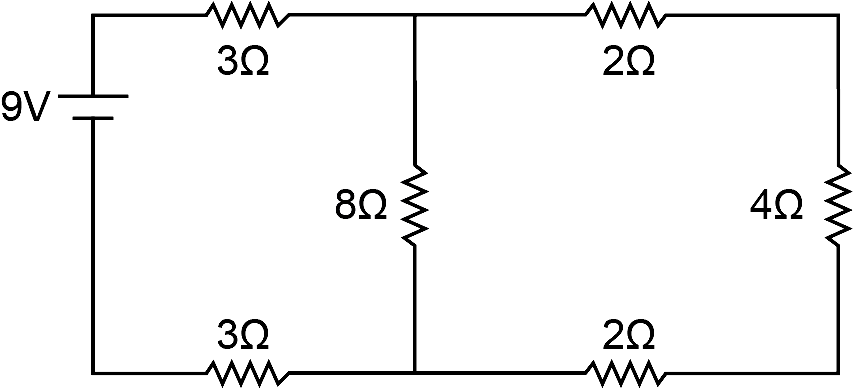 WBJEE 2013 Medium