


WBJEE · Chemistry · d and f Block Elements
The metal which can be used to obtain metallic Cu from aqueous CuSO \(_{4}\) solution is
- A Na
- B Ag
- C Hg
- D Fe
Answer & Solution
Correct Answer
(D) Fe
Step-by-step Solution
Detailed explanation
Iron (Fe) is used to obtain Curmetal from CuSO, (aq) because Fe is more reactive than Cu (and also easly available and is cheaper) thus, replace the copper from CuSO \(_{4}\) to give copper (Cu)…
See the Complete Solution
Get step-by-step explanations for this and 2.5 Lakh+ more JEE, NEET & CET questions.
- Unlock all solutions
- Practice the full chapter
- Track accuracy across PYQs
4.8 rated on Google Play · 14,000+ reviews
More questions from Chemistry
- Addition of excess potassium iodide solution to a solution of mereuric chloride gives the halide complexWBJEE 2013 Medium
- Ribose and 2 -deoxyribose can be differentiated byWBJEE 2013 Medium
- For a spontaneous process, the incorrect statement isWBJEE 2024 Easy
- Which of the following statement(s) is/are incorrect:WBJEE 2020 Hard
- The reagents to carry out the following conversion are
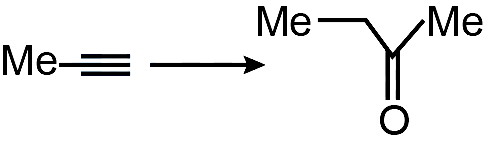 WBJEE 2014 Easy
 - The value of \(\Delta H\) for cooling 2 mole of an ideal monoatomic gas from \(225^{\circ} \mathrm{C}\) to \(125^{\circ} \mathrm{C}\) at constant pressure will be [given \(\left.C_{p}=\frac{5}{2} R\right]\)WBJEE 2014 Easy
More PYQs from WBJEE
- A common emitter transistor amplifier is connected with a load resistance of \(6 \mathrm{k} \Omega\). When a small a.c. signal of 15 \(\mathrm{mV}\) is added to the base emitter voltage, the alternating base current is \(20 \mu \mathrm{A}\) and the alternating collector current is \(1.8 \mathrm{~mA}\). What is the voltage gain of the amplifier?WBJEE 2020 Medium
- In \(\mathrm{a} \triangle \mathrm{ABC}, 2 \operatorname{acsin} \frac{\mathrm{A}-\mathrm{B}+\mathrm{C}}{2}\) is equal toWBJEE 2010 Medium
- A plane progressive wave is given by \(y=2 \cos 6.284(330 \mathrm{t}-\mathrm{x})\). What is period of the wave?WBJEE 2011 Easy
- An electron in a circular orbit of radius \(0.05 \mathrm{nm}\) performs \(10^{16}\) revolutions per second. The maghetic moment due to this rotation of electron is (in \(\mathrm{Am}^{2}\) )WBJEE 2014 Easy
- The solution of the differential equation \(\left(y^{2}+2 x\right) \frac{d y}{d x}=y\) satisfies \(x=1, y=1\). Then the solution isWBJEE 2013 Medium
- Let \(z_1\) and \(z_2\) be two non-zero complex numbers. ThenWBJEE 2022 Easy