


WBJEE · Maths · Application of Derivatives
Let \(f:[a, b] \rightarrow \mathbb{R}\) be continuous in \([a, b]\), differentiable in \((a, b)\) and \(f(a)=0=f(b)\). Then
- A there exists at least one point \(c \in(a, b)\) for which \(f^{\prime}(c)=f(c)\)
- B \(f^{\prime}(x)=f(x)\) does not hold at any point of \((a, b)\)
- C at every point of \((a, b), f^{\prime}(x)>f(x)\)
- D at every point of \((a, b), f^{\prime}(x) < f(x)\)
Answer & Solution
Correct Answer
(A) there exists at least one point \(c \in(a, b)\) for which \(f^{\prime}(c)=f(c)\)
Step-by-step Solution
Detailed explanation
\(:\) Let \(g(x)=e^{-x} f(x)\) \[ \mathrm{g}(\mathrm{a})=\mathrm{g}(\mathrm{b})=0 \] By Rolle's theorem, for atleast one \(c \in(a, b)\) where \(\mathrm{g}^{\prime}(\mathrm{c})=0\) or \(e^{-c} f^{\prime}(c)-f(c) e^{-c}=0\) or \(e^{-c}\left(f^{\prime}(c)-f(c)\right)=0\) or…
See the Complete Solution
Get step-by-step explanations for this and 2.5 Lakh+ more JEE, NEET & CET questions.
- Unlock all solutions
- Practice the full chapter
- Track accuracy across PYQs
4.8 rated on Google Play · 14,000+ reviews
More questions from Maths
- The value of \(\lim _{x \rightarrow 0^{+}} \frac{x}{p}\left[\frac{q}{x}\right]\) isWBJEE 2019 Easy
- The value of \(\lim _{x \rightarrow 2} \int_{2}^{x} \frac{3 t^{2}}{(x-2)} d t\) isWBJEE 2015 Easy
- A determinant is chosen at random from the set of all determinants of order 2 with elements 0 or 1 only. The probability that the determinant chosen is non-zero isWBJEE 2022 Hard
- The solution of \(25 \frac{d^{2} y}{d x^{2}}-10 \frac{d y}{d x}+y=0\), \(y(0)=1, y(1)=2 e^{1 / 5}\) isWBJEE 2012 Medium
- The remainder obtained when \(11+2 !+95 !\) is divided by 15 isWBJEE 2012 Easy
- A bulb is placed at the centre of a circular track of radius \(10 \mathrm{~m}\). A vertical wall is erected touching the track at a point P. A man is running along the track with a speed of \(10 \mathrm{~m} / \mathrm{sec}\). Starting from \(\mathrm{P}\) the speed with which his shadow is running along the wall when he is at an angular distance of \(60^{\circ}\) from \(P\) isWBJEE 2021 Medium
More PYQs from WBJEE
- A particle starts moving from rest from a fixed point in a fixed direction. The distance s from the fixed point at a timet is given by \(s=t^{2}+a t-b+17,\) where \(a\) and \(b\) are real numbers. If the particle comes to rest after 5s at a distance of \(s=25\) units from the fixed point, then values of \(a\) and \(b\) are. respectivelyWBJEE 2015 Easy
- In hemoglobin the metal ion present isWBJEE 2010 Easy
- The potential of a hydrogen electrode at \(\mathrm{pH}=10\) isWBJEE 2010 Medium
- The differential of \(f(x)=\log _{e}\left(1+e^{10 x}\right)-\tan ^{-1}\left(e^{5 x}\right)\) at \(x=0\) and for \(d x=0.2\) isWBJEE 2021 Medium
-
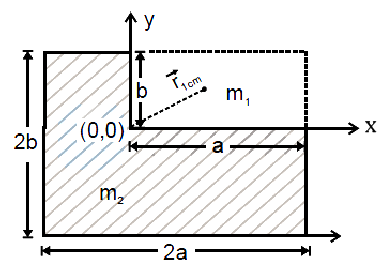
The position of the centre of mass of the uniform plate as shown in the figure isWBJEE 2024 Medium - The number of solution(s) of the equation \(\sqrt{x+1}-\sqrt{x-1}=\sqrt{4 x-1}\) is/areWBJEE 2014 Easy