


WBJEE · Chemistry · General Organic Chemistry
Among the following statements about the molecules \(X\) and \(Y\), the one(s) which correct is (are) 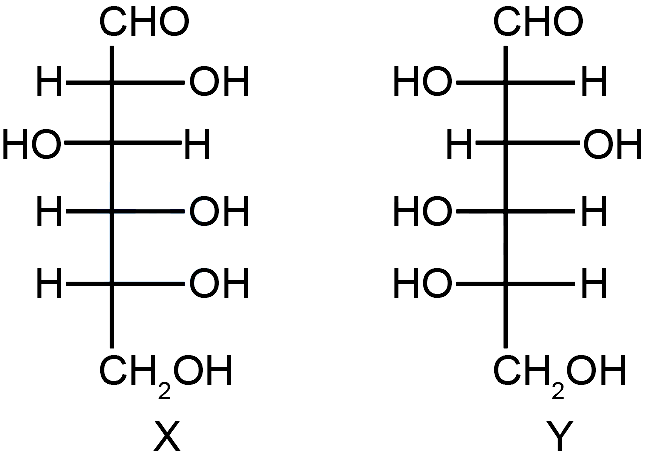
- A \(X\) and \(Y\) are diastereomers
- B \(X\) and \(Y\) are enantiomers
- C \(X\) and \(Y\) are both aldohexoses
- D \(X\) is a D-sugar and \(Y\) is an L-sugar
Answer & Solution
Correct Answer
(D) \(X\) is a D-sugar and \(Y\) is an L-sugar
Step-by-step Solution
Detailed explanation
Both the given molecules contain 6 carbon atoms with an aldehyde group, so these are called aldohexoser, In \(X\), the \(-O H\) attached to second last carbon in on right hand side while in \(Y\) it is on left hand side, so \(x_{i j}\) D-sugar and \(Y\) is L-sugar, \(X\) and…
See the Complete Solution
Get step-by-step explanations for this and 2.5 Lakh+ more JEE, NEET & CET questions.
- Unlock all solutions
- Practice the full chapter
- Track accuracy across PYQs
4.8 rated on Google Play · 14,000+ reviews
More questions from Chemistry
- For making distinction between 2-pentanone and 3-pentanone the reagent to be employed isWBJEE 2009 Medium
- \([P] \stackrel{\text { Br }_{2}}{\longrightarrow} C_{2} \mathrm{H}_{4}\) Br \(_{2} \frac{\text { NaNH }_{2}}{\mathrm{NH}_{3}}\) ? \([Q]\)
\([Q] \frac{20 \% \mathrm{H}_{2} \mathrm{SO}_{4}}{\mathrm{Hg}^{2+} \cdot \Delta}[R] \stackrel{\mathrm{Zn}-\mathrm{Hg} / \mathrm{HC}}{\longrightarrow}[S]\)
The species \(P, Q, R\) and \(S\) respectively areWBJEE 2018 Medium - P and Q combines to form two compounds \(\mathrm{PQ}_2\) and \(\mathrm{PQ}_3\). If \(1 \mathrm{~g} \mathrm{P} Q_2\) is dissolved in 51 g benzene the depression of freezing point becomes \(0.8^{\circ} \mathrm{C}\). On the other hand if \(1 \mathrm{~g} \mathrm{PQ}_3\) is dissolved in 51 g of benzene, the depression of freezing point becomes \(0.625^{\circ} \mathrm{C}\). The atomic mass of \(P\) and \(Q\) are \(\left(\mathrm{K}_{\mathrm{f}}\right.\) of benzene \(\left.=5.1 \mathrm{~K} \mathrm{~kg} \mathrm{~mol}^{-1}\right)\)WBJEE 2025 Hard
- Hybridisation of central atom in \(\mathrm{NF}_3\) isWBJEE 2009 Easy
- Consider an electron moving in the first Bohr orbit of a \(\mathrm{He}^{+}\)ion with a velocity \(\mathrm{v}_1\). If it is allowed to move in the third Bohr orbit with a velocity \(v_3\), then indicate the correct \(v_3: v_1\) ratioWBJEE 2024 Medium
- The indicated atom is not a nucleophilic site inWBJEE 2019 Easy
More PYQs from WBJEE
- An electric bulb, a capacitor, a battery and a switch are all in series in a circuit. How does the intensity of light vary when the switch is
turn on?WBJEE 2018 Easy - Which one of the following is the correct set of four quantum numbers \((n, l, m, s)\) ?WBJEE 2022 Easy
- The molar conductances of \(\mathrm{Ba}(\mathrm{OH})_2, \mathrm{BaCl}_2\) and \(\mathrm{NH}_4 \mathrm{Cl}\) at infinite dilution are \(523.28,280.0\) and \(129.8 \mathrm{~S} \mathrm{~cm}^2 \mathrm{~mol}^{-1}\) respectively. The molar conductance of \(\mathrm{NH}_4 \mathrm{OH}\) at infinite dilution will beWBJEE 2025 Medium
- General solution of \(\sin \mathrm{x}+\cos \mathrm{x}=\min _{a \in I R}\left\{1, a^2-4 a+6\right\}\) isWBJEE 2009 Hard
- A solution is saturated with \(\mathrm{SrCO}_{3}\) and \(\mathrm{Sr} \mathrm{F}_{2}\). The \(\left[\mathrm{CO}_{3}^{2-}\right]\) is found to be \(1.2 \times 10^{-3} \mathrm{M}\). The concentration of \(\mathrm{F}\) - in the solution would beWBJEE 2020 Hard
- Let \(X\) be a nonvoid set. If \(\rho_1\) and \(\rho_2\) be the transitive relations on \(X\), thenWBJEE 2023 Easy