


TS EAMCET · Physics · Ray Optics
What minimum separation between two objects a human eye would be able to resolve, if the eye pupil diameter is \(2 \mathrm{~mm}\) and the two objects are \(20 \mathrm{~m}\) away from the eye? (Assume, human eye to be equivalent to a convex lens and consider the average wave length of light as \(600 \mathrm{~nm}\) )
- A \(7.32 \mathrm{~mm}\)
- B \(8.72 \mathrm{~mm}\)
- C \(6.2 \mathrm{~mm}\)
- D \(4.71 \mathrm{~mm}\)
Answer & Solution
Correct Answer
(A) \(7.32 \mathrm{~mm}\)
Step-by-step Solution
Detailed explanation
Given, diameter of pupil, \(d=2 \mathrm{~mm}=2 \times 10^{-3} \mathrm{~m}\) \(D=20 \mathrm{~m}, \lambda=600 \mathrm{~nm}=6 \times 10^{-7} \mathrm{~m}\) For any aparture, limit of resolution is given as,…
See the Complete Solution
Get step-by-step explanations for this and 2.5 Lakh+ more JEE, NEET & CET questions.
- Unlock all solutions
- Practice the full chapter
- Track accuracy across PYQs
4.8 rated on Google Play · 14,000+ reviews
More questions from Physics
- A gas is suddenly compressed such that its absolute temperature is doubled. If the ratio of the specific heat capacities of the gas is 1.5, then the percentage decrease in the volume of the gas isTS EAMCET 2025 Medium
- A prism is made up of material of refractive index \(\sqrt{3}\). The angle of the prism is \(Å\). If the angle of minimum deviation is equal to the angle of the prism, then the value of \(A\) is:TS EAMCET 2002 Medium
- A copper rod of length \(75 \mathrm{~cm}\) and an iron rod of length \(125 \mathrm{~cm}\) are joined together end to end. Both are of circular cross-section with diameter \(2 \mathrm{~cm}\). The free ends of the copper and iron are maintained at \(100^{\circ} \mathrm{C}\) and \(0^{\circ} \mathrm{C}\) respectively. The surfaces of the bars are insulated thermally. The temperature of the copper-iron junction is [Thermal conductivity of copper is \(386.4 \mathrm{~W} / \mathrm{m}-\mathrm{K}\) and thermal conductivity of iron is \(48.46 \mathrm{~W} / \mathrm{m}-\mathrm{K}\) ]TS EAMCET 2015 Easy
- One end of a string is tied to the ceiling of a lift and a load is attached ai the bottom end of the string. When the lift is moving upwards with an acceleration of \(2.1 \mathrm{~ms}^{-2}\), the speed of the transverse wave at the lower end of the string is \(88 \mathrm{~ms}^{-1}\). If the lift moves downwards with an acceleration of \(1.9 \mathrm{~ms}^{-2}\), the speed of the transverse wave at the lower end of the string is \(\left(\mathrm{g}=10 \mathrm{~ms}^{-2}\right)\)TS EAMCET 2023 Medium
- The velocity of an object of mass \(2 \mathrm{~kg}\) is given by \(\mathbf{v}=\left(8 t \hat{\mathbf{i}}+3 t^2 \hat{\mathbf{j}}\right) \mathrm{m} / \mathrm{s}\), where \(t\) is time in seconds. What will be the direction of net force on the object relative to the positive direction of \(X\)-axis, at the instant when its magnitude is \(20 \mathrm{~N} ?\)TS EAMCET 2020 Medium
- The voltage gain of a transistor in common emitter configuration is 160 . The resistances in base and collector sides of the circuit are 1 kW and 4 kW respectively. If the change in base current is \(100 \mu \mathrm{~A}\), then the change in output current isTS EAMCET 2024 Medium
More PYQs from TS EAMCET
- A particle of charge 2 C is moving with a velocity of \((3 \hat{i}+4 \hat{j}) \mathrm{ms}^{-1}\) in the presence of magnetic and electric fields. If the magnetic field is \((\hat{i}+2 \hat{j}+3 \hat{k}) \mathrm{T}\) and the electric field is \((-2 \hat{k}) \mathrm{NC}^{-1}\), then the Lorentz force on the particle isTS EAMCET 2024 Easy
- Two charges \(+q\) and \(-q\) are kept apart. Then at any point on the right bisector of line joining the two chargesTS EAMCET 2008 Easy
- Assertion (A): When we bounce a ball on the ground, it comes to rest after a few bounces, losing all its energy. This is an example of violation of conservation of energy. Reason (R): Energy can change from one form to another but the total energy is always conserved. Which of the following is true?TS EAMCET 2018 Easy
- \(\mathrm{N}\) molecules each of mass \(\mathrm{m}\) of gas \(\mathrm{A}\) and \(2 \mathrm{~N}\) molecules each of mass \(2 \mathrm{~m}\) of gas \(\mathrm{B}\) are contained in a vessel which is maintained at temperature \(T\). The mean square velocity of the molecules of gas B is denoted by \(V_2^2\) and the mean square of the \(\mathrm{X}\)-component velocity of the molecules of gas \(A\) is denoted by \(V_1^2\), then \(\frac{V_1}{V_2}\) isTS EAMCET 2023 Medium
- A ball of mass \(0.2 \mathrm{~kg}\) is thrown from a height of \(1 \mathrm{~m}\) and with an initial velocity of \(\sqrt{10} \mathrm{~m} / \mathrm{s}\) at an angle of \(45^{\circ}\) with the horizontal. Assuming, acceleration due to gravity \(g=10 \mathrm{~m} /\) \(\mathrm{s}^2\), then modulus of momentum increment during the total time of motion in \(\mathrm{kg} \mathrm{m} / \mathrm{s}\) isTS EAMCET 2018 Easy
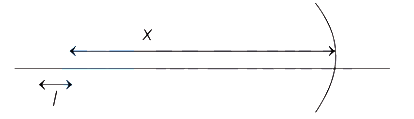
- A short straight object of length \(l\) lies along the central axis of a spherical concave mirror, at a distance \(X\) from the mirror. The focal length of the mirror is \(F\). If the length of the image in the mirror is \(l^{\prime}\), then ratio \(\left(\frac{l^{\prime}}{l}\right)\) is (assume, \(l< < \) and \(l< < F\) )
 TS EAMCET 2020 Easy