


TS EAMCET · Physics · Electrostatics
Two point charges of magnitudes \(-8 \mu \mathrm{C}\) and \(+32 \mu \mathrm{C}\) are separated by a distance of 15 cm in air. The position of the point from \(-8 \mu \mathrm{C}\) charge at which the resultant electric field becomes zero is
- A 15 cm
- B 30 cm
- C 7.5 cm
- D 5 cm
Answer & Solution
Correct Answer
(A) 15 cm
Step-by-step Solution
Detailed explanation
Let the charge be placed at a distance \(x\) from \(-8 \mu \mathrm{c}\) at which resultant electric field becomes zero \(\begin{aligned} & \therefore \frac{8}{4 \pi \varepsilon_0 x^2}=\frac{32}{4 \pi \varepsilon_0(15+x)^2} \\ & \Rightarrow \frac{x+15}{x}=2 \end{aligned}\) On…
See the Complete Solution
Get step-by-step explanations for this and 2.5 Lakh+ more JEE, NEET & CET questions.
- Unlock all solutions
- Practice the full chapter
- Track accuracy across PYQs
4.8 rated on Google Play · 14,000+ reviews
More questions from Physics
- From a uniform circular disc of radius \(2 \mathrm{~cm}\) (its centre of mass is at \(O\) ) a circular portion of radius \(1 \mathrm{~cm}\) is removed such that the shift in centre of mass is maximum. The disc is now rotated by an angle \(\theta\) about an axis perpendicular to its plane and passing through \(O\). If the magnitude of displacement of new centre of mass is \(\frac{1}{\sqrt{3}} \mathrm{~cm}\), then the \(\theta\) isTS EAMCET 2020 Hard
- The thermo emf of a hypothetical thermocouple varies with the temperature \(\theta\) of hot junction as \(E=a \theta+b \theta^2\) in volts, where the ratio \(a / b\) is \(700^{\circ} \mathrm{C}\). If the cold junction is kept at \(0^{\circ} \mathrm{C}\), then the neutral temperature isTS EAMCET 2011 Medium
- A body is moving up an inclined plane of angle \(\theta\) with an initial kinetic energy \(E\). The coefficient of friction between the plane and the body is \(u\). The work done against friction before the body comes to rest isTS EAMCET 2002 Hard
- Some physical constants are given in List-I and their dimensional formulae are given in List-II. Match the following
List-I
(1) Planck's constant
(2) Gravitational constant
(3) Bulk modulus
(4) Coefficient of viscosity
List-II
(i) \(\left[\mathrm{ML}^{-1} \mathrm{~T}^{-2}\right]\)
(ii) \(\left[\mathrm{ML}^{-1} \mathrm{~T}^{-1}\right]\)
(iii) \(\left[\mathrm{ML}^2 \mathrm{~T}^{-1}\right]\)
(iv) \(\left[\mathrm{M}^{-1} \mathrm{~L}^3 \mathrm{~T}^{-2}\right]\)
The correct answer isTS EAMCET 2007 Easy - The orbit of geo-stationary satellite is circular, the time period of satellite depends on (i) mass of the satellite (ii) mass of the earth (iii) radius of the orbit (iv) height of the satellite from the surface of earth Which of the following is correct?TS EAMCET 2008 Medium
- A solid sphere of mass 2 kg and radius 0.5 m is rolling without slipping on a horizontal surface. The ratio of the rotational and translational kinetic energies of the sphere isTS EAMCET 2025 Medium
More PYQs from TS EAMCET
- If a body is projected with an angle \(\theta\) to the horizontal, thenTS EAMCET 2008 Easy
- If the temperature of a gas is increased from \(27^{\circ} \mathrm{C}\) to \(159^{\circ} \mathrm{C}\), then the percentage increase in the rms speed of the gas molecules isTS EAMCET 2023 Easy
- When the engine is switched off a vehicle of mass \(M\) is moving on a rough horizontal road with momentum \(p\). If the coefficient of friction between the road and tyres of the vehicle is \(\mu_k\), the distance travelled by the vehicle before it comes to rest isTS EAMCET 2012 Easy
- A copper ball of radius \(3.0 \mathrm{~mm}\) falls in an oil tank of viscosity \(1 \mathrm{~kg} / \mathrm{ms}\). Then, the terminal velocity of the copper ball will be (Density of oil \(=1.5 \times 10^3 \mathrm{~kg} / \mathrm{m}^3\), Density of copper \(=9 \times 10^3 \mathrm{~kg} / \mathrm{m}^3\) and \(g=10 \mathrm{~m} / \mathrm{s}^2\).)TS EAMCET 2019 Easy
- A hydraulic lift as shown in the figure is used to lift a mass of \(1000 \mathrm{~kg}\), which is placed on a piston \(\left(P_1\right)\) of area \(1 \mathrm{~m}^2\). If the cross-section area of the piston \(\left(P_2\right)\) at the other end is \(0.01 \mathrm{~m}^2\), then how much mass needs to be put on it to lift the \(1000 \mathrm{~kg}\) ?
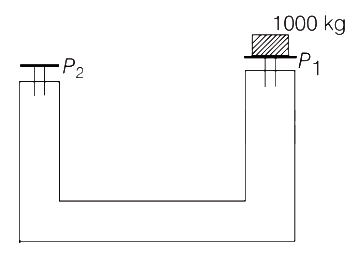 TS EAMCET 2020 Easy
 - Considering the Bohr's model of hydrogen atom, the ratio of velocities of electrons orbiting in the \(4^{\text {th }}\) orbit to that in the \(9^{\text {th }}\) orbit isTS EAMCET 2022 Easy