


TS EAMCET · Physics · Electromagnetic Induction
The thermo emf of a thermocouple is given by, \(E=a T+b T^2\), where \(\frac{a}{b}=-200^{\circ} \mathrm{C}\). If the cold function is kept at \(30^{\circ} \mathrm{C}\), then the inversion temperature is ( \(\varepsilon\) in volt, \(T\) in centigrade)
- A \(103 \mathrm{~K}\)
- B \(143 \mathrm{~K}\)
- C \(333 \mathrm{~K}\)
- D \(443 \mathrm{~K}\)
Answer & Solution
Correct Answer
(D) \(443 \mathrm{~K}\)
Step-by-step Solution
Detailed explanation
At temperature of inversion \(E=0\) \(\because \quad E=a T+b T^2\) \(\therefore \quad 0=a T+b T^2\) or \(\quad T=-\frac{a}{b}=200^{\circ} \mathrm{C}\) Because the cold function is kept at \(30^{\circ} \mathrm{C}\), then the inversion temperature…
See the Complete Solution
Get step-by-step explanations for this and 2.5 Lakh+ more JEE, NEET & CET questions.
- Unlock all solutions
- Practice the full chapter
- Track accuracy across PYQs
4.8 rated on Google Play · 14,000+ reviews
More questions from Physics
- In the given circuit, the equivalent resistance between \(\mathrm{A}\) and \(B\) is
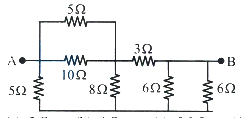 TS EAMCET 2023 Medium
 - Two coherent point sources \(S_1\) and \(S_2\) vibrating in phase emit light of wavelength \(\lambda\). The separation between them is \(2 \lambda\) as shown in figure. The first bright fringe is formed at \(P\) due to interference on a screen placed at a distance \(D\) from \(S_1(D>>\lambda)\), then \(O P\) is
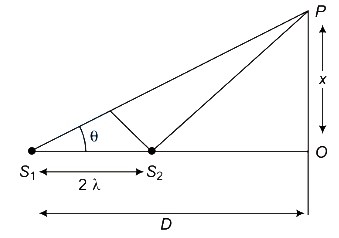 TS EAMCET 2012 Hard
 - A charge \(q\) enters a region having electric field \(\mathbf{E}\) and magnetic field \(\mathbf{B}\) with velocity \(\mathbf{v}\). If it continues to move with the same velocity, then which of the following statement is not trueTS EAMCET 2018 Easy
- Two parallel rails of a railway track insulated from each other and with the ground are connected to a millivoltmeter. The distance between the rails is one metre. A train is travelling with a velocity of \(72 \mathrm{~km} / \mathrm{h}\) along the track. The reading of the millivoltmeter (in \(\mathrm{mV}\) ) is (vertical component of the earth's magnetic induction is \(2 \times 10^{-5} \mathrm{~T}\) )TS EAMCET 2005 Hard
- The Fahrenheit and Kelvin scales of temperature will have the same reading at a temperature ofTS EAMCET 2023 Easy
- A very long wire carrying a current \(4 \sqrt{2} \mathrm{~A}\) is bent at a right angles. The magnitude of magnetic field ( \(|\mathbf{B}|)\) at a point \(P\) lying on a line perpendicular to the bent wire at a distance, \(d=20 \mathrm{~cm}\) from the point of the bending will be (Let \(\mu_0=4 \pi \times 10^{-7} \mathrm{H} / \mathrm{m}\) )
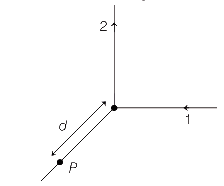 TS EAMCET 2019 Medium
More PYQs from TS EAMCET
- A wheel of radius \(0.4 \mathrm{~m}\) can rotate freely about its axis as shown in the figure. A string is wrapped over its rim and a mass of \(4 \mathrm{~kg}\) is hung. An angular acceleration of 8 rad- \(\mathrm{s}^{-2}\) is produced in it due to the torque. Then, moment of inertia of the wheel is \(\left(g=10 \mathrm{~ms}^{-2}\right)\)TS EAMCET 2009 Easy
- A stone is thrown vertically up from the top end of a window of height 1.8 m with a velocity of \(8 \mathrm{~ms}^{-1}\). The time taken by the stone to cross the window during its downward journey is (Acceleration due to gravity \(=10 \mathrm{~ms}^{-2}\) )TS EAMCET 2024 Medium
- A semi-infinite non conducting rod lies along -axis with its left end at the origin. The rod has uniform linear charge density The magnitude of electric field at a point on the -axis at the distance from the origin, will be
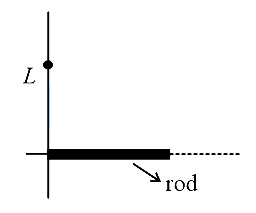 TS EAMCET 2021 Easy
 - A body of mass is executing simple harmonic motion (SHM). Its displacement (in ) at time t given by Its maximum kinetic energy isTS EAMCET 2021 Medium
- A conducting rod is moving towards right with a velocity ' \(\mathrm{V}\) ' in a uniform magnetic field ' \(\mathrm{B}\) '. If the direction of induced current ' \(\mathrm{i}\) ' is as shown in the figure, then the direction of ' \(\mathrm{B}\) ' is
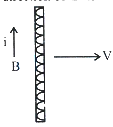 TS EAMCET 2023 Medium
 - At a given instant of time two particles are having the position vectors \(4 \hat{\mathbf{i}}+4 \hat{\mathbf{j}}+57 \hat{\mathbf{k}}\) metres and \(2 \hat{\mathbf{i}}+2 \hat{\mathbf{j}}+5 \hat{\mathbf{k}}\) respectively. If the velocity of the first particle be \(0.4 \hat{\mathbf{i}} \mathrm{ms}^{-1}\), the velocity of second particle in metre per second if they collide after \(10 \mathrm{sec}\) isTS EAMCET 2004 Medium