


TS EAMCET · Physics · Rotational Motion
Assume the earth's orbit around the sun as circular and the distance between their centres as \(D\). Mass of the earth is \(M\) and its radius is \(R\). If earth has an angular velocity \(\omega_0\) with respect to its centre and \(\omega\) with respect to the centre of the sun, the total kinetic energy of earth is :
- A \(\frac{M R^2 \omega_0^2}{5}\left[1+\left(\frac{\omega}{\omega_0}\right)^2+\frac{5}{2}\left(\frac{D \omega}{R \omega_0}\right)^2\right]\)
- B \(\frac{M R^2 \omega_0^2}{5}\left[1+\frac{5}{2}\left(\frac{D \omega}{R \omega_0}\right)^2\right]\)
- C \(\frac{2}{5} M R^2 \omega_0^2\left[1+\frac{5}{2}\left(\frac{D \omega}{R \omega_0}\right)^2\right]\)
- D \(\frac{2}{5} M R^2 \omega_0^2\left[1+\left(\frac{\omega}{\omega_0}\right)^2+\frac{5}{2}\left(\frac{D \omega}{R \omega_0}\right)^2\right]\)
Answer & Solution
Correct Answer
(B) \(\frac{M R^2 \omega_0^2}{5}\left[1+\frac{5}{2}\left(\frac{D \omega}{R \omega_0}\right)^2\right]\)
Step-by-step Solution
Detailed explanation
\((\mathrm{KE})_{\text {total }}=\frac{1}{2} \times \frac{2}{5} M R^2 \omega_0^2+\frac{1}{2} M R^2\left(\frac{D^2}{R^2}\right) \omega^2\) \(=\frac{M R^2 \omega_0^2}{5}\left[1+\frac{5}{2}\left(\frac{D \omega}{R \omega_0}\right)^2\right]\)
See the Complete Solution
Get step-by-step explanations for this and 2.5 Lakh+ more JEE, NEET & CET questions.
- Unlock all solutions
- Practice the full chapter
- Track accuracy across PYQs
4.8 rated on Google Play · 14,000+ reviews
More questions from Physics
- Materials suitable for permanent magnets, must have which of the following properties?TS EAMCET 2023 Easy
- A uniform disc of mass \(100 \mathrm{~kg}\) and radius \(2 \mathrm{~m}\) is rotating at \(1 \mathrm{rad} / \mathrm{s}\) about a perpendicular axis passing through its centre. A boy of mass \(60 \mathrm{~kg}\) standing at the centre of the disk suddenly jumps to a point which is \(1 \mathrm{~m}\) from the centre of the disc. The final angular velocity of the boy (in \(\mathrm{rad} / \mathrm{s}\) ) isTS EAMCET 2018 Easy
- When the right gap of a meter bridge consists of two equal resistors in series, the balancing point is at 50 cm. When one of the resistors in the right gap is removed and is connected in parallel to the resistor in the left gap, the balancing point is atTS EAMCET 2025 Medium
- The temperature on a Fahrenheit temperature scale that is twice the temperature on a Celsius temperature scale isTS EAMCET 2024 Easy
- A cubical block of wood, of length \(10 \mathrm{~cm}\), floats at the interface between oil of density \(800 \mathrm{~kg} / \mathrm{m}^3\) and water. The lower surface of the block is \(1.5 \mathrm{~cm}\) below the interface. If the depth of water is \(10 \mathrm{~cm}\) below the interface and oil is upto \(10 \mathrm{~cm}\) above the interface then the difference in pressure at the lower and the upper face of the wooden block is (Assume density of water, \(\rho=1000 \mathrm{~kg} / \mathrm{m}^3\) and acceleration of gravity, \(g=10 \mathrm{~m} / \mathrm{s}^2\) )
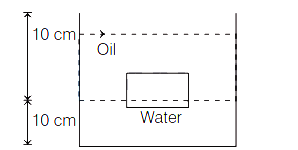 TS EAMCET 2019 Medium
 - A man of \(50 \mathrm{~kg}\) is standing at one end on a boat of length \(25 \mathrm{~m}\) and mass \(200 \mathrm{~kg}\). If he starts running and when he reaches the other end, he has a velocity \(2 \mathrm{~ms}^{-1}\) with respect to the boat. The final velocity of the boat is : (in \(\mathrm{ms}^{-1}\) )TS EAMCET 2006 Easy
More PYQs from TS EAMCET
- The half-life period of element \(\mathrm{X}\) is same as the mean life time of element \(Y\). Assume initially \(\mathrm{X}\) and \(\mathrm{Y}\) have same number of atoms. ThenTS EAMCET 2023 Medium
- Two stars of equal masses are orbiting in a circle of radius Their orbital time period is proportional toTS EAMCET 2021 Medium
- The de Broglie wavelength of an electron of kinetic energy is (take , and the mass of electron as )TS EAMCET 2018 Medium
- Calculate the minimum thickness of a soap film ( \(n=1.33)\) that results in constructive interference in reflected light, if the film is illuminated with light whose wavelength in free space is \(532 \mathrm{~nm}\).TS EAMCET 2018 Hard
- What minimum separation between two objects a human eye would be able to resolve, if the eye pupil diameter is \(2 \mathrm{~mm}\) and the two objects are \(20 \mathrm{~m}\) away from the eye? (Assume, human eye to be equivalent to a convex lens and consider the average wave length of light as \(600 \mathrm{~nm}\) )TS EAMCET 2020 Medium
- A rectangular loop of wire is placed in the \(X Y\)-plane with its side of length \(3 \mathrm{~cm}\) parallel to the \(X\)-axis and the side of length \(4 \mathrm{~cm}\) parallel to the \(Y\)-axis. It is moving in the positive \(X\)-direction with the speed \(10 \mathrm{~cm} / \mathrm{s}\). A magnetic field exists in the space with its direction parallel to the \(Z\)-axis. The field decreases by \(2 \times 10^{-3} \mathrm{~T} / \mathrm{cm}\) along the positive \(X\)-axis and increases in time by \(2 \times 10^{-2} \mathrm{~T} / \mathrm{s}\). The induced emf in the wire isTS EAMCET 2018 Medium