


TS EAMCET · Physics · Nuclear Physics
A radioactive element which can decay by two processes, has half-life \(t_1\) for first process and half-life \(t_2\) for second process. Let \(\langle t\rangle\) be the effective average-life of this element. Which of the following is correct?
- A \(\langle t\rangle < \frac{t_1 t_2}{t_1+t_2}\)
- B \(\langle t\rangle=\frac{t_1 t_2}{t_1+t_2}\)
- C \(\langle t\rangle>\frac{t_1 t_2}{t_1+t_2}\)
- D \(\langle t\rangle=\ln 2\left(\frac{t_1+t_2}{t_1 t_2}\right)\)
Answer & Solution
Correct Answer
(B) \(\langle t\rangle=\frac{t_1 t_2}{t_1+t_2}\)
Step-by-step Solution
Detailed explanation
Radioactive decay rate is directly proportional to number of nucleus present at any instant, \(\frac{d N}{d t}=-\lambda N\) \(\ldots(\mathrm{i})\) Here, \(\lambda\) is a constant related to half-life \(\left(\lambda=\frac{\ln 2}{T_{1 / 2}}\right)\), where, \(T_{1 / 2}\) is…
See the Complete Solution
Get step-by-step explanations for this and 2.5 Lakh+ more JEE, NEET & CET questions.
- Unlock all solutions
- Practice the full chapter
- Track accuracy across PYQs
4.8 rated on Google Play · 14,000+ reviews
More questions from Physics
- A particle of mass \(\mathrm{m}\) and charge \(\mathrm{q}\) travelling with a velocity \(v\) along the \(\mathrm{x}\)-axis enters a uniform electric field \(\overrightarrow{\mathrm{E}}\) directed along the y-axis. What will be the trajectory of the particle?TS EAMCET 2022 Medium
- A generator produces a current of \(100 \mathrm{~A}\) at \(4000 \mathrm{~V}\). The voltage is stepped up to \(2 \times 10^5 \mathrm{~V}\) by a transformer before being sent on a high voltage transmission line of resistance \(50 \Omega\). The percentage of power loss in the transmission line isTS EAMCET 2022 Easy
- A solid sphere and a solid cylinder, each of mass \(M\) and radius \(R\) are rolling with a linear speed on a flat surface without slipping. Let \(L_1\) be magnitude of the angular momentum of the sphere with respect to a fixed point along the path of the sphere. Likewise \(L_2\) be the magnitude of angular momentum of the cylinder with respect to the same fixed point along its path. The ratio \(\frac{L_1}{L_2}\) isTS EAMCET 2020 Medium
- When a sound wave of wavelength \(\lambda\) is propagating in a medium, the maximum velocity of the particle is equal to the wave velocity. The amplitude of wave isTS EAMCET 2008 Easy
- An electron in n-region of a p-n junction moves towards the junction with a speed of \(5 \times 10^5 \mathrm{~ms}^{-1}\). If the barrier potential of the junction is 0.45 V, then the speed with which the electron enters the p-region after penetration through the barrier is (Charge of the electron \(=1.6 \times 10^{-19} \mathrm{C}\) and mass of the electron \(=9 \times 10^{-31} \mathrm{~kg}\) )TS EAMCET 2025 Medium
- Consider a light source placed at a distance of \(1.5 \mathrm{~m}\) along the axis facing the convex side of a spherical mirror of radius of curvature \(1 \mathrm{~m}\). The position \(\left(s^{\prime}\right)\), natwre and magnification (m) of the image areTS EAMCET 2017 Easy
More PYQs from TS EAMCET
- A parallel beam of light of intensity \(I_0\) is incident on a coated glass plate. If \(25 \%\) of the incident light is reflected from the upper surface and \(50 \%\) of light is reflected from the lower surface of the glass plate, the ratio of maximum to minimum intensity in the interference region of the reflected light isTS EAMCET 2017 Hard
- In the circuit shown below, the ammeter reading is zero. Then the value of the resistance \(R\) is
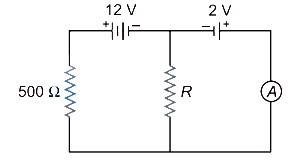 TS EAMCET 2011 Medium
 - A man weighing \(75 \mathrm{~kg}\) is standing in a lift. The weight of the man standing on a weighing machine kept in the lift when the lift is moving downwards freely under gravity isTS EAMCET 2023 Easy
- In a transistor circuit, the collector current is changed by , if the emitter current is changed to . The value of current amplification factor, isTS EAMCET 2019 Easy
- In a -type semiconductor, which of the following statement is true?TS EAMCET 2022 Medium
- A carrier signal of frequency and peak voltage of is modulated by a message signal of frequency and peak voltage of . Let be the modulation index and be side bands produced. The correct statement isTS EAMCET 2020 Easy