


TS EAMCET · Physics · Mechanical Properties of Fluids
A liquid flows steadily through a cylindrical pipe having a radius 2R at a point A and radius R at point B farther along the flow direction. If the velocity at point B is 4v, what will be the velocity at point A?
- A \(\frac{1}{2} v\)
- B v
- C 2v
- D 3v
Answer & Solution
Correct Answer
(B) v
Step-by-step Solution
Detailed explanation
From equation of continuing…
See the Complete Solution
Get step-by-step explanations for this and 2.5 Lakh+ more JEE, NEET & CET questions.
- Unlock all solutions
- Practice the full chapter
- Track accuracy across PYQs
4.8 rated on Google Play · 14,000+ reviews
More questions from Physics
- A bouncing ball of mass \(200 \mathrm{~g}\) falls from the height of \(5 \mathrm{~m}\) on a horizontal ground. After every impact with the ground, the velocity of the ball decreases by \(\frac{1}{2}\) times. The total momentum, the ball imparts on to the ground after 3 impacts is \(\left(\right.\) Let \(\left.g=10 \mathrm{~m} / \mathrm{s}^2\right)\)TS EAMCET 2019 Medium
- Statement (I) : An object subjected to velocities \(\overrightarrow{v_1}\) and \(\overrightarrow{v_2}\) has a resultant velocity with magnitude \(|\vec{v}|=\left|\overrightarrow{v_1}\right|+\left|\overrightarrow{v_2}\right|\).
Statement (II) : The magnitude of displacement is either less or equal to the path length of an object between two points.
Statement (III) : The instantaneous acceleration is the limiting value of the average acceleration as the time interval approaches zero.
Which of the following is correct?TS EAMCET 2022 Easy - The deceleration of a car traveling on a straight highway is a function of its instantaneous velocity \(v\) given by \(\omega=a \sqrt{v}\), where \(a\) is a constant. If the initial velocity of the car is \(60 \mathrm{~km} / \mathrm{h}\), the distance of the car will travel and the time it takes before it stops areTS EAMCET 2017 Medium
- Three bodies a ring, a solid cylinder and a solid sphere roll down an inclined plane without slipping. They start from rest. Which of the bodies reaches bottom of plane with minimum velocity?TS EAMCET 2021 Easy
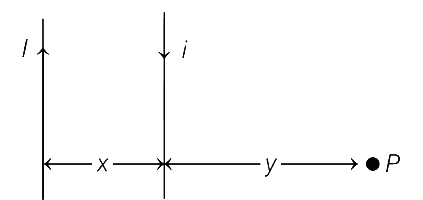
- Two infinite wires carrying opposite electrical currents \(I\) and \(i\) are placed a distance \(x\) apart. A point \(P\) at a distance \(y\) away from the wire carrying current \(i\) is shown in the figure. If the magnetic field is zero at point \(P\), then the magnitude of \(i\) is
 TS EAMCET 2020 Easy
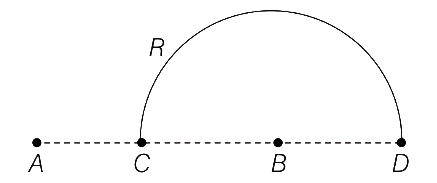
 - Electric charges \(+q\) and \(-q\) are placed at points \(A\) and \(B\) respectively which are at a distance of \(2 L\) apart. If \(C\) is the midpoint between \(A\) and \(B\), then the work done in moving a charge \(+Q\) along the semi-circle \(C R D\) is
 TS EAMCET 2020 Easy
More PYQs from TS EAMCET
- A car accelerates from rest with \(2 \mathrm{~m} / \mathrm{s}^2\) on a straight line path and then comes to rest after applying brakes. Total distance travelled by the car is \(100 \mathrm{~m}\) in 20 seconds. Then, the maximum velocity attained by the car isTS EAMCET 2016 Medium
- To increase the length of a metal rod by \(0.4 \%\), the temperature of the rod is to be increased by
(Coefficient of linear expansion of the metal \(=20 \times 10^{-6}{ }^{\circ} \mathrm{C}^{-1}\) )TS EAMCET 2025 Easy - When light of an unknown polarisation is examined with a polaroid, it is found to exhibit maximum intensity \(I_0\) along \(y\)-axis and minimum intensity \(\frac{2 Y_0}{3}\) along \(x\)-axis. The intensity transmited through a polaroid with pass axis at \(45^{\circ}\) to \(y\)-axis (in \(x\) - \(y\) plane) isTS EAMCET 2019 Medium
- In a Young's double slit experiment, \(m\) th order and \(n\)th order of bright fringes are formed at point \(P\) on a distant screen, if monochromatic source of wavelength \(400 \mathrm{~nm}\) and \(600 \mathrm{~nm}\) are used respectively. The minimum value of \(m\) and \(n\) are respectively,TS EAMCET 2019 Easy
- When \(n-p-n\) transistor is used as an amplifier :TS EAMCET 2003 Easy
- In \(\beta^{-}\)decay, a neutron transforms into a proton within the nucleus according to the equation:
\(\text { neutron } \rightarrow \text { proton }+\beta^{-}+x\)
In this equation the particle represented by ' \(x\) ' isTS EAMCET 2025 Easy