


TS EAMCET · Physics · Gravitation
A launching vehicle carrying an artificial satellite of mass \(m\) is set for launch on the surface of the earth of mass \(M\) and radius \(R\). If the satellite is intended to move in a circular orbit of radius \(7 R\), the minimum energy required to be spent by the launching vehicle on the satellite is \((\) Gravitational constant \(=G\) )
- A \(\frac{G M m}{R}\)
- B \(-\frac{13 G M m}{14 R}\)
- C \(\frac{G M m}{7 R}\)
- D \(\frac{G M m}{14 R}\)
Answer & Solution
Correct Answer
(B) \(-\frac{13 G M m}{14 R}\)
Step-by-step Solution
Detailed explanation
The energy of artificial satellite at the surface of the earth \(E_1=-\frac{G M m}{R}\) When the satellite is intended to move in a circular orbit of radius \(7 R\), then energy of artificial satellite \(E_2=-\frac{1}{2} \frac{G M m}{7 R}\) The minimum energy required…
See the Complete Solution
Get step-by-step explanations for this and 2.5 Lakh+ more JEE, NEET & CET questions.
- Unlock all solutions
- Practice the full chapter
- Track accuracy across PYQs
4.8 rated on Google Play · 14,000+ reviews
More questions from Physics
- When a body of mass \(1.0 \mathrm{~kg}\) is suspended from a certain light spring hanging vertically, its length increases by \(5 \mathrm{~cm}\). By suspending \(2.0 \mathrm{~kg}\) block to the spring and if the block is pulled through \(10 \mathrm{~cm}\) and released, the maximum velocity in it in \(\mathrm{m} / \mathrm{s}\) is : (Acceleration due to gravity \(=10 \mathrm{~m} / \mathrm{s}^2\) )TS EAMCET 2003 Medium
- In the circuit shown, the heat produced in \(5 \Omega\) resistance due to current through is \(50 \mathrm{~J} / \mathrm{s}\). Then, the heat generated per second in \(2 \Omega\) resistance is
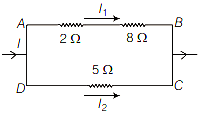 TS EAMCET 2014 Easy
 - The distance between Sun and Earth is \(1.6 \times 10^{11} \mathrm{~m}\) and the radius of Earth is \(6.4 \times 10^6 \mathrm{~m}\). The ratio of the angular momentum of Earth around the Sun to the angular momentum around its own axis is approximately (Assume Earth as a solid sphere with uniform mass density and rotates around the Sun in a circular path.)TS EAMCET 2019 Medium
- The frequency of sound heard by an observer moving towards a stationary source with certain speed is \(n_1\) and if the observer moves away from the same source with same speed, the frequency of sound heard by the observer is \(\mathrm{n}_2\). If the speed of sound in air is \(340 \mathrm{~ms}^{-1}\) and \(\mathrm{n}_1: \mathrm{n}_2=71: 65\), then speed of observer isTS EAMCET 2025 Medium
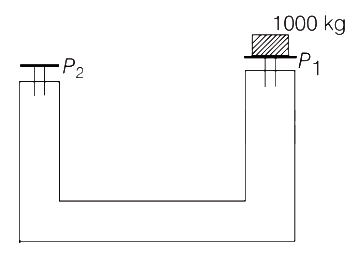
- A hydraulic lift as shown in the figure is used to lift a mass of \(1000 \mathrm{~kg}\), which is placed on a piston \(\left(P_1\right)\) of area \(1 \mathrm{~m}^2\). If the cross-section area of the piston \(\left(P_2\right)\) at the other end is \(0.01 \mathrm{~m}^2\), then how much mass needs to be put on it to lift the \(1000 \mathrm{~kg}\) ?
 TS EAMCET 2020 Easy
 - Match the following (Take the relative strength of the strongest fundamental forces in nature as one)
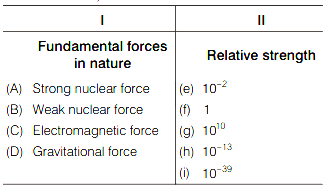
The correct match isTS EAMCET 2014 Easy
More PYQs from TS EAMCET
- A body of mass \(10 \mathrm{~kg}\) is acted upon by a force given by equation \(F=\left(3 t^2-30\right)\) newtons. The initial velocity of the body is \(10 \mathrm{~m} / \mathrm{s}\). The velocity of the body after \(5 \mathrm{~s}\) isTS EAMCET 2015 Medium
- A spherical drop of radium r is divided in to 8 equal droplets. If the surface tension is S, then the work done in the process will beTS EAMCET 2022 Easy
- 113. Energy released in the fission of a single uranium nucleus is \(200 \mathrm{MeV}\). Then the number of fissions per second to produce \(5 \mathrm{~mW}\) power isTS EAMCET 2023 Easy
- A body of mass \(m\) is suspended to an ideal spring of force constant \(k\). The expected change in the position of the body due to an additional force \(F\) acting vertically downwards isTS EAMCET 2005 Medium
- A negative charge is placed at the centre of the non-conducting sphere. The direction of electric field on any point at the surface of the sphere isTS EAMCET 2019 Easy
- The internal and external diameters of a hollow cylinder measured with vernier calipers are \((5.73 \pm 0.01) \mathrm{cm}\) and \((6.01 \pm 0.01) \mathrm{cm}\) respectively. Then the thickness of the cylinder wall isTS EAMCET 2024 Easy