


TS EAMCET · Physics · Ray Optics
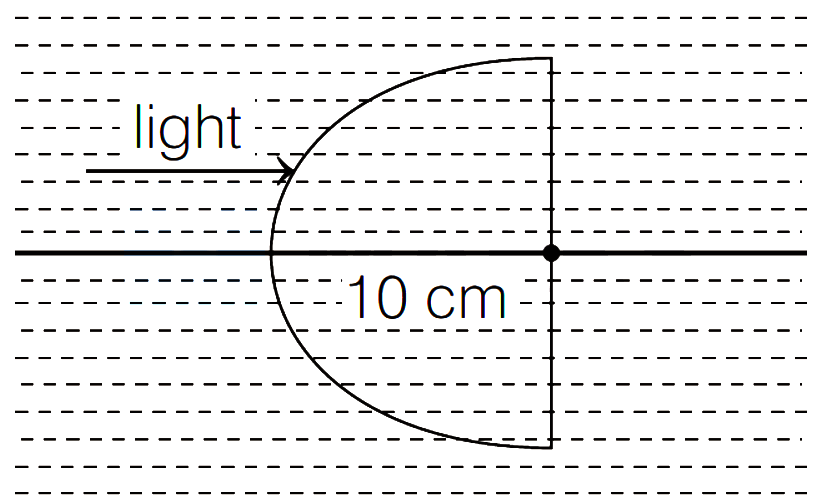
A half spherical glass lens with refractive index 1.5 is placed in a liquid with refractive index of 1.3 (see following figure). The radius of the half spherical lens is \(10 \mathrm{~cm}\). A parallel beam of light travelling in the liquid is refracted by the glass lens. Then the absolute value of the position of the image from the centre of the glass lens will be
- A \(10 \mathrm{~cm}\)
- B \(65 \mathrm{~cm}\)
- C \(5 \mathrm{~cm}\)
- D \(11.5 \mathrm{~cm}\)
Answer & Solution
Correct Answer
(B) \(65 \mathrm{~cm}\)
Step-by-step Solution
Detailed explanation
Focal length of the lens, \[ \frac{1}{f}=\left(\frac{n_2}{n_1}-1\right)\left(\frac{1}{R_1}-\frac{1}{R_2}\right) \] Here, refractive index for glass lens, \(n_2=1.5\) Refractive index for water, \(n_1=1.3\) Radius of curvature, \(R_1=10 \mathrm{~cm}\), \[ R_2=\infty \] Putting…
See the Complete Solution
Get step-by-step explanations for this and 2.5 Lakh+ more JEE, NEET & CET questions.
- Unlock all solutions
- Practice the full chapter
- Track accuracy across PYQs
4.8 rated on Google Play · 14,000+ reviews
More questions from Physics
- Two coils have mutual inductance \(0.005 \mathrm{H}\). The current changes in the first coil according to equation \(I=I_0 \sin \omega t\), where \(I_0=10 \mathrm{~A}\) and \(\omega=100 \pi \mathrm{rad} \mathrm{s}\). The maximum value of induced emf in the second coil isTS EAMCET 2016 Medium
- Two metal rods \(\mathrm{A}\) and \(\mathrm{B}\) each of length \(50 \mathrm{~cm}\) and diameter \(4.0 \mathrm{~mm}\) are joined together at temperature \(30^{\circ} \mathrm{C}\). What is the change in length of the combined rod at \(230^{\circ} \mathrm{C}\) ? [Given linear expansion coefficients of rods A and B are respectively, \(2.0 \times 10^{-5} /{ }^{\circ} \mathrm{C}\) and \(\left.1.0 \times 10^{-5} /{ }^{\circ} \mathrm{C}\right]\)TS EAMCET 2022 Easy
- A hot body placed in air cools down to a lower temperature. The rate of decrease of temperature is proportional to the temperature difference from the surrounding. The body loses \(60 \%\) and \(80 \%\) of maximum heat it can loose in time \(t_1\) and \(t_2\) respectively. The ratio \(t_2 / t_1\) will beTS EAMCET 2019 Easy
- The half-life of \({ }_{84}^{209} \mathrm{P}_0\) is 103 years. The time it takes for \(100 \mathrm{~g}\) sample of \({ }_{84}^{209} \mathrm{P}_0\) to decay to 3.125 \(\mathrm{g}\) isTS EAMCET 2018 Easy
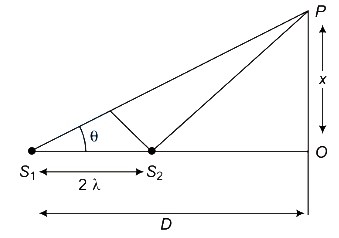
- Two coherent point sources \(S_1\) and \(S_2\) vibrating in phase emit light of wavelength \(\lambda\). The separation between them is \(2 \lambda\) as shown in figure. The first bright fringe is formed at \(P\) due to interference on a screen placed at a distance \(D\) from \(S_1(D>>\lambda)\), then \(O P\) is
 TS EAMCET 2012 Hard
 - A short magnetic needle is pivoted in a uniform magnetic field of induction \(1 \mathrm{~T}\). Now, simultaneously another magnetic field of induction \(\sqrt{3} \mathrm{~T}\) is applied at right angles to the first field; the needle deflects through an angle \(\theta\) whose value isTS EAMCET 2010 Medium
More PYQs from TS EAMCET
- The operation of a nuclear reactor is said to be critical when the value of neutron multiplication factor \(K\) isTS EAMCET 2024 Easy
- If the seventh harmonic of a closed organ pipe is in unison with fourth harmonic of an open organ pipe, then the ratio of length of closed pipe to that of open pipe isTS EAMCET 2023 Medium
- The expression for the magnetic energy stored in a solenoid of length \(L\), in terms of magnetic field \(B\) and area \(\mathrm{A}\) isTS EAMCET 2023 Easy
- The effect due to uniform magnetic field on a freely suspended magnetic needle is as follows :TS EAMCET 2006 Easy
- Consider a \(p-n\) junction as a capacitor, formed with \(p\) and \(n\)-materials acting as thin metal electrodes and depletion layer width acting as separation between them. Basing on this, assume that a \(n-p-n\) transistor is working as an amplifier in CE configuration. If \(C_1\) and \(C_2\) are the base-emitter and collector-emitter junction capacitances, then :TS EAMCET 2006 Medium
- 1. The focal lengths of the objective and the eyepiece of a compound microscope are \(2 \mathrm{~cm}\) and \(3 \mathrm{~cm}\) respectively and the distance between them is \(15 \mathrm{~cm}\). The final image formed by the eyepiece is at infinity. The distances of the object and the image produced by the object from the objective lens are respectivelyTS EAMCET 2023 Easy