


TS EAMCET · Physics · Ray Optics
1. The focal lengths of the objective and the eyepiece of a compound microscope are \(2 \mathrm{~cm}\) and \(3 \mathrm{~cm}\) respectively and the distance between them is \(15 \mathrm{~cm}\). The final image formed by the eyepiece is at infinity. The distances of the object and the image produced by the object from the objective lens are respectively
- A \(2.4 \mathrm{~cm}, 12 \mathrm{~cm}\)
- B \(2.4 \mathrm{~cm}, 15 \mathrm{~cm}\)
- C \(2.3 \mathrm{~cm}, 12 \mathrm{~cm}\)
- D \(2.3 \mathrm{~cm}, 3 \mathrm{~cm}\)
Answer & Solution
Correct Answer
(A) \(2.4 \mathrm{~cm}, 12 \mathrm{~cm}\)
Step-by-step Solution
Detailed explanation
Given \(\mathrm{f}_0=2 \mathrm{~cm}, \mathrm{f}_{\mathrm{e}}=3 \mathrm{~cm}\) and \(\mathrm{f}_0+\mathrm{f}_{\mathrm{e}}=15 \mathrm{~cm}\). Final image is formed at infinity, so object for eye-piece i.e., image formed by objective lens at \(\mathrm{f}=3 \mathrm{~cm}\) from it…
See the Complete Solution
Get step-by-step explanations for this and 2.5 Lakh+ more JEE, NEET & CET questions.
- Unlock all solutions
- Practice the full chapter
- Track accuracy across PYQs
4.8 rated on Google Play · 14,000+ reviews
More questions from Physics
- The internal and external diameters of a hollow cylinder measured with vernier calipers are \((5.73 \pm 0.01) \mathrm{cm}\) and \((6.01 \pm 0.01) \mathrm{cm}\) respectively. Then the thickness of the cylinder wall isTS EAMCET 2024 Easy
- A block is in simple harmonic motion (S.H.M) on the end of the spring with position given by \(x=(5) \cos \left(\omega t+\frac{\pi}{4}\right)\) If the total mechanical energy used is 100 J to achieve maximum displacement, then the potential energy at time t = 0 isTS EAMCET 2022 Medium
- To excite the spectral line of wavelength of an atom, an excitation energy of is required. The ground state energy of the atom is . The energies of two levels involved in the emission of line are (Assume he , where is Planck's constant and is speed of light)TS EAMCET 2019 Easy
- A cubical block of wood having mass of \(160 \mathrm{~g}\) has a metal piece fastened underneath as shown in the figure. Find the maximum mass of the metal piece which will allow the block to float in water. Specific gravity of wood is 0.8 and that metal is 10 and density of water \(=1 \mathrm{~g} / \mathrm{cc}\).
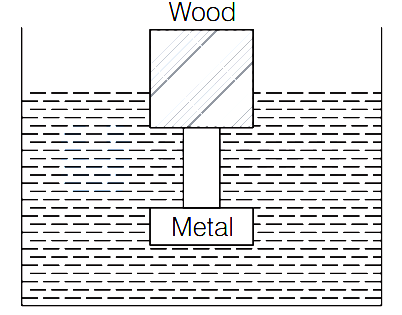 TS EAMCET 2020 Medium
 - The ratio between kinetic and potential energies of a body executing simple harmonic motion, when it is at a distance of \(\frac{1}{N}\) of its amplitude from the mean position isTS EAMCET 2014 Medium
- A venturimeter has a pipe diameter of \(4 \mathrm{~cm}\) and a throat diameter of \(2 \mathrm{~cm}\). Velocity of water in the pipe section is \(10 \mathrm{~m} / \mathrm{s}\). The pressure drop, between pipe section and the throat section is [use density of water \(=1000 \mathrm{~kg} / \mathrm{m}^3\) ]TS EAMCET 2022 Medium
More PYQs from TS EAMCET
- When a bullet is fired from a rifle its momentum becomes \(20 \mathrm{~kg}-\mathrm{ms}^{-1}\). If the velocity of the bullet is \(1000 \mathrm{~ms}^{-1}\), then what is its mass?TS EAMCET 2020 Easy
- In an experiment, the coefficient of viscosity (in mPa s) of a liquid was determined as 2.62, 2.68, 2.58, 2.57, 2.54 and 2.55. The mean absolute error in the determination of the coefficient of viscosity of the liquid isTS EAMCET 2025 Medium
- A \(4 \mu \mathrm{F}\) capacitor is charged by a \(200 \mathrm{~V}\) battery. It is then disconnected from the supply and is connected to another uncharged \(2 \mu \mathrm{F}\) capacitor. During the process, loss of energy (in \(\mathrm{J}\) ) isTS EAMCET 2005 Medium
- A wave is given by the equation \(y=(0.02) \sin (\pi x-8 \pi t)\) then the velocity of the wave is ( \(y\) and \(x\) are in metre and \(\mathrm{t}\) is in second)TS EAMCET 2023 Hard
- The ratio of the radii of two planets is ' \(\mathrm{r}\) ' and the ratio of accelerations due to gravity on the planets is ' \(x\) '. Then the ratio of the escape velocities from the planets isTS EAMCET 2023 Easy
- A quantity \(z\), to be estimated has a dependency on the variables \(a, b\) and \(c\) as \(z=a b^2 c^{-2}\). The percentage of error in the measurement of \(a, b\) and \(c\) are respectively, \(2.1 \%, 1.3 \%\) and \(2.2 \%\). The percentage of error in the measurement of \(z\) would then beTS EAMCET 2019 Easy