


TS EAMCET · Physics · Thermal Properties of Matter
A circular copper ring at \(30^{\circ} \mathrm{C}\) has a hole with an area of \(9.98 \mathrm{~cm}^2\). It is made to slip onto a steel rod of crosssectional area of \(10 \mathrm{~cm}^2\), by raising the temperature of both ring and rod simultaneously by an amount \(\Delta \mathrm{T}\). If the coefficient of linear expansion of copper and steel are \(17 \times 10^{-6} /{ }^{\circ} \mathrm{C}\) and \(11 \times 10^{-6} /{ }^{\circ} \mathrm{C}\), then minimum value of \(\Delta \mathrm{T}\) should be
- A \(167.6^{\circ} \mathrm{C}\)
- B \(133.3{ }^{\circ} \mathrm{C}\)
- C \(83.3{ }^{\circ} \mathrm{C}\)
- D \(249.9^{\circ} \mathrm{C}\)
Answer & Solution
Correct Answer
(A) \(167.6^{\circ} \mathrm{C}\)
Step-by-step Solution
Detailed explanation
For slipping of ring on steel rod…
See the Complete Solution
Get step-by-step explanations for this and 2.5 Lakh+ more JEE, NEET & CET questions.
- Unlock all solutions
- Practice the full chapter
- Track accuracy across PYQs
4.8 rated on Google Play · 14,000+ reviews
More questions from Physics
- A wire of length, carries a current along the - axis. The magnetic force acting on the wire is given by where is a constant. The existing magnetic field isTS EAMCET 2021 Hard
- Two stars of equal masses are orbiting in a circle of radius Their orbital time period is proportional toTS EAMCET 2021 Medium
- In an \(n\)-type semiconductor, electrons are majority charge carriers and holes are minority charge carriers. The charge of an \(n\)-type semiconductor isTS EAMCET 2024 Easy
- Two straight conducting rails form a right angle as shown below. A conducting bar in contact with the rails starts at the vertex at time and moves with constant velocity of along them. A magnetic field with is directed out of the page. The absolute value of the around the triangle at the time will be?
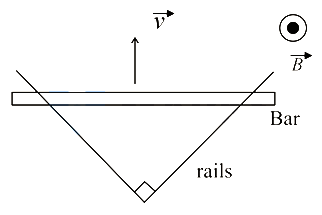 TS EAMCET 2020 Easy
 - A carrier signal of frequency and peak voltage of is modulated by a message signal of frequency and peak voltage of . Let be the modulation index and be side bands produced. The correct statement isTS EAMCET 2020 Easy
- The velocity of a particle having magnitude of \(10 \mathrm{~ms}^{-1}\) in the direction of \(60^{\circ}\) with positive \(\mathrm{X}\)-axis isTS EAMCET 2023 Medium
More PYQs from TS EAMCET
- In the circuit shown below, the ammeter reading is zero. Then the value of the resistance \(R\) is
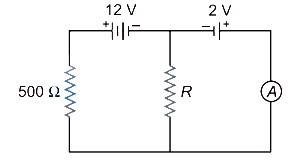 TS EAMCET 2011 Medium
 - A light bulb of power is placed at the centre of a hollow sphere of radius If the of the energy is converted into light, then the pressure exerted by the light on the surface of the sphere will be
(Assume the surface of sphere to be perfectly absorbing)TS EAMCET 2021 Easy - A force acts on a \(30 \mathrm{~g}\) particle in such a way that the position of the particle as a function of time is given by \(x=\alpha t^2\), where \(x\) is in metre, \(t\) is in seconds and \(\alpha=1 \mathrm{~m} / \mathrm{s}^2\). The work done during the first \(4 \mathrm{~s}\) isTS EAMCET 2020 Easy
- A particle of charge 2 C is moving with a velocity of \((3 \hat{i}+4 \hat{j}) \mathrm{ms}^{-1}\) in the presence of magnetic and electric fields. If the magnetic field is \((\hat{i}+2 \hat{j}+3 \hat{k}) \mathrm{T}\) and the electric field is \((-2 \hat{k}) \mathrm{NC}^{-1}\), then the Lorentz force on the particle isTS EAMCET 2024 Easy
- A printed page is kept pressed by a transparent cube of edge \(t\). The refractive index of the cube varies as \(\mu(z)=1+\frac{z}{t}\), where \(z\) is the vertical distance from bottom of the cube. If viewed from top, then the printed letters appear to be shifted by an amountTS EAMCET 2018 Medium
- The ratio of the energies of the electron in the hydrogen atom in the first and second excited states isTS EAMCET 2023 Medium