


TS EAMCET · Physics · Laws of Motion
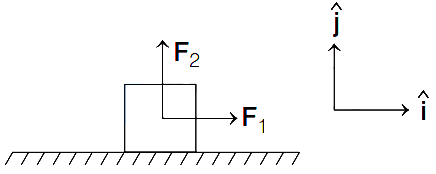
A block of mass \(m=2 \mathrm{~kg}\) is initially at rest on a horizontal surface. A horizontal force \(\mathbf{F}_1=(6 \mathrm{~N}) \hat{\mathbf{i}}\) and a vertical force \(\mathbf{F}_2=(10 \mathrm{~N}) \hat{\mathbf{j}}\) are then applied to the block. The coefficients of static friction and kinetic friction for the block and the surfaces are 0.4 and 0.25 , respectively. The magnitude of the frictional force acting on the block is (assume, \(g=10 \mathrm{~m} / \mathrm{s}^2\) )
- A \(2.5 \mathrm{~N}\)
- B \(4.0 \mathrm{~N}\)
- C \(3.3 \mathrm{~N}\)
- D \(3.0 \mathrm{~N}\)
Answer & Solution
Correct Answer
(A) \(2.5 \mathrm{~N}\)
Step-by-step Solution
Detailed explanation
In addition to the forces shown in figure, there will be another upcoming normal force \(\mathbf{F}_N\) exerted by the floor on the block. Using Newton's second law in horizontal and vertical directions, we get In horizontal direction, \(F_1-f_s=m a\) \(\ldots(\mathrm{i})\) and…
See the Complete Solution
Get step-by-step explanations for this and 2.5 Lakh+ more JEE, NEET & CET questions.
- Unlock all solutions
- Practice the full chapter
- Track accuracy across PYQs
4.8 rated on Google Play · 14,000+ reviews
More questions from Physics
- A circular coil of area \(200 \mathrm{~cm}^2\) and 50 turns is rotating about its vertical diameter with an angular speed of \(40 \mathrm{rads}^{-1}\) in a uniform horizontal magnetic field of magnitude \(2 \times 10^{-2} \mathrm{~T}\). The maximum emf induced in the coil isTS EAMCET 2024 Easy
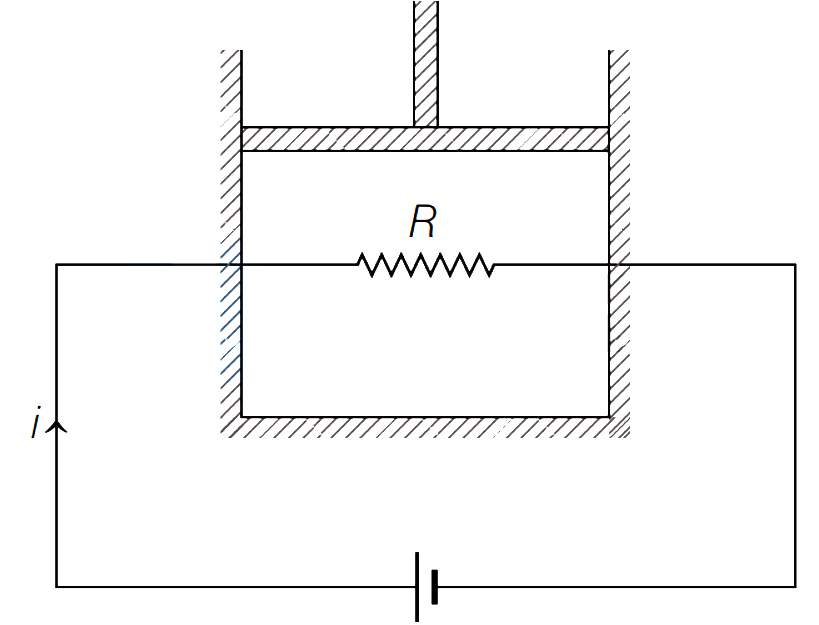
- A \(500 \Omega\) resistor connected to an external battery is placed inside a thermally insulated cylinder fitted with a frictionless piston. The cylinder contains an ideal gas. A current \(i\) of \(200 \mathrm{~mA}\) flows through the resistor as shown in the figure. The mass of the piston is \(10 \mathrm{~kg}\). Assuming \(g=10 \mathrm{~m} / \mathrm{s}^2\), the speed at which the piston will move upward, due to heat dissipated by the resistor, so that the temperature of the gas remains unchanged is
 TS EAMCET 2018 Medium
 - A telescope has an objective of focal length \(100 \mathrm{~cm}\) and an eye-piece of focal length \(5 \mathrm{~cm}\). The magnifying power of the telescope isTS EAMCET 2020 Easy
- For an n-p-n transistor structure which of the following statements is NOT true?TS EAMCET 2022 Easy
- The magnetic induction and the intensity of magnetic field inside an iron core of an electromagnet are \(1 \mathrm{~Wb} \mathrm{~m}^{-2}\) and \(150 \mathrm{Am}^{-1}\), respectively. The relative permeability of iron is \(\left(\mu_0=4 \pi \times 10^{-7}\right.\) henry \(\left./ \mathrm{m}\right)\)TS EAMCET 2004 Easy
- A moving coil galvanometer has a rectangular wire coil of enclosed area \(0.001 \mathrm{~m}^2\) and 500 turns. The coil operates in a radial magnetic field of \(0.2 \mathrm{~T}\) and carries a current of \(6 \pi \times 10^{-8} \mathrm{~A}\). If the torsional spring constant is \(6 \times 10^{-7} \mathrm{~N}-\mathrm{m} / \mathrm{rad}\), then the angular deflection of the coil in radians isTS EAMCET 2018 Easy
More PYQs from TS EAMCET
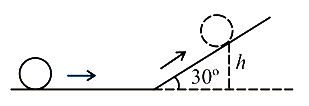
- A solid spherical ball rolls on a horizontal surface at and continues to roll up on an inclined surface as shown in the figure. If the mass of the ball is and frictional losses are negligible, the value of , where the ball stops and starts rolling down the inclination is (Assume )
 TS EAMCET 2019 Medium
 - Consider a frictionless ramp on which a smooth object is made to slide down from an initial height \(h\). The distance \(d\) necessary to stop the object on a flat track (of coefficient of friction \(\mu\) ), kept at the ramp end isTS EAMCET 2017 Medium
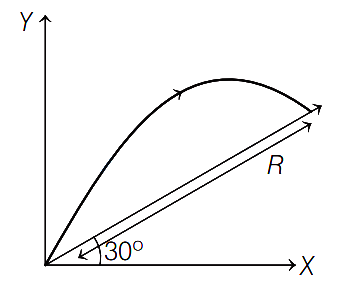
- Initial velocity with which a body is projected is \(10 \mathrm{~m} / \mathrm{s}\) from the base of an inclined plane as shown in the given figure. If the angle of projection is \(60^{\circ}\) with the horizontal, then the range \(R\) is [take, \(g=10 \mathrm{~m} / \mathrm{s}^2\) ]
 TS EAMCET 2020 Easy
 - A body is moved along a straight line by an engine which delivers a constant power. The distance moved by the body in time ' \(\mathrm{t}\) ' is proportional toTS EAMCET 2023 Easy
- A child is on a merry-go-round, standing at a distance \(2 \mathrm{~m}\) from the centre. The coefficient of static friction between the child and the surface of merry-go-round is 0.8 . At what maximum angular velocity can the merry-go-round be rotated before the child slips? (Talse, \(g=10 \mathrm{~m} / \mathrm{s}^2\) )TS EAMCET 2018 Medium
- Two buses \(A\) and \(B\) are moving in opposite direction. Now if the first bus \(A\) moves towards east with a speed of \(36 \mathrm{~km} / \mathrm{h}\) and bus \(B\) moves towards west with a speed of \(18 \mathrm{~km} / \mathrm{h}\), then the bus \(B\) appears to bus \(A\) asTS EAMCET 2020 Easy