


TS EAMCET · Physics · Work Power Energy
A ball is falling freely from a height. When it reaches \(10 \mathrm{~m}\) height from the ground its velocity is \(v_0\). It collides with the ground and loses \(50 \%\) of its energy and rises back to height of \(10 \mathrm{~m}\). Then the velocity \(v_0\) is
- A \(7 \mathrm{~m} / \mathrm{s}\)
- B \(10 \mathrm{~m} / \mathrm{s}\)
- C \(14 \mathrm{~m} / \mathrm{s}\)
- D \(16 \mathrm{~m} / \mathrm{s}\)
Answer & Solution
Correct Answer
(C) \(14 \mathrm{~m} / \mathrm{s}\)
Step-by-step Solution
Detailed explanation
At height \(10 \mathrm{~m}\), the kinetic energy is equal to potential energy then \(\frac{1}{2} m v_0^2=m g h\) \(\frac{1}{2} v_0^2=9.8 \times 10\) \(v_0^2=2 \times 9.8 \times 10\) \(v_0=\sqrt{196}\) \(v_0=14 \mathrm{~m} / \mathrm{s}\)
See the Complete Solution
Get step-by-step explanations for this and 2.5 Lakh+ more JEE, NEET & CET questions.
- Unlock all solutions
- Practice the full chapter
- Track accuracy across PYQs
4.8 rated on Google Play · 14,000+ reviews
More questions from Physics
- Due to global warming, if the ice in the polar region melts and some of this water flows to the equatorial region, thenTS EAMCET 2025 Medium
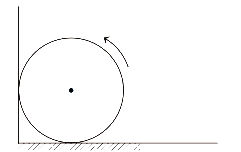
- A uniform cylinder of radius \(1 \mathrm{~m}\), mass \(1 \mathrm{~kg}\) spins about its axis with an angular velocity \(20 \mathrm{rad} / \mathrm{s}\). At certain moment, the cylinder is placed into a corner as shown in the figure. The coefficient of friction between the horizontal wall and the cylinder is \(\mu\), whereas the vertical wall is frictionless. If the number of rounds made by the cylinder is 5 before it stops, then the value of \(\mu\) is (acceleration due to gravity, \(g=10 \mathrm{~m} / \mathrm{s}^2\) )
 TS EAMCET 2018 Hard
 - A message signal of peak voltage 12 V is used to amplitude modulate a carrier signal of frequency 1.2 MHz . The amplitude of the side bands isTS EAMCET 2024 Easy
- If a capacitor of capacitance \(100 \mu \mathrm{F}\) is charged at a steady rate of \(100 \mu \mathrm{C} \mathrm{s}^{-1}\), then the time taken to produce a potential difference of \(100 \mathrm{~V}\) between the capacitor plates isTS EAMCET 2023 Medium
- In a potentiometer experiment, a wire of length 10 m and resistance \(5 \Omega\) is connected to a cell of emf 2.2 V. If the potential difference between two points separated by a distance of 660 cm on potentiometer wire is 1.1 V, then the internal resistance of the cell isTS EAMCET 2025 Medium
- The area of cross-section of a potentiometer wire is \(6 \times 10^{-7} \mathrm{~m}^2\). The potential difference per unit length of the potentiometer wire when it is connected to a cell of negligible internal resistance and a resistor in series is \(0.15 \mathrm{Vm}^{-1}\). If the current through potentiometer wire is 0.3 A, then the resistivity of the material of the potentiometer wire isTS EAMCET 2025 Medium
More PYQs from TS EAMCET
- A coil having \(n\) turns and resistance \(R \Omega\) is connected with a galvanometer of resistance \(4 R \Omega\). This combination is moved in time \(t\) seconds from a magnetic flwx \(\phi_1\) Weber to \(\phi_2\) Weber. The induced current in the circuit isTS EAMCET 2017 Medium
- Photons of energy \(2.4 \mathrm{eV}\) and wavelength \(\lambda\) fall on a metal plate and release photoelectrons with a maximum velocity \(v\). By decreasing \(\lambda\) by \(50 \%\), the maximum velocity of photoelectrons becomes \(3 v\). The work function of the material of the metal plate isTS EAMCET 2020 Hard
- The cold junction of a thermocouple is at \(0^{\circ} \mathrm{C}\). The thermo e.m.f produced in the thermocouple is given by an equation \(E=16 T-0.04 T^2\), where \(T\) is the temperature of the hot junction. The temperature of inversion and neutral temperature of the thermocouple areTS EAMCET 2002 Hard
- A body of mass \(3 \mathrm{~kg}\) moving with a velocity \((2 \hat{\mathbf{i}}+3 \hat{\mathbf{j}}+3 \hat{\mathbf{k}}) \mathrm{m} / \mathrm{s}\) collides with another body of mass \(4 \mathrm{~kg}\) moving with a velocity \([3 \hat{\mathbf{i}}+2 \hat{\mathbf{j}}-3 \hat{\mathbf{k}}] \mathrm{m} / \mathrm{s}\). The two bodies stick together after collision. The velocity of the composite body isTS EAMCET 2016 Medium
- Uranium has two isotopes of masses 235 and 238 wits. If both of them are present in wranium hexafluoride gas, find the percentage ratio of difference in rms velocities of two isotopes to the rms velocity of heavier isotope.TS EAMCET 2016 Easy
- In planetary motion the areal velocity of position vector of a planet depends on angular velocity \(\omega\) and the distance of the planet from sun \(r\). The correct relation for areal velocity isTS EAMCET 2003 Easy