


TS EAMCET · Maths · Application of Derivatives
\(y=f(x)\) and \(x=g(y)\) are two curves and \(P(x, y)\) is a common point of the two curves. If at \(P\), on the curve \(y=f(x), \frac{d y}{d x}=Q(x)\) and at the same point \(P\) on the curve \(x=g(y), \frac{d x}{d y}=-Q(x)\), then
- A the two curves have a common tangent
- B the angle between two curves is \(45^{\circ}\)
- C tangent drawn at \(P\) to one curve is normal to the other curve at \(P\)
- D the two curves never intersect orthogonally
Answer & Solution
Correct Answer
(C) tangent drawn at \(P\) to one curve is normal to the other curve at \(P\)
Step-by-step Solution
Detailed explanation
At point \(P\) : \(\begin{aligned} & y=f(x), \frac{d y}{d x}=\mathrm{Q}(x) \\ & x=g(y), \frac{d x}{d y}=-\mathrm{Q}(x) \Rightarrow \frac{d y}{d x}=\frac{1}{-\mathrm{Q}(x)}\end{aligned}\) \(\therefore\) Tangent drawn at \(P\) to one curve is normal to the other curve
See the Complete Solution
Get step-by-step explanations for this and 2.5 Lakh+ more JEE, NEET & CET questions.
- Unlock all solutions
- Practice the full chapter
- Track accuracy across PYQs
4.8 rated on Google Play · 14,000+ reviews
More questions from Maths
- In a binomial distribution the probability of getting success is \(\frac{1}{4}\) and the standard deviation is 3 . Then, its mean isTS EAMCET 2002 Easy
- In a battery manufacturing factory, machines P,Q and R manufacture \(20 \%, 30 \%\) and \(50 \%\) respectively of the total output. The chances that a defective battery is produced by these machines are \(1 \%, 1.5 \%\) and \(2 \%\) respectively. If a battery is selected as random from production, then the probability that it is defective isTS EAMCET 2018 Medium
- If 3 is a root of \(x^2+k x-24=0\). It is also a root ofTS EAMCET 2002 Easy
- The position vector of a point \(P\) is \(2 \hat{\mathbf{i}}+\hat{\mathbf{j}}+3 \hat{\mathbf{k}}\) and \(\mathbf{a}=-\hat{\mathbf{i}}-2 \hat{\mathbf{k}}, \mathbf{b}=\hat{\mathbf{i}}+\hat{\mathbf{j}}+2 \hat{\mathbf{k}}\) are two vectors which determine a plane \(\pi\). The equation of a line through \(P\) normal to \(\mathbf{b}\) and lying on the plane \(\pi\) isTS EAMCET 2020 Easy
- If \(0 \leq x \leq \pi / 2\), then \(\lim _{x \rightarrow a} \frac{|2 \cos x-1|}{2 \cos x-1}\)TS EAMCET 2024 Easy
- \(\frac{\cos 13^{\circ}-\sin 13^{\circ}}{\cos 13^{\circ}+\sin 13^{\circ}}+\frac{1}{\cot 148^{\circ}}\) is equal toTS EAMCET 2016 Easy
More PYQs from TS EAMCET
- Iron crystalizes in with an edge length of . If it contains Schottky defects, calculate its approximate density [ of ]TS EAMCET 2022 Hard
- Which of the following is not correct?TS EAMCET 2006 Medium
- What are the products formed when an aqueous solution of magnesium bicarbonate is boiled?TS EAMCET 2003 Easy
- Equation of one of the tangents passing through \((2,8)\) to the hyperbola \(5 x^2-y^2=5\) isTS EAMCET 2012 Medium
- A sheet of steel at \(20^{\circ} \mathrm{C}\) has size as shown in figure below. If the co-efficient of linear expansion for steel is \(10^{-5 \circ} \mathrm{C}^{-1}\), then what is the change in the area at \(60^{\circ} \mathrm{C}\) ?
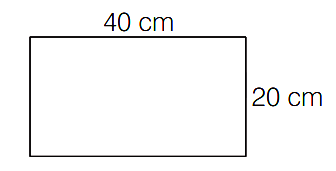 TS EAMCET 2020 Easy
 - Two identical bodies have temperatures \(277^{\circ} \mathrm{C}\) and \(67^{\circ} \mathrm{C}\). If the surroundings temperature is \(27^{\circ} \mathrm{C}\), the ratio of loss of heats of the two bodies during the same interval of time is (approximately)TS EAMCET 2005 Easy