


TS EAMCET · Maths · Vector Algebra
\(\mathbf{x}, \mathbf{y}, \mathbf{z}\) are three vectors each of magnitude \(\sqrt{2}\) and each making an angle \(60^{\circ}\) with one another. If \(\mathbf{a}=\mathbf{x} \times(\mathbf{y} \times \mathbf{z}), \mathbf{b}=\mathbf{y} \times(\mathbf{z} \times \mathbf{x})\), \(\mathbf{c}=\mathbf{x} \times \mathbf{y}\), then \(\mathbf{x}=\)
- A \(\frac{1}{2}[(a+b) \times c-(a+b)]\)
- B \(\frac{1}{2}[c+a-b]\)
- C \(\frac{1}{2}[(a+b) \times c+(a+b)]\)
- D \(\frac{1}{2}[(a \times b) \times c-a+b]\)
Answer & Solution
Correct Answer
(A) \(\frac{1}{2}[(a+b) \times c-(a+b)]\)
Step-by-step Solution
Detailed explanation
Given that, \(|\mathbf{x}|=|\mathbf{y}|=|\mathbf{z}|=\sqrt{2}\) and \(\theta=60^{\circ}\) Thus, \(\mathbf{x} \cdot \mathbf{y}=|\mathbf{x}||\mathbf{y}| \cos \theta=(\sqrt{2})(\sqrt{2}) \cos 60^{\circ}\) \(=2 \times \frac{1}{2}=1\) Similarly…
See the Complete Solution
Get step-by-step explanations for this and 2.5 Lakh+ more JEE, NEET & CET questions.
- Unlock all solutions
- Practice the full chapter
- Track accuracy across PYQs
4.8 rated on Google Play · 14,000+ reviews
More questions from Maths
- If the circle \(S=x^2+y^2+2 g x+2 f y+c=0\) cuts each of the three circles \(x^2+y^2+4 x+4 y+7=0, x^2+y^2-4 x+\) \(4 y+7=0\) and \(x^2+y^2-4 x-4 y+7=0\) orthogonally, then the equation of the tangent drawn at the point \((\sqrt{3}, 2)\) to the circle \(\mathrm{S}=0\) isTS EAMCET 2023 Medium
- If \(f: R /\{0\} \rightarrow R\) is such that \(2 f(x)+f\left(\frac{1}{x}\right)=4 x\) and \(S=\{x \in R: f(x)=f(-x)\}\), then the number of elements in \(S\) isTS EAMCET 2021 Easy
- Let and . If the trace of is and thenTS EAMCET 2022 Medium
- The slope of a line is If are slopes of two lines which are inclined at an angle of with thenTS EAMCET 2021 Easy
- \(\int \frac{3^x(x \log 3-1)}{x^2} d x=\)TS EAMCET 2025 Medium
- Consider the following statements: Assertion (A): The direction ratios of a line \(\mathrm{L}_1\) are \(2,5,7\) and the direction ratios of another line \(\mathrm{L}_2\) are \(\frac{4}{\sqrt{19}}, \frac{10}{\sqrt{19}}, \frac{14}{\sqrt{19}}\). Then the lines \(\mathrm{L}_1, \mathrm{~L}_2\) are parallel Reason (R): If the direction ratios of a line \(L_1\) are \(a_1, b_1, c_1\), the direction ratios of a line \(\mathrm{L}_2\) are \(\mathrm{a}_2, \mathrm{~b}_2, \mathrm{c}_2\) and \(\mathrm{a}_1 \mathrm{a}_2+\mathrm{b}_1 \mathrm{~b}_2\) \(+c_1 c_2=0\), then the lines of \(L_1, L_2\) are parallel Which one of the following is True?TS EAMCET 2023 Easy
More PYQs from TS EAMCET
- The order of basicity among the following nitrogen compounds is
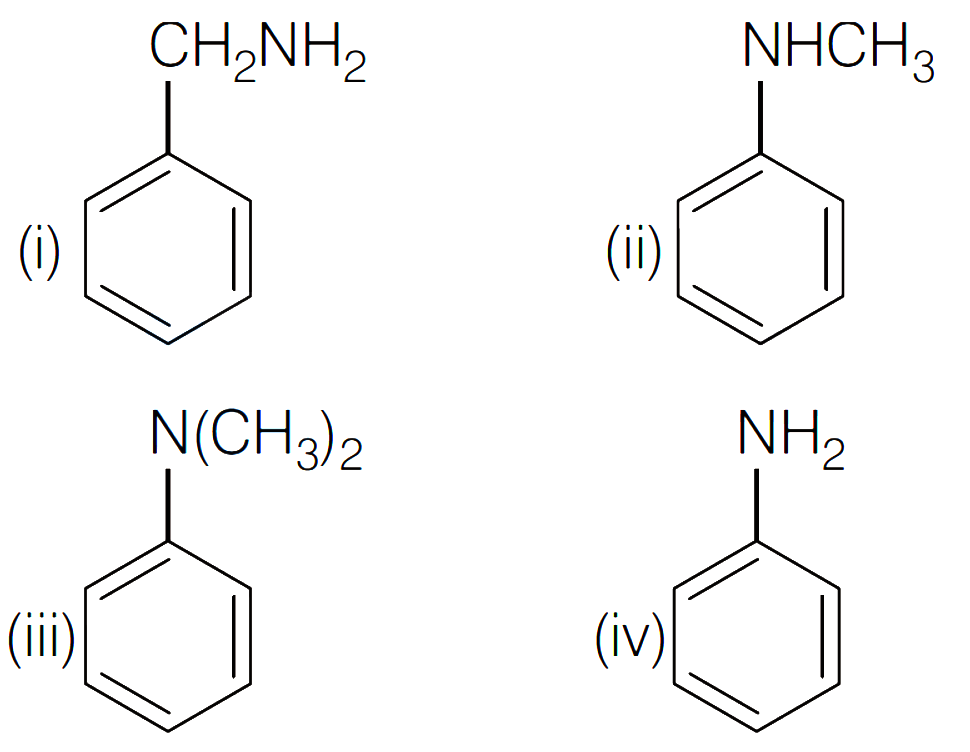 TS EAMCET 2018 Hard
 - If \(f: \mathbf{R} \rightarrow \mathbf{R}\) be defined by \(f(x)=x+2|x+1|+2|x-1|\), then the element in the co-domain, which has unique pre image in the domain isTS EAMCET 2020 Easy
- A wire loop enclosing a semi-circle of radius is located on the boundary of a uniform magnetic field of induction At time , the loop is set into rotation with velocity ? about its axis , coinciding with a line of vector on the boundary as shown in the figure. The emf induced in the loop is
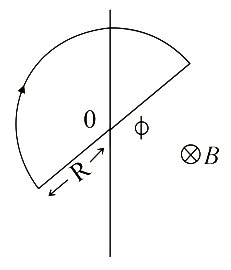 TS EAMCET 2018 Medium
 - If \(y=\tan ^{-1}(\sin \sqrt{x})+\operatorname{cosec}^{-1}\left(e^{2 x+1}\right)\), then \(\frac{d y}{d x}=\)TS EAMCET 2018 Medium
- An empty tank has concave mirror as its bottom. When sunlight falls normally on the mirror, it is focussed at a height of \(32 \mathrm{~cm}\) from the mirror. If the tank is filled with water upto a height of \(20 \mathrm{~cm}\), then the sunlight focusses at (refractive index of water \(=\frac{4}{3}\) )TS EAMCET 2023 Hard
- \(\int \frac{2 \sin x-3 \cos x}{4 \cos x-3 \sin x} d x=\)TS EAMCET 2025 Medium