


TS EAMCET · Maths · Differentiation
If \(y=\tan ^{-1}(\sin \sqrt{x})+\operatorname{cosec}^{-1}\left(e^{2 x+1}\right)\), then \(\frac{d y}{d x}=\)
- A \(\frac{1}{\sqrt{x}\left(1+\sin ^2 \sqrt{x}\right)}+\frac{1}{\sqrt{e^{4 x+2}+1}}\)
- B \(\frac{\cos \sqrt{x}}{2 \sqrt{x}\left(1+\sin ^2 \sqrt{x}\right)}-\frac{2}{\sqrt{e^{4 x+2}-1}}\)
- C \(\frac{\cos \sqrt{x}}{\left(1+\sin ^2 \sqrt{x}\right)}+\frac{2}{\sqrt{e^{4 x+2}+1}}\)
- D \(\frac{1}{2 \sqrt{x}} \frac{\cos \sqrt{x}}{\left(1+\sin ^2 \sqrt{x}\right)}-\frac{1}{\sqrt{e^{2 x+1}-1}}\)
Answer & Solution
Correct Answer
(B) \(\frac{\cos \sqrt{x}}{2 \sqrt{x}\left(1+\sin ^2 \sqrt{x}\right)}-\frac{2}{\sqrt{e^{4 x+2}-1}}\)
Step-by-step Solution
Detailed explanation
\(y=\tan ^{-1}(\sin \sqrt{x})+\operatorname{cosec}^{-1}\left(e^{2 x+1}\right)\) So, \(\frac{d y}{d x}=\frac{1}{1+\sin ^2 \sqrt{x}} \cdot \frac{\cos \sqrt{x}}{2 \sqrt{x}}-\frac{1 \cdot e^{2 x+1} \cdot 2}{e^{2 x+1} \sqrt{e^{4 x+2}-1}}\)…
See the Complete Solution
Get step-by-step explanations for this and 2.5 Lakh+ more JEE, NEET & CET questions.
- Unlock all solutions
- Practice the full chapter
- Track accuracy across PYQs
4.8 rated on Google Play · 14,000+ reviews
More questions from Maths
- Consider the parabola \(25\left[(x-2)^2+(y+5)^2\right]=(3 x+4 y-1)^2\) match the characteristic of this parabola given in List-I with its corresponding item in List-II.
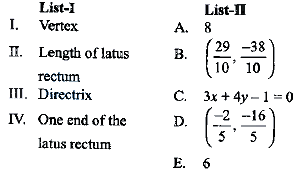
The correct answer isTS EAMCET 2024 Easy - The differential equation of a family of hyperbolas whose axes are parallel to coordinate axes, centres lie on the line \(y=2 x\) and eccentricity is \(\sqrt{3}\) isTS EAMCET 2025 Hard
- Let , if , thenTS EAMCET 2022 Medium
- If \((4,3)\) and \((1,-2)\) are the end points of a diagonal of a square, then the equation of one of its sides isTS EAMCET 2024 Easy
- \(C_1\) and \(C_2\) are the external and internal centres of similitude of the circles \(x^2+y^2-2 x+4 y+1=0\) and \(x^2+y^2+4 x-6 y+12=0\). If the radius of the circle having \(C_1 C_2\) as its diameters is \(r\), then \(\frac{9}{2} r=\)TS EAMCET 2020 Medium
- If \(\omega_0, \omega_1, \ldots, \omega_{n-1}\) are the \(n\)th roots of unity, then \(\left(1+2 \omega_0\right)\left(1+2 \omega_1\right)\left(1+2 \omega_2\right) \ldots\left(1+2 \omega_{n-1}\right)=\)TS EAMCET 2018 Easy
More PYQs from TS EAMCET
- A telephonic communication service is working at a carrier frequency of \(20 \mathrm{GHz}\). Only \(20 \%\) of it is utilized for transmission. If each channel requires a bandwidth of \(5 \mathrm{kHz}\), then the number of telephonic channels that can be transmitted simultaneously areTS EAMCET 2023 Medium
- If \(x y \neq 0, x+y \neq 0\) and \(x^m y^n=(x+y)^{m+n}\), where \(m, n \notin N\), then \(\frac{d y}{d x}\) is equal toTS EAMCET 2012 Medium
- If \(f(x, y)=0\) is the combined equation of the lines joining the origin to the points where the line \(4 x-6 y-2=0\) meets the curve \(3 x^2-4 x y+5 y^2-2 x+y-6=0\), then \(\frac{f(1,-1)}{f(-1,-1)}=\)TS EAMCET 2022 Medium
- \[ \int_0^2 \frac{x}{(2-x)^{\frac{3}{4}}} d x= \]TS EAMCET 2023 Medium
- If \(\triangle A B C\), if \(\cot \frac{A}{2}: \cot \frac{B}{2}: \cot \frac{C}{2}=4: 3: 2\), then \(a: b: c=\)TS EAMCET 2018 Medium
- For any quadratic polynomial it is true that
where is any real number.
If and thenTS EAMCET 2021 Medium