


TS EAMCET · Maths · Three Dimensional Geometry
Consider the following statements: Assertion (A): The direction ratios of a line \(\mathrm{L}_1\) are \(2,5,7\) and the direction ratios of another line \(\mathrm{L}_2\) are \(\frac{4}{\sqrt{19}}, \frac{10}{\sqrt{19}}, \frac{14}{\sqrt{19}}\). Then the lines \(\mathrm{L}_1, \mathrm{~L}_2\) are parallel Reason (R): If the direction ratios of a line \(L_1\) are \(a_1, b_1, c_1\), the direction ratios of a line \(\mathrm{L}_2\) are \(\mathrm{a}_2, \mathrm{~b}_2, \mathrm{c}_2\) and \(\mathrm{a}_1 \mathrm{a}_2+\mathrm{b}_1 \mathrm{~b}_2\) \(+c_1 c_2=0\), then the lines of \(L_1, L_2\) are parallel Which one of the following is True?
- A (A) and (R) are true. (R) is the correct explanation of (A)
- B (A) and (R) are true, but (R) is not the correct explanation of \((\mathrm{A})\)
- C (A) is true, (R) is false
- D (A) is false, (R) is true
Answer & Solution
Correct Answer
(C) (A) is true, (R) is false
Step-by-step Solution
Detailed explanation
D.R. of \(L_1:\left(a_1, b_1, c_1\right)\) D.R. of \(L_2:\left(a_2, b_2, c_2\right)\) If \(L_1 \| L_2 \Rightarrow \frac{a_1}{a_2}=\frac{b_1}{b_2}=\frac{c_1}{c_2}\) \(\therefore(R)\) is false.
See the Complete Solution
Get step-by-step explanations for this and 2.5 Lakh+ more JEE, NEET & CET questions.
- Unlock all solutions
- Practice the full chapter
- Track accuracy across PYQs
4.8 rated on Google Play · 14,000+ reviews
More questions from Maths
- \(\int_0^{1 / 2}|\sin 4 \pi x| d x=\)TS EAMCET 2018 Easy
- TS EAMCET 2022 Medium
- If \(\alpha\) and \(\beta\) are scalar and \(\mathbf{r}=(2+\alpha-3 \beta) \hat{\mathbf{i}}+(\beta-3) \hat{\mathbf{j}}+(2 \alpha-5 \beta-1) \hat{\mathbf{k}}\) is equation of a plane, then that equation in Cartesian form isTS EAMCET 2021 Medium
- If \(m x-y+c=0\) is a normal at a point \(P\) on the parabola \(y^2=16 x\) and the focal distance of \(P\) is 40 units, then \(|c|=\)TS EAMCET 2020 Medium
- If the distance from a variable point \(P\) to the point \((4,3)\) is equal to the perpendicular distance from \(P\) to the line \(x+2 y-1=0\), then the equation of the locus of the point \(P\) isTS EAMCET 2024 Easy
- The degree of the differential equationTS EAMCET 2022 Easy
More PYQs from TS EAMCET
- Let be a line passing through and is a line perpendicular to and passing through The area of the triangle formed by and -axis isTS EAMCET 2021 Easy
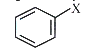
- The rate of attack of an electrophile is least when \(\mathrm{X}\) in the given compound is
 TS EAMCET 2023 Easy
 - The number of molecules of \(\mathrm{CO}_2\) liberated by the complete combustion of \(0.1 \mathrm{~g}\) atom of graphite in air isTS EAMCET 2010 Easy
- If \(Z_1=\sqrt{3}+i \sqrt{3}\) and \(Z_2=\sqrt{3}+i\), and \(\left(\frac{Z_1}{Z_2}\right)^{50}=x+i y\), then the point \((x, y)\) lies inTS EAMCET 2024 Hard
- In a family with 4 children, the probability that there are atleast two girls, isTS EAMCET 2016 Medium
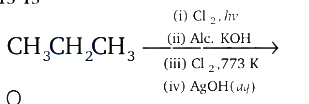
- The major product of the following synthetic reactions is
 TS EAMCET 2021 Medium