


TS EAMCET · Maths · Differential Equations
The general solution of the differential equation \(\left(1+y^2\right) d x=\left(\tan ^{-1} y-x\right) d y\) is
- A \(2 x e^{\tan ^{-1} y}=e^{2 \tan ^{-1} y}+c\)
- B \(x y+\tan ^{-1} y=c\)
- C \(2 \tan ^{-1} y=\left(y^2-1\right) x+c\)
- D \(x e^{\tan ^{-1} y}=e^{\tan ^{-1} y}\left(\tan ^{-1} y-1\right)+c\)
Answer & Solution
Correct Answer
(D) \(x e^{\tan ^{-1} y}=e^{\tan ^{-1} y}\left(\tan ^{-1} y-1\right)+c\)
Step-by-step Solution
Detailed explanation
We have, \[ \begin{aligned} \Rightarrow \quad\left(1+y^2\right) d x & =\left(\tan ^{-1} y-x\right) d y \\ \Rightarrow \quad \frac{d x}{d y} & =\frac{\tan ^{-1} y-x}{1+y^2} \\ \Rightarrow \frac{d x}{d y}+\frac{x}{1+y^2} & =\frac{\tan ^{-1} y}{1+y^2} \end{aligned} \] This is in…
See the Complete Solution
Get step-by-step explanations for this and 2.5 Lakh+ more JEE, NEET & CET questions.
- Unlock all solutions
- Practice the full chapter
- Track accuracy across PYQs
4.8 rated on Google Play · 14,000+ reviews
More questions from Maths
- The solution of the differential equation \(x y^2 d y-\left(x^3+y^3\right) d x=0\) isTS EAMCET 2008 Medium
- For \(n \in N\), the largest positive integer that divides \(81 n+20 n-1\) is \(k\). If \(S\) is the sum of all positive divisors of \(k\) then \(S-k=\)TS EAMCET 2024 Easy
- If then the minimum value of isTS EAMCET 2021 Medium
- If \(\alpha\) and \(\beta\) are the least positive integers such that for all \(n \in N, n^3+\alpha n\) is divisible by 3 and \(n^3-\beta n\) is divisible by 6 , then \(\alpha+\beta=\)TS EAMCET 2019 Easy
- If \(a \alpha^2+b \beta^2+c \alpha \beta+d=0\) is the transformed equation of \(4 x^2+\sqrt{3} x y+5 y^2-4=0\) obtained by using \(\alpha=\frac{\sqrt{3}}{2} x+\frac{y}{2}\) and \(\beta=-\frac{x}{2}+\frac{\sqrt{3}}{2} y\), then \(c(a+b+d)=\)TS EAMCET 2020 Hard
- \(\mathbf{a}, \mathbf{b}\) and \(\mathbf{c}\) are three vectors such that \(|\mathbf{a}|=1,|\mathbf{b}|=2,|\mathbf{c}|=3 \quad\) and \(\mathbf{b}, \mathbf{c} \quad\) are perpendicular. If projection of \(\mathbf{b}\) on \(\mathbf{a}\) is the same as the projection of \(\mathbf{c}\) on \(\mathbf{a}\), then \(|\mathbf{a}-\mathbf{b}+\mathbf{c}|\) is equal toTS EAMCET 2016 Easy
More PYQs from TS EAMCET
- If \(\cos ^{-1}\left(\frac{1}{2}\right)=\cot \left(\cos ^{-1} x\right)\), then the value of \(x\) isTS EAMCET 2015 Easy
- If , thenTS EAMCET 2021 Easy
- If \(\hat{\mathbf{i}}+2 \hat{\mathbf{j}}+3 \hat{\mathbf{k}}, 3 \hat{\mathbf{i}}+2 \hat{\mathbf{j}}+\hat{\mathbf{k}}\) are sides of a parallelogram, then a unit vector is parallel to one of the diagonals of the parallelogram isTS EAMCET 2004 Easy
- Let the centre of the circle \(\mathrm{S}=0\) lie on the line \(x+y-5=0\) and also lie in the first quadrant. If this circle touches both the lines \(x-2=0\) and \(y-5=0\), then the area of the circle isTS EAMCET 2022 Medium
- As shown in the figure, a dielectric of constant K is placed between the plates of a parallel plate capacitor and is charged to a potential V using a battery. If the dielectric is pulled out after disconnecting the battery from the capacitor, the final potential difference across the plates of the capacitor is
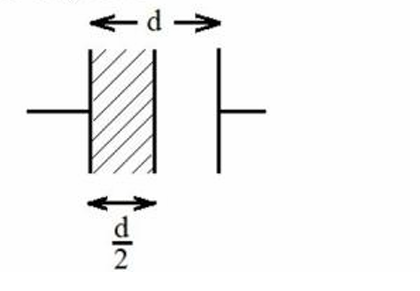 TS EAMCET 2025 Medium
 - Consider a radioactive nuclide which follow decay rate given by \(A(t)=A_0 2^{\left(t / t_0\right\}}\), where \(A(t)\) is the fraction of radioactive material remaining after time \(t\) from the initial \(A_0\) at zero time. Let \(A_1\) be the fraction of original activity which remains after 120 hours. Likewise \(A_2\) is the fraction of original activity remaining after 200 hours. If \(\frac{A_2}{A_2}=1.6\), then the half-life \(\left(t_0\right)\) will beTS EAMCET 2018 Medium