


TS EAMCET · Maths · Differential Equations
The differential equation for which \(l x^2+m y^2=x+y\) is the general solution is
- A \(\left|\begin{array}{ccc}x^2 & y^2 & x+y \ 2 x & 2 y^{\prime} y & y^{\prime}+1 \ 2 & 2 y y^{\prime \prime} & y^{\prime \prime}\end{array}\right|=0\)
- B \(\left|\begin{array}{ccc}x^2 & y^2 & x+y \ 2 x & 2 y y^{\prime} & 1+y^{\prime} \ 2 & 2\left(y^{\prime 2}+y y^{\prime \prime}\right) & y^{\prime \prime}\end{array}\right|=0\)
- C \(\left|\begin{array}{ccc}x^2 & y^2 & x+y \ 2 x & 2 y y^{\prime} & y+1 \ 2 & 2\left(y^{\prime 2}+y^{\prime} y^{\prime \prime}\right) & y^{\prime \prime}\end{array}\right|=0\)
- D \(\left|\begin{array}{ccc}x^2 & y^2 & x+y \ 2 x & 2 y & 1+y^{\prime} \ 2 & 2 y y^{\prime} y^{\prime \prime} & y^{\prime \prime}\end{array}\right|=0\)
Answer & Solution
Correct Answer
(B) \(\left|\begin{array}{ccc}x^2 & y^2 & x+y \ 2 x & 2 y y^{\prime} & 1+y^{\prime} \ 2 & 2\left(y^{\prime 2}+y y^{\prime \prime}\right) & y^{\prime \prime}\end{array}\right|=0\)
Step-by-step Solution
Detailed explanation
Given equation is \(l x^2+m y^2-x-y=0\) \(\ldots\) (i) On differentiating successively twice we get \(2 l x+2 m y y^{\prime}-1-y^{\prime}=0\) \(\ldots\) (ii) and \(2 l+2 m\left(y y^{\prime \prime}+\left(y^{\prime}\right)^2\right)-y^{\prime \prime}=0\) \(\ldots\) (iii) from Eqs.…
See the Complete Solution
Get step-by-step explanations for this and 2.5 Lakh+ more JEE, NEET & CET questions.
- Unlock all solutions
- Practice the full chapter
- Track accuracy across PYQs
4.8 rated on Google Play · 14,000+ reviews
More questions from Maths
- The point which lies on the plane passing through the points \(\hat{i}-2 \hat{j}-3 \hat{k}, 3 \hat{i}-\hat{j}+4 \hat{k},-3 \hat{i}+2 \hat{j}-5 \hat{k}\) isTS EAMCET 2022 Hard
- If \(\frac{(1+i) x-i}{2+i}+\frac{(1+2 i) y+i}{2-i}=1\), then \((x, y)\) is equal toTS EAMCET 2013 Easy
- If \(u=\sin ^{-1}\left(\frac{x^4+y^4}{x+y}\right)\), then \(x \frac{\partial u}{\partial x}+y \frac{\partial u}{\partial y}\) is equal toTS EAMCET 2010 Medium
- If \(\operatorname{Sinh}^{-1} x=\operatorname{Cosh}^{-1} y=\log (1+\sqrt{2})\) then \(\operatorname{Tan}^{-1}(x+y)=\)TS EAMCET 2025 Medium
- If \(\lim _{x \rightarrow 0} \frac{3^{x^3}-\left(1-x^3\right)^{2 / 3}}{x^2 \sin x}=p+\log q\) then \(p q=\)TS EAMCET 2025 Hard
- Let \(n=1 !+4 !+7 !+\ldots+400 !\). Then ten's digit of \(n\) isTS EAMCET 2010 Hard
More PYQs from TS EAMCET
- \(y=f(x)\) and \(x=g(y)\) are two curves and \(P(x, y)\) is a common point of the two curves. If at \(P\), on the curve \(y=f(x), \frac{d y}{d x}=Q(x)\) and at the same point \(P\) on the curve \(x=g(y), \frac{d x}{d y}=-Q(x)\), thenTS EAMCET 2024 Easy
- TS EAMCET 2018 Medium
- The order of reactivity of the following compounds towards the esterification with acetic acid is
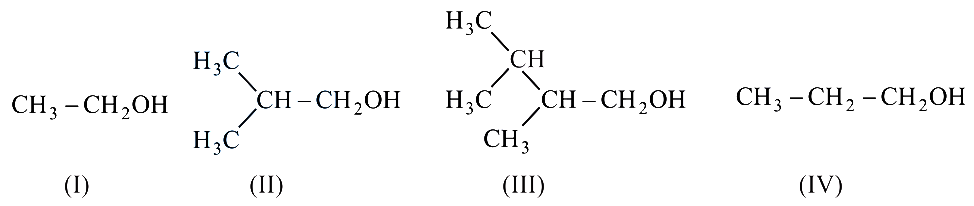 TS EAMCET 2022 Medium
 - If \(\int \mathrm{e}^x\left(\sin ^2 2 \mathrm{x}-8 \cos 4 \mathrm{x}\right) \mathrm{dx}=\mathrm{e}^x f(\mathrm{x})+\mathrm{c}\), then \(f\left(\frac{\pi}{4}\right)=\)TS EAMCET 2023 Medium
- If \(\cos (A-B)=3 / 5\) and \(\tan A \tan B=2\), then which one of the following is true?TS EAMCET 2007 Medium
- The term independent of \(x\) in the expansions of \(\left(\sqrt{x}-\frac{2}{\sqrt{x}}\right)^{18}\) isTS EAMCET 2014 Easy