


TS EAMCET · Maths · Binomial Theorem
If \(y=\frac{3}{4}+\frac{3.5}{4.8}+\frac{3.5 .7}{4.8 .12}+\ldots\) to \(\infty\), then
- A \(y^2-2 y+5=0\)
- B \(y^2+2 y-7=0\)
- C \(y^2-3 y+4=0\)
- D \(y^2+4 y-6=0\)
Answer & Solution
Correct Answer
(B) \(y^2+2 y-7=0\)
Step-by-step Solution
Detailed explanation
\(y=\frac{3}{4}+\frac{3.5}{4.8}+\frac{3.5 .7}{4.8 .12}+\ldots \infty\)…
See the Complete Solution
Get step-by-step explanations for this and 2.5 Lakh+ more JEE, NEET & CET questions.
- Unlock all solutions
- Practice the full chapter
- Track accuracy across PYQs
4.8 rated on Google Play · 14,000+ reviews
More questions from Maths
- If \(\alpha, \beta\) are the roots of the equation \(x^2+5 x+2=0\), then \(\left(\frac{\alpha}{2+5 \alpha}\right)^2+\left(\frac{\beta}{2+5 \beta}\right)^2=\)TS EAMCET 2018 Easy
- If \(z=1+i \sqrt{3}\) then \(|\operatorname{Arg} z|+|\operatorname{Arg} \bar{z}|\) is equal toTS EAMCET 2010 Hard
- If \(z=x+i y\) is a complex number such that \(z \bar{z}+\bar{z} z^3=350\) and \(x, y\) are integers, then \(|z|=\)TS EAMCET 2023 Easy
- \(\mathbf{p}=2 \hat{\mathbf{i}}-3 \hat{\mathbf{j}}+\hat{\mathbf{k}}, \mathbf{q}=\hat{\mathbf{i}}+\hat{\mathbf{j}}-\hat{\mathbf{k}}\). If the vectors \(\mathbf{a}\) and \(\mathbf{b}\) are the orthogonal projections of \(\mathbf{p}\) on \(\mathbf{q}\) and \(\mathbf{q}\) on \(\mathbf{p}\) respectively, then \(\frac{\mathbf{a} \times \mathbf{b}}{\mathbf{a} \cdot \mathbf{b}}=\)TS EAMCET 2020 Medium
- Let be differentiable function for all and If thenTS EAMCET 2021 Easy
- If \(\int \frac{x^{49} \tan ^{-1}\left(x^{50}\right)}{\left(1+x^{100}\right)} d x=k\left(\tan ^{-1}\left(x^{50}\right)\right)^2+c\), then \(k=\)TS EAMCET 2023 Medium
More PYQs from TS EAMCET
- The potential difference between points C and D of the electrical circuit shown in the figure is
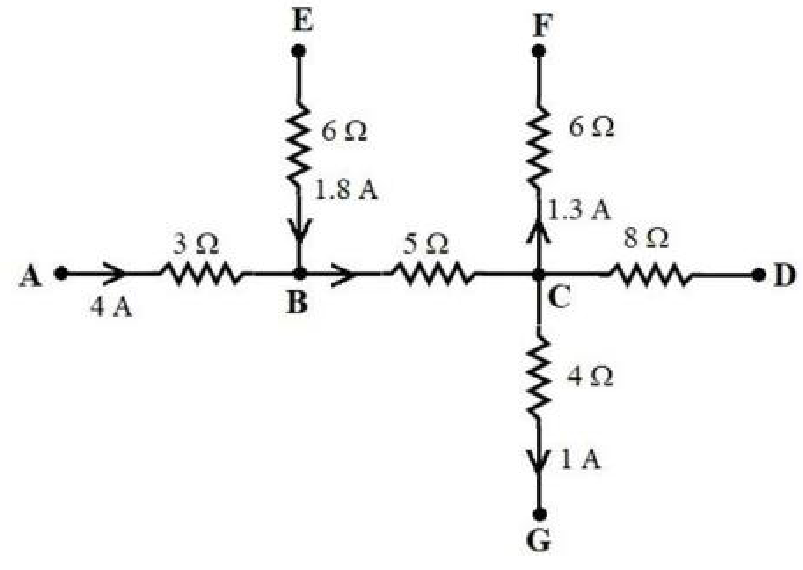 TS EAMCET 2025 Medium
 - The two surfaces of a concave lens, made of glass of refractive index 1.5 have the same radii of curvature \(R\). It is now immersed in a medium of refractive index 1.75 , then the lensTS EAMCET 2013 Hard
- The de-Broglie wavelength of an electron with kinetic energy of \(320 \mathrm{eV}\) is \(\left(\right.\) Take \(\mathrm{h}=6.0 \times 10^{-34}\) SI unit, mass of electron \(=\mathrm{m}_{\mathrm{e}}\) \(=9.0 \times 10^{-31} \mathrm{~kg}\). Charge of an electron \(=1.6 \times 10^{-19} \mathrm{C}\) )TS EAMCET 2022 Easy
- An electromagnetic wave having frequency \(4 \times 10^{14} \mathrm{~Hz}\) is passing through a small volume. The energy contained in this volume oscillates with frequencyTS EAMCET 2018 Easy
- If \(x^2+y^2=t+\frac{2}{t}\) and \(x^4+y^4=t^2+\frac{4}{t^2}\), then \(x^3 y \frac{d y}{d x}\) equalsTS EAMCET 2015 Easy
- A body is rolling without slipping on a horizontal plane. If the rotational kinetic energy of the body \(50 \%\) of its total kinetic energy, then the body isTS EAMCET 2023 Easy