


TS EAMCET · Maths · Differentiation
If \(x=\frac{9 t^2}{1+t^4}\) and \(y=\frac{16 t^2}{1-t^4}\) then \(\frac{d y}{d x}=\)
- A \(\frac{16}{9}\left(\frac{1-t^4}{1+t^4}\right)^3\)
- B \(\frac{16\left(1-t^4\right)}{9\left(1+t^4\right)}\)
- C \(\frac{9\left(1-t^4\right)}{16\left(1+t^4\right)}\)
- D \(\frac{16}{9}\left(\frac{1+t^4}{1-t^4}\right)^3\)
Answer & Solution
Correct Answer
(D) \(\frac{16}{9}\left(\frac{1+t^4}{1-t^4}\right)^3\)
Step-by-step Solution
Detailed explanation
\(y=\frac{16 t^2}{1-t^4} ; \frac{d y}{d t}=\frac{\left(1-t^4\right) \times 32 t-16 t^2 \times\left(-4 t^3\right)}{\left(1-t^4\right)^2}\)…
See the Complete Solution
Get step-by-step explanations for this and 2.5 Lakh+ more JEE, NEET & CET questions.
- Unlock all solutions
- Practice the full chapter
- Track accuracy across PYQs
4.8 rated on Google Play · 14,000+ reviews
More questions from Maths
- When is defined, thenTS EAMCET 2018 Easy
- If the slopes of the lines represented by the equation \(6 x^2+2 h x y+4 y^2=0\) are in the ratio \(2: 3\), then the value of h such that both the lines make acute angles with the positive X -axis measured in positive direction isTS EAMCET 2025 Medium
- If \(\overrightarrow{\mathbf{a}}=\hat{\mathbf{i}}+\hat{\mathbf{j}}+\hat{\mathbf{k}}, \overrightarrow{\mathbf{b}}=\hat{\mathbf{i}}-\hat{\mathbf{j}}+\hat{\mathbf{k}}, \quad \overrightarrow{\mathbf{c}}=\hat{\mathbf{i}}+\hat{\mathbf{j}}-\hat{\mathbf{k}}\) and \(\overrightarrow{\mathbf{d}}=\hat{\mathbf{i}}-\hat{\mathbf{j}}-\hat{\mathbf{k}}\), then observe the
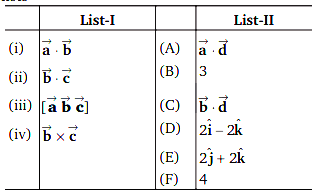
following The correct match of List-I to List-II \(\begin{array}{llll}\text { i } & \text { ii } & \text { iii } & \text { iv }\end{array}\)TS EAMCET 2008 Easy - If \(\ell, \mathrm{m}, \mathrm{n}\) and \(\mathrm{a}, \mathrm{b}, \mathrm{c}\) are direction cosines of two lines thenTS EAMCET 2023 Easy
- If the direction ratios of two lines are given by \(a+2 b+c=0\) and \(11 b c+6 c a-14 a b=0\). then the angle between these lines isTS EAMCET 2019 Easy
- If \(\alpha\) and \(\beta\) are the roots of the equation \(x^2+2 x+2=0\), then \(\alpha^{15}+\beta^{15}=\)TS EAMCET 2023 Medium
More PYQs from TS EAMCET
- \(\mathrm{f}: \mathbb{R} \rightarrow \mathbb{R}\) is a function defined by \(f(x)=\frac{1}{e^x+2 e^{-x}}\) Assertion (A) : \(\mathrm{f}(\mathrm{c})=\frac{1}{3}\) for some values of \(\mathrm{c} \in \mathrm{R}\) Reason (R): \(0 < \mathrm{f}(\mathrm{x}) \leq \frac{1}{2 \sqrt{2}}\) for all \(\mathrm{x} \in \mathrm{R}\) Then which of the following options is correct?TS EAMCET 2023 Medium
- If \(\alpha, \beta\) are the roots of quadratic equation \(x^2+b x+c=0\) such that \(\alpha^2+\beta^2=5\) and \(\alpha^3+\beta^3=9\), then \(b+c=\)TS EAMCET 2022 Medium
- If the imaginary part of \(\frac{2 z+1}{i z+1}\) is -2 , then the locus of the point representing \(z\) in the complex plane isTS EAMCET 2017 Hard
- If \(\mathrm{X}\) is a Poisson variate such that \(\frac{5}{3} k=P(\mathrm{X}=2)\) \(=P(\mathrm{X}=3)\), then \(P(\mathrm{X}=5)=\)TS EAMCET 2022 Medium
- Identify the correct set of sulphide ores from the followingTS EAMCET 2018 Medium
- A positive charge \(Q\) is placed on a conducting spherical shell with inner radius \(R_1\) and outer radius \(R_2\). A particle with charge \(q\) is placed at the center of the spherical cavity. The magnitude of the electric field at a point in the cavity, a distance \(r\) from center isTS EAMCET 2017 Medium