


TS EAMCET · Maths · Quadratic Equation
If \(\alpha\) and \(\beta\) are the roots of the equation \(x^2+2 x+2=0\), then \(\alpha^{15}+\beta^{15}=\)
- A \(-512\)
- B \(-256\)
- C \(256\)
- D \(512\)
Answer & Solution
Correct Answer
(B) \(-256\)
Step-by-step Solution
Detailed explanation
\begin{aligned} & x^2+2 x+2=0 \\ & x= \frac{-2 \pm \sqrt{4-8}}{2}=\frac{-2 \pm 2 i}{2} \\ & x=-1 \pm i, \alpha=-1+i, \beta=-1-i \\ & \alpha^{15}+\beta^{15}=(-1+i)^{15}+(-1-i)^{15} \\…
See the Complete Solution
Get step-by-step explanations for this and 2.5 Lakh+ more JEE, NEET & CET questions.
- Unlock all solutions
- Practice the full chapter
- Track accuracy across PYQs
4.8 rated on Google Play · 14,000+ reviews
More questions from Maths
- The sum of the least positive arguments of the distinct cube roots of the complex number \((1-i \sqrt{3})\) isTS EAMCET 2018 Medium
- For \(x=\frac{5}{7}\), if \(t_k\) is the first negative term in the expansion of \((1+x)^{7 / 5}\), then, \(t_1+t_2+\ldots+t_k=\)TS EAMCET 2019 Medium
- The value of the greatest integer \(k\) satisfying the inequation \(2^{n+4}+12 \geq k(n+4)\) for all \(n \in \mathrm{~N}\) isTS EAMCET 2025 Hard
- Match the points on the curve \(2 y^2=x+1\) with the slopes of normals at those points and choose the correct answer.
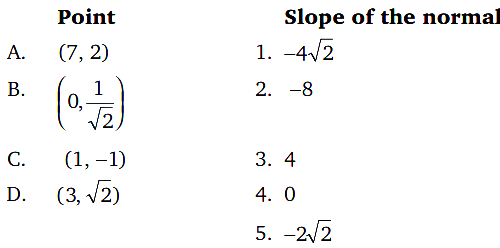 TS EAMCET 2004 Hard
 - A family of curves whose equation is general solution of a differential equation having order 1 and degree 3 , is \((g, a, c\) are arbitrary constants)TS EAMCET 2018 Medium
- If \(\mathrm{C}_0, \mathrm{C}_1, \mathrm{C}_2, \ldots, \mathrm{C}_8\) are the binomial coefficients in the expansion of \((1+x)^8\) then \(\sum_{r=1}^8 r^3 \frac{\mathrm{C}_r}{\mathrm{C}_{r-1}}=\)TS EAMCET 2025 Medium
More PYQs from TS EAMCET
- Which one of the following statements is correct?TS EAMCET 2023 Easy
- \(\int_0^{\frac{\pi}{2}} \sin ^6 \cdot x \cos ^4 \cdot x d x=\)TS EAMCET 2023 Easy
- \(\int_0^\pi \frac{\theta \sin \theta}{1+\cos ^2 \theta} d \theta\) is equal toTS EAMCET 2005 Medium
- If the cold junction is held at \(0^{\circ} \mathrm{C}\), the same thermo emf \(V\) of a thermocouple varies as \(V=10 \times 10^{-6} t-\frac{1}{40} \times 10^{-6} t^2\), where \(t\) is the temperature of the hot junction in \({ }^{\circ} \mathrm{C}\). The neutral temperature and the maximum value of thermo emf are respectively :TS EAMCET 2006 Medium
- Let a function be continuous in an interval . Let be a very small real number. Let be such that and for every . Let and . ThenTS EAMCET 2022 Medium
- The domain and range of \(f(x)=\frac{1}{\sqrt{|x|-x^2}}\) are A and B respectively. Then \(\mathrm{A} \cup \mathrm{B}=\)TS EAMCET 2025 Medium